What Carrera publishes, model by model
We read Carrera’s own product pages for every frame below before featuring it, because the Amazon listing titles state the fitting but not the material — and Carrera sells frames that are not acetate alongside ones that are. The brand name is not evidence of the material. Here is what each page states.
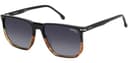
329/S. A full-rim geometrical frame — octagonal, in practice — with an acetate front and acetate temples, sized 58 mm lens, 18 mm bridge, 145 mm temple. The lens is given as a grey shaded gold mirror gradient and specified as non-polarized. UV protection 100. Supplied with a storage case. The Amazon listing title repeats 58/18/145, which is how we matched the ASIN to the model.
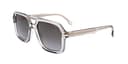
317/S. A square double-bridge navigator with an acetate front and metal inserts on each side, sized 55-20-150, with gradient lens treatment and UV protection 100. Polarization is not stated, so we record it as not published rather than assume it either way. Note the 150 mm temple — the longest of the three.
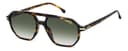
341/S. A pilot with a double bridge and a metal insert running back to the temples, with an acetate front and acetate temples. The Black Gold colorway page publishes 54-17-145; the Havana Gold page — which is the colorway our ASIN is — states acetate front and temples with green shaded lenses but gives no dimensions. The Amazon listing title for that ASIN states 54/17/145, consistent with the Black Gold figures, and that is the provenance for the number on our card. Carrera advertises 100% UV protection on its US page and offers the model prescription-ready.
One more we read and deliberately did not feature: the 3017/S, a cat-eye with an acetate front and temples at 55-19-140 in Havana, UV Protection 100, gradient treatment, filter category 3 stated, RXAble, with metal frontal rivets and a relief C on each temple. It is a perfectly good frame and the only one of the four whose page states a filter category — we left it off only because we could not verify a clean, currently-purchasable listing for it on the day we built this page, and we do not feature what we cannot confirm is in stock. Our lens category guide explains what a category 3 lens is and which categories are legal for driving.
The thing Carrera gets right that budget acetate does not
Published measurements. It sounds dull and it is the single most practical advantage on this page.
Almost every budget acetate frame we track — SOJOS, CARFIA, Gleyemor, Privé Revaux, Earthly Ones — publishes no measurements at all. Our product tables say “Not published” for those fields because the seller genuinely does not publish them, and that is a real cost to the buyer: you cannot tell whether a frame will fit before it arrives, so you buy, try and return. Carrera publishes a lens width, a bridge width and a temple length for every model, and repeats the fitting in the Amazon listing title, so you can measure a frame you already own and know.
Here that matters more than usual, because the three frames are not interchangeable sizes. 58-18-145, 55-20-150 and 54-17-145 are three genuinely different fits: the 329/S is wide, the 317/S is narrower with a much wider bridge and longer arms, and the 341/S is the smallest front with the narrowest bridge. A 20 mm bridge versus a 17 mm bridge is the difference between a frame that sits where you want it and one that slides. Our sizing guide explains how to read the three numbers, and how should sunglasses fit covers what to check once the frame is on your face.
The two catches, stated plainly
No stated polarization on any of the three. Carrera gives these as gradient lenses, and on the 329/S the page specifies a non-polarized mirror gradient. A gradient is a tint that fades from darker at the top to lighter at the bottom — it is a styling and a driving-visibility choice, not a glare filter. If you want glare cut on water, snow or a wet road, this is the wrong page and almost any $35 polarized acetate frame beats these on that one axis. That is not a small point, and it is the main reason we would not tell everyone to buy Carrera. Our polarized vs non-polarized guide sets out what you actually lose, and mirrored vs gradient lenses covers the treatment Carrera is using.
What you do get on all three is UV protection 100, stated by Carrera, and that is the figure that matters for your eyes. The FDA’s point is that you cannot judge UV protection by how dark a lens looks or what it cost, so a stated figure is the whole test. Non-polarized does not mean unprotected. Our how to check UV protection guide covers reading it off any listing and UV400 explained covers what the number means.
Metal inserts on two of the three. The 317/S has metal inserts on each side; the 341/S has a metal insert running to the temples. Carrera says so, and as a design line it is attractive — it is a large part of why these frames look like designer frames rather than plain slabs. But an acetate frame with metal running through the temple is a combination frame, not an all-acetate one, and if you are shopping acetate because nickel makes your skin react, that distinction is the entire reason you are here. The 329/S is the one of the three that Carrera states as acetate front and acetate temples with no insert mentioned, which is part of why it is our top pick. Our hypoallergenic sunglasses roundup ranks only frames whose listings state acetate for the front and the temples, and acetate and metal frames covers the combination construction honestly.
Who each pick is for
Carrera 329/S — best overall. The frame that makes the Carrera argument on its own terms. Acetate front and acetate temples per Carrera, the full 58-18-145 published and repeated in the listing title, UV protection 100, a storage case included, at the lowest price of the three and in the band where unbranded handmade-acetate listings sit. Cons: it is explicitly not polarized; 58 mm is a wide eye size, so this is a medium-to-wide face frame and will look oversized on a small one; and a geometric octagonal front is a stronger, more dateable look than a plain rectangle. If you want the same money spent on a polarized frame instead, our affordable acetate sunglasses roundup is the other side of that trade.
Carrera 317/S — best double bridge. The navigator in the line, and the most distinctive of the three to look at. A square double-bridge front with a published 55-20-150, gradient treatment and UV protection 100. The double bridge is doing real work: on a squared front it is the detail that keeps the frame from reading as a flat slab, which is the same reason we like it on budget frames. Cons: the metal inserts mean this is not an all-acetate frame and not the pick for a nickel sensitivity; polarization is not stated here either; and a 20 mm bridge is wide, so if you have a narrow or low nose bridge this frame will sit lower than you want. Our sunglasses for a low nose bridge guide covers that problem, and keyhole bridge sunglasses covers the other bridge style that addresses it.
Carrera 341/S — best pilot. The answer to the standard objection to an acetate pilot, which is that pilots are usually enormous: at a published 54-17-145 this is cut for a normal face. Acetate front and acetate temples per Carrera, a pilot double bridge, 100% UV protection advertised, and offered prescription-ready. Cons, and there are three worth weighing: a metal insert runs to the temples, so this is a combination frame; it is the most expensive of the three for the smallest frame; and the 54-17-145 fitting was published on the Black Gold colorway while this listing is Havana Gold, so we are relying on the Amazon title repeating the same figures — treat it as well-evidenced rather than brand-confirmed for this exact colorway. Our aviator acetate guide covers the shape.
How Carrera compares to what else we track
Against budget acetate — SOJOS, CARFIA, Gleyemor, Privé Revaux — the trade is clear and genuinely close. Carrera gives you published measurements, a designer name and, on the 329/S, acetate stated for front and temples. The budget brands give you polarization, which Carrera does not state on any of these, usually at a slightly lower price. If glare matters to you, buy budget and polarized. If fit certainty matters more, buy Carrera. Our SOJOS and CARFIA reviews cover those brands, and CARFIA vs Ray-Ban sets out what a price gap does and does not buy.
Against Ray-Ban, the comparison most people are really making: Ray-Ban publishes fittings too, has a far deeper service and parts network, and the RB2140 is the reference acetate shape. Carrera is substantially cheaper and more adventurously shaped. Neither of the two Carrera frames with metal inserts is the better choice for an all-acetate requirement than a plain RB2140. Our Ray-Ban review and thick frame sunglasses cover that ground.
Against premium acetate — Persol, RAEN, Serengeti, OTIS — Carrera is not in that conversation on finish or lens substrate, and we would not pretend it is. Those brands publish Italian acetate, hand-finishing, mineral glass and filter categories. What Carrera offers instead is most of the published-spec discipline at a fraction of the money. Our designer acetate roundup and best glass lens sunglasses are where that tier lives.
Should you buy Carrera?
Buy it if fit certainty and a published material matter more to you than polarization, and you want a designer-shaped acetate frame without paying designer prices. The 329/S specifically is a lot of frame for the money: acetate front and temples stated, a full fitting published, UV protection 100, in the same price band as frames that tell you nothing.
Skip it if you spend your time on water, snow or a long commute into low sun — buy a polarized frame instead, and accept not knowing the measurements. Skip the 317/S and 341/S specifically if metal on your skin is the reason you are shopping acetate; the inserts are stated, and they are real. And skip the whole brand if what you want is the depth of color and edge polish that premium Italian acetate gives you, because that is a different price and Carrera does not claim it.
We have not handled any of these frames. Everything above is read off Carrera’s own product pages and the live Amazon listings, on a dated visit, and where Carrera does not publish something — polarization on two models, dimensions on one colorway — our cards say so rather than filling the gap. That is how we choose everything on this site.
Two cross-brand pages put these frames in context rather than on their own. Both the 317/S and the 341/S are double-bridge fronts, and our best double bridge sunglasses roundup ranks them against the budget frames that state the same detail. And because Carrera publishes a material and a full fitting at prices where almost nobody does, both sit near the top of the best acetate sunglasses under $100.