Why a triangle face wants width up top
Think of a triangle face as bottom-heavy: the widest, most eye-catching line runs across the jaw, and the face narrows as it climbs. Sunglasses are one of the few things you wear right at the top of that taper, on the narrowest part of the face, which makes them a genuinely useful balancing tool. The goal is to build up the top so the face reads more evenly from top to bottom rather than heavy at the base. You do that by choosing frames that carry weight, width or interest along their upper half and stay light or plain along the bottom. When the top of the frame is the loudest part, the eye travels up to meet it, and the jaw stops being the first thing you notice.
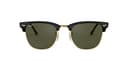
The clearest example of this principle is the browline, which is why the Ray-Ban Clubmasteris our best overall pick. Its heavy acetate brow sits across the top of the frame while a slim metal lower rim carries the bottom — that is almost exactly the shape a triangle face wants, with the horizontal weight up high and next to nothing below. A useful side effect is that the metal lower rim keeps the whole frame lighter and less blocky than an all-acetate shape would be, so you get the top-heavy balance without a frame that feels heavy on the face. The honest trade-off is that the Clubmaster is a medium-sized, fairly classic frame rather than a bold statement piece, and it is not full acetate the way the other picks here are; if you want maximum drama up top, a cat-eye pushes harder. For a broader look at this shape, our browline guide rounds up the best of them.
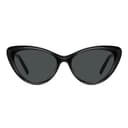
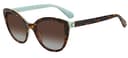
The cat-eye is the other shape almost purpose-built for this face, because its upswept outer corners lift the eye up and out— away from the jaw and toward the temples, exactly where a triangle face is narrow and could use the width. The SOJOS Acetate Cat-Eyeis our best cat-eye and the value standout: genuine cellulose acetate, polarized and UV400, with corners that flick upward enough to do real balancing work for very little money. The honest cons are what you would expect at a budget price — the hinges and finish are not on the level of a designer frame, and it leans women’s in fit and styling. If you want the same upswept effect in a more grown-up, less overtly costume shape, the Kate Spade Amberlee is our best for women: a softened, polarized acetate cat-eye that adds genuine interest at the top of the frame without tipping into a novelty look. It sits at a mid-tier price rather than budget, and because the cat-eye sweep is gentler, it lifts a little less dramatically than the SOJOS — the payoff is a frame you can wear anywhere without it reading as a costume choice. Both frames earn their place the same way: you can see the whole family in our cat-eye guide.
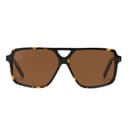
Aviators can work for a triangle face too, as long as you choose the right one. A classic teardrop aviator is actually widest lower down, which is the wrong direction here — but a squared aviator with a defined top bar fixes that, because the straight brow bar carries width straight across the upper face. That is why the SOJOS Square Aviatoris our best aviator: an acetate-bodied, squared take on the shape, polarized and UV400, unisex, where the top bar does the balancing work a rounded aviator would not. The trade-offs are that it is a budget frame in build and materials, and that an aviator’s top bar is a subtler cue than a full browline brow or an upswept cat-eye corner — it nudges the balance rather than shouting about it. If you like the shape in general, our aviator guide covers how to pick one that flatters rather than fights your proportions.
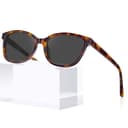
Finally, not everyone wants a corrective frame that announces itself, and for a safe, flattering everyday option the CARFIA Designer Acetateis our best budget pick. It is a soft-square women’s frame in genuine acetate, polarized and UV400, with enough presence across the top to give a triangle face a little balance while staying forgiving across face shapes generally. Be clear about what it is, though: it is a well-rounded generalist, not a shape engineered specifically to counter a wide jaw. It will not lift and widen the upper face the way a true cat-eye or browline does, so if balancing a strong jawline is your main goal, treat the CARFIA as the easy-going option and one of the top-heavier picks as the corrective one.
Shape is the biggest lever, but it is not the only one, and a triangle face has two more you can pull. The first is color and detailing along the top rim. A frame that puts its color, its pattern or a heavier brow up high — and keeps the lower rim plain, thin or metal — draws the eye upward even if the overall silhouette is fairly neutral. This is a big part of why a browline like the Clubmaster works so well: the contrast between a bold acetate brow and a quiet metal lower rim is itself a top-weighting trick. Look for temples and top rims that carry the interest, and be wary of frames that save their boldest color or thickest edge for the bottom, because that pulls the eye straight back down to the jaw. Warm layered acetate in a tortoise or Havana is a safe way to add that top-of-frame richness without shouting.
The second lever is scale and width. A triangle face is helped by a frame that spans at least the width of the cheekbones, because a frame that reaches out to the sides adds width high on the face where you want it, while a frame that stops short leaves the jaw as the widest line by default. That does not mean going oversized — a frame that overwhelms the narrow upper face can look just as unbalanced as one that is too small — but it does mean choosing a shape with genuine presence up top rather than a dainty one. Get the scale right and even a fairly simple top-weighted frame will do most of the balancing work for you, which is why every pick here is a real, substantial acetate frame rather than a flimsy one.
Shapes to avoid on a triangle face
The frames to skip are the ones that reinforce the wide jaw or leave the top of the face looking even narrower by comparison. Three groups cause most of the trouble:
- Bottom-heavy frames. Anything that carries its weight, color or detailing along the lowerrim drops the eye toward the jaw — exactly the opposite of what you want. This is the one instance where a heart-shaped face and a triangle face want directly opposite frames, so if a guide recommends a bottom-weighted shape, check which face shape it is written for.
- Frames that are widest at the bottom.Shapes that flare out along the lower edge — some teardrop aviators, certain rounded or bottom-swept styles — echo and emphasize the widest part of the face. Look instead for frames that are balanced or wider across the top.
- Small or narrow frames. A frame that stops well short of the width of your jaw makes the jaw look wider still by contrast, and adds no width where the face actually needs it. Go for a frame that reaches at least the width of your cheekbones, with the visual interest kept up high.
None of these is a hard ban — face-shape guidance is about tipping the odds, not laying down laws. But if you have tried frames that felt like they made your jaw look heavier, it was very likely one of these three at fault, and switching to a top-weighted shape is usually the fix. When in doubt, our full best acetate sunglasses roundup and the by-face-shape hub let you compare shapes side by side.
How to tell if you have a triangle face
The quickest test is to compare the width of your jaw with the width of your forehead. On a triangle (base-down) face, the jaw is the widest point and the forehead is noticeably narrower, so the face looks like it broadens as it goes down. Cheekbones usually sit somewhere in between, and the jawline itself is often the most defined feature. If instead your forehead is the widest part and the face tapers to a narrower chin, you have the opposite shape — an inverted-triangle or heart face — and you should follow our heart-shaped face guide instead, because the flattering and unflattering frames are reversed.
It is genuinely easy to mix the two up from a mirror glance, so it is worth measuring properly before you commit to a frame. Our guide to measuring your face shapewalks through a simple five-step method using a tape measure — forehead, cheekbones, jaw and face length — that tells you with confidence whether the wide part sits at the bottom (triangle) or the top (heart). Once you know it is a triangle, the rule to carry into any store is short: keep the weight and the interest up top, keep the lower half light, and you will have the balance most of the picks on this page are built to give you.