Acetate vs Titanium Frames
Titanium is the lightest serious frame material and the safest bet for a nickel allergy. Acetate is the one you can have adjusted to your face and the only one that comes in real tortoise. For sunglasses specifically, that trade lands differently than it does for glasses.
How this is funded:we earn a commission if you buy through our links, at no extra cost to you. It never changes which product we recommend, and we’ll tell you when we’d skip one. Full disclosure.
The short answer: titanium if weight on your nose is the problem or you react to nickel; acetate if you want a frame with real color depth, a substantial front, and the ability to have it heat-adjusted to your face. For sunglasses in particular, acetate wins more often than it does for clear glasses, and the reason is the lens: a sun lens is larger and heavier than a prescription one, and a thick cut-sheet front carries it more comfortably than a thin metal rim.
This page completes our material comparisons — we already cover acetate vs metal in general, acetate vs plastic, acetate vs TR90, acetate vs polycarbonate, acetate vs propionate and acetate vs zyl. Titanium is the one metal worth pulling out of the general “metal” bucket, because it behaves differently from steel and from the nickel alloys most cheap metal frames are made of.
The comparison
Titanium properties below are the ones stated by the optometry frame-materials reference cited in our sources; the acetate column is drawn from the material’s own characteristics, documented across this section of the site.
| Property | Acetate | Titanium |
|---|---|---|
| Weight | Heavier; thickness is part of the look | Lightweight; suits a thin, light profile |
| Strength | Good in thick sheet; thin sections are the weak point | Very strong for its weight |
| Corrosion and sweat | Does not corrode; surface shine can dull with skin oils | Corrosion-resistant; handles sweat and humidity without pitting |
| Nickel allergy | Not a metal, so nothing to react to | Hypoallergenic — the usual recommendation for nickel sensitivity |
| Color and pattern | Layered tortoise, havana, gradients, crystal — through the material | Surface finishes and coatings only |
| Adjustability | The whole front can be heat-adjusted by an optician | Temples and pads bend; the front is essentially fixed |
| Repair | Screws and hinges yes; a snapped front, realistically no | Bends can often be corrected |
| Cost | Budget to designer — the widest range of any frame material | Higher than basic metals; narrower range |
| Best suited to | Bold shapes, sun lenses, anyone who wants a frame fitted to them | Minimal shapes, all-day prescription wear, metal sensitivity |
Where titanium genuinely wins
Weight. This is the headline and it is real. Because titanium is strong for its weight, a frame can be built with a thin cross-section and still hold its shape, which reduces both actual weight and visual bulk. If you have ever taken glasses off at the end of the day and felt the two dents either side of your nose, that is the problem titanium solves best.
Nickel. Nickel is the metal behind most eyewear contact reactions, and titanium frames are the standard recommendation when that is the issue. Acetate is also nickel-free — it is not a metal — but the distinction matters if you want a metal frame and have reacted before.
Sweat and humidity. The reference we cite is specific that titanium’s corrosion resistance handles sweat, humidity and daily handling without pitting. That is why titanium turns up in frames intended for hot climates and active wear, where a plated base-metal frame would eventually show through at the temples.
Where acetate wins
Color, and it is not a small thing. Cellulose acetate can be laminated before it is cut, so a tortoise or havana pattern runs through the thickness of the frame and changes as light passes through the edge. That is a property of the material, not a finish, and nothing metal can imitate it — a painted metal frame is a painted metal frame. Our pages on what acetate is and Italian acetate cover why the good sheet costs what it does, and tortoise shell sunglasses shows what the layering looks like in practice.
Adjustability. Acetate softens with gentle heat, which means an optician can change the angle of the temples, the splay of the front and how the bridge sits — the whole fit, not just the bits that bend. On a metal frame you can adjust the temples and (on most designs) the nose pads, and that is it. This is the single most underrated advantage acetate has, and our guide to adjusting acetate frames explains what is safe to attempt at home and what to leave alone.
It suits a sun lens. Sunglass lenses are bigger, darker and often thicker than clear ones, and on glass-lens models noticeably heavier — see best glass lens sunglasses. A substantial acetate front distributes that weight across a wide bridge or a keyhole, explained in our keyhole bridge guide, whereas a thin metal rim concentrates it on two small pads. It is also why nearly every heritage sunglass shape — wayfarer, panto, cat-eye — was designed in acetate in the first place.
The honest verdict for sunglasses
If you are choosing a frame for prescription glasses you will wear from breakfast to bedtime, titanium’s lightness is a strong argument and we would not talk you out of it. For sunglasses, three things push the other way: the lens is heavier so the front needs more substance; the frame is a style object where color depth is most of the appeal; and sunglasses get knocked about, which favors a material you can have re-set rather than one whose thin sections bend out of true. That is why this site is about acetate — not because titanium is a worse material, but because it is a better answer to a different question.
One middle route worth knowing about: combination frames, with an acetate front and metal temples, or an acetate brow over a metal lower rim like the Ray-Ban Clubmaster. You get some of the lightness and some of the color, and you add a join that can loosen over seasons because the two materials expand differently with heat. Our page on acetate and metal frames sets out when that trade is worth making, and Clubmaster alternatives covers what to buy if you want the look without the join.
Whichever material you choose, the lens is what protects your eyes, and the American Academy of Ophthalmology’s advice is to look for 99 to 100% UV-A and UV-B blocking. Material tells you nothing about that. Our guide to checking UV protection covers how to verify it on a listing, and how to tell if frames are real acetate covers the other claim sellers are loose with.
If acetate is the right call for you
We do not stock a titanium frame to recommend - this is an acetate site, and we will not add a product we have not researched just to balance a comparison. These three are the acetate frames where the material's advantages are most obvious: layered color, thick cut sheet and a front an optician can re-set. Prices are live and dated.
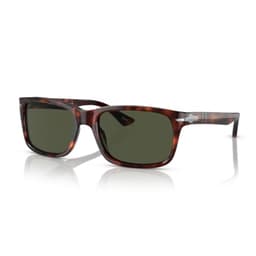
Persol PO3048S Rectangular
The clearest example of what acetate does that titanium cannot: Italian acetate, hand-finished, with the color depth that comes from pattern running through the layers of a cut sheet rather than sitting on a surface. A 58 mm eye, so it runs large.
Price as of October 5, 2026. #ad How we’re funded
Frame material: Italian cellulose acetate. Specs read from the listing on July 21, 2026.
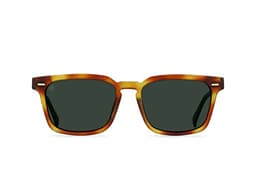
RAEN Adin 54 Round
Hand-finished Italian acetate from an independent brand at roughly a third of legacy-designer money, in a soft round that suits square and angular faces. A 54 mm eye size - medium, and published, which is more than most frames in this band manage.
Price as of October 5, 2026. #ad How we’re funded
Frame material: Italian cellulose acetate. Specs read from the listing on July 21, 2026.
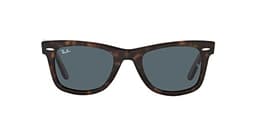
Ray-Ban Original Wayfarer RB2140
Thick cellulose acetate with layered tortoise on the havana rather than a printed pattern, and the most serviceable frame here: Ray-Ban publishes it in 50-22 and 54-18 and keeps the model in production, so it can be fitted and repaired for years.
Price as of October 5, 2026. #ad How we’re funded
Frame material: Cellulose acetate. Specs read from the listing on July 21, 2026.
Frequently asked questions
Is titanium better than acetate for glasses frames?
For weight and for a nickel allergy, yes. An optometry frame-materials reference describes titanium as very strong, lightweight and corrosion-resistant, suited to a thin, light profile, and hypoallergenic in a way that matters for patients with a nickel allergy - and notes its corrosion resistance handles sweat, humidity and daily handling without pitting. What it cannot do is carry color and pattern through the material or be heat-adjusted the way acetate can. For prescription glasses worn all day, titanium's lightness often wins. For sunglasses, where the frame is bolder and the lens is bigger, acetate usually does.
Which is more durable, acetate or titanium?
Titanium, in the sense that matters most: it resists corrosion from sweat and humidity, and a bent titanium frame can usually be bent back. Acetate's failure mode is different - it does not corrode at all, and it can be heat-reset by an optician repeatedly, but a genuinely snapped acetate front cannot be meaningfully re-bonded. Thick acetate is tougher than thin acetate, which is one of the reasons premium frames are cut from heavier sheet. ISO 12870 is the standard that governs how spectacle frames are tested for durability; note that it does not apply to sunglass filters, which fall under ISO 12312-1.
Is titanium good for sensitive skin?
It is the usual recommendation for metal sensitivity, because the frame-materials reference we cite describes titanium as hypoallergenic and singles out nickel allergy as the reason it matters. Acetate is also a reasonable choice for sensitive skin for a simpler reason: it is not a metal, so there is no nickel in it to react to. If your reaction has been to the nose pads or the temple tips of a metal frame rather than to the frame front, a single-material acetate frame removes the contact point entirely.
Why are there no titanium sunglasses on this site?
Because this site covers acetate frames, and every product we name has had its listing read and its specifications recorded - we do not add a product to fill a slot in a comparison. Titanium is also an unusual choice for sunglasses specifically: sun lenses are larger and heavier than clear ones, and a thin titanium rim is a less natural fit for them than a substantial acetate front. Where titanium does appear in sunglasses it is usually as the temples or the lower rim of a combination frame, which is covered on our acetate and metal frames page.
Does titanium cost more than acetate?
Generally yes among comparable frames, and the reference we cite puts titanium at a higher cost than basic metals. But the bands overlap heavily: a hand-finished Italian acetate frame from a designer house costs considerably more than a mass-produced titanium one, while a budget acetate frame costs a fraction of either. Material is only one input into price - finish, brand and whether the frame is cut from sheet or molded matter at least as much, which is the point our page on why acetate sunglasses are expensive makes.
Sources
- Specialty Vision — Eyeglass Frame Materials (optometry-practice reference) — On titanium frames: very strong, lightweight and corrosion-resistant, suited to a thin, light profile and small or delicate styles; hypoallergenic, which matters for patients with a nickel allergy; corrosion resistance handles sweat, humidity and daily handling without pitting; a higher cost than basic metals. On plastic frames: the most popular choice for affordability and styling, but they break more easily than metal and may fade in color over time, while Italian zyl acetate is known for its quality and lasts many years with proper care (accessed October 5, 2026)
- Mazzucchelli 1849 — the cellulose-acetate maker for eyewear — Background on cellulose acetate as the traditional material for spectacle and sunglass frames (accessed July 21, 2026)
- ISO 12870:2024 — Ophthalmic optics — Spectacle frames — Requirements and test methods — The spectacle-frame construction and durability standard. Not a biodegradability standard, and not applicable to sunglasses with afocal filters (ISO 12312-1 applies there) (accessed September 7, 2026)
- American Academy of Ophthalmology — Recommended Types of Sunglasses — AAO on choosing sunglasses that block 99–100% of UV-A and UV-B (UV400) (accessed July 21, 2026)
Keep reading
Acetate vs metal frames
The broader comparison titanium sits inside.
Read the guideAcetate and metal frames
What combination frames gain, and where they loosen.
Read the guideHow to adjust acetate frames
The advantage acetate has over every metal: heat.
Read the guideWhy acetate sunglasses are expensive
Where the money goes in a cut-sheet frame.
Read the guide