What people actually want from a Clubmaster
Three things, and separating them is how you pick a replacement. The first is the top line. A browline puts all the visual weight along your brow and leaves the bottom of the lens almost unframed, which lifts the eye, adds structure to a round or heart-shaped face, and reads as deliberate rather than sporty. The second is the era: the shape is 1950s, and it carries a specific bookish, old-newsroom association that no wraparound will ever have. The third is the size — the RB3016 is a medium frame with a 51 mm eye, so it suits faces that a deep 1950s wayfarer swamps.
A full acetate frame with a thick, straight brow delivers the first and second of those and usually the third as well. What it does not give you is the bare-bottom lens, and you should know that going in: these are alternatives, not clones. If the half-rim look specifically is the thing you love, our browline acetate sunglasses page covers the shape properly and the Clubmaster itself is the frame to buy.
Why we do not recommend a cheap browline
Because the construction is the expensive part. On a well-made browline the metal lower rim is a closed, soldered wire with a screw-tensioned bridge, and it holds a lens under tension for years. On a budget browline it is a thin stamped rim or a nylon cord seated in a groove, and the first time the acetate brow flexes — in a hot car, in a pocket — the lens pops. Mixed-material frames also fail differently than single-material ones: acetate expands with heat and metal does not, so the join works loose over seasons even when nothing dramatic happens to it.
None of that is an argument against browlines in general. It is an argument against browlines at the bottom of the market, which is exactly the price band a Clubmaster-alternative search lands in. A single-material acetate frame has nothing to come apart, can be heat-adjusted by an optician, and holds its fit — see how acetate frames are adjusted for why that matters more than it sounds.
The picks, and who each suits
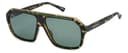
Our best overall alternative is the Privé Revaux Clevelander. It is a stated cellulose acetate rectangle with a straight, heavy top line and a tortoise option, polarized with 100% UV stated, and it is one of the better-finished frames in the budget band. On a face it does what the Clubmaster does: draws a firm horizontal line along the brow and squares off a round or heart shape. It is not a half-rim, and the finish is good-for-the-price rather than designer. It is also about a sixth of the price, which changes how freely you wear it.
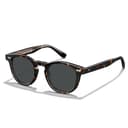
The CARFIA Vintage Round is our best vintage alternative, and it is the pick for anyone whose real attachment is to the era rather than the silhouette. Hand-crafted acetate, a keyhole bridge — the same 1950s detail the Clubmaster’s generation used — and polarized UV400 lenses at a budget price. The round shape reads more professorial and less newsroom, it suits square and angular faces where the Clubmaster suits round ones, and the substantial acetate front is exactly the kind of frame a keyhole bridge was invented to carry.
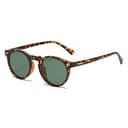
Cheapest is the Gleyemor Vintage Round in tortoise. It is stated hand-crafted acetate, polarized, in the retro round shape, at a price where a lost pair is an inconvenience rather than a loss. The compromises are real: Gleyemor publishes no measurements, so you are buying blind on fit, and the finish is the plainest here. As a second pair for the car, or a way to find out whether you actually like a vintage frame before spending properly, it is hard to argue with.
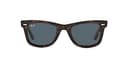
Our best same-brand alternative is the Ray-Ban Original Wayfarer RB2140, and it is here for a specific reason: it is the Clubmaster’s stablemate in all-acetate form. Same brand, same heritage, same serviceability, published sizing in a 50 mm and a 54 mm — and nothing to come loose, because there is no metal rim. If you were drawn to the Clubmaster partly because it is a Ray-Ban, this is the frame that keeps that and drops the mixed-material join. It sits larger and more angular than the Clubmaster, and the classic lens is not polarized; our 50 vs 54 comparison covers which size to take, and Wayfarer alternatives covers the cheaper routes to that shape.
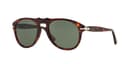
Finally, the upgrade: the Persol 649. It costs considerably more than a Clubmaster, and it is the answer to “what beats it?” rather than “what is cheaper?” Acetate handmade in Italy, a keyhole bridge and Meflecto temples named on Persol’s own spec panel, crystal lenses, and a pilot shape from 1957 with the same vintage authority the Clubmaster trades on. It is offered in multiple eye sizes, and the classic green lens is not polarized. Our 649 vs 714 comparison explains the folding alternative if you want one frame that lives in a jacket pocket.
How to choose
Work from the face first. A round or heart-shaped face is what the Clubmaster flatters, and the Privé Revaux rectangle and the Ray-Ban Wayfarer are the two picks here that do the same job — straight lines, defined corners. A square or angular face is better served by the CARFIA or Gleyemor rounds, which soften rather than reinforce. Our round-face guide and square-face guide have the full reasoning.
Then decide on money. Under $40 buys real acetate and real polarization, and gives up published measurements and finish. Around the Clubmaster’s own price you are choosing between a mixed-material icon and an all-acetate one — and we would take the all-acetate one for longevity. Above it, the Persol is a different class of object. Whatever you choose, check the listing states cellulose acetate rather than “plastic” and states UV400 or 100% UV protection; our guide to telling real acetate from acetate-look plastic covers the first, and how to check UV protection covers the second.