Acetate Frame Hinges: Barrel vs Spring
Nobody shops for a hinge, and it is the part that decides whether a frame is still wearable in five years. Here is what the three constructions are, and why 'spring hinge' is a weaker selling point on sunglasses than on glasses.
How this is funded: we earn a commission if you buy through our links, at no extra cost to you. It never changes which product we recommend, and we’ll tell you when we’d skip one. Full disclosure.
Everything about a pair of sunglasses is marketed except the part most likely to end its life. Lens tint, polarization, frame material, the colourway, the shape — all described at length. The hinge, which is where a frame actually breaks, usually goes unmentioned.
The verdict, if you want it in one line: on an acetate frame a plain barrel hinge, screwed into the acetate, with a stainless screw is the construction to want, because it is the one an optician can tighten, re-seat or replace for the life of the frame. A spring hinge buys forgiveness rather than durability, and it is a stronger selling point on everyday glasses than on sunglasses. A moulded-in plastic hinge means the frame is disposable.
The three constructions
1. The barrel hinge. Two interleaved metal knuckles — the barrels — held by a screw through the middle. The frame half is riveted or set into the acetate front; the temple half is set into the temple. You will see them described by count: three barrel, five barrel, seven barrel. More barrels spread the load over a wider contact area and are a reasonable proxy for a better frame, because they cost more to align. One moving part, one screw, nothing to wear out but the screw and the screw thread.
2. The spring hinge. A barrel hinge with a spring-loaded sliding barrel inside the temple end. The temple opens to its stop like any other hinge, and then flexes outward past the stop and pulls itself back. That is useful if your head is slightly wider than the frame was cut for, and it tolerates being pulled off one-handed by one temple. The costs are real too: more parts in the weakest location, a spring that softens over years so the temple develops play, and a failure mode that is much harder to repair than a loose screw. It also masks a bad fit, which matters, because an acetate frame can be fitted properly instead — see how to adjust acetate frames.
3. The moulded-in hinge. On the cheapest frames the hinge is formed in the plastic itself, with a plastic pin or a thin integrated web rather than a metal knuckle set into the material. It works until it does not, and then nothing can be done: there is no screw to tighten and no metal part to re-seat. This is the construction the SOJOS listing on this page is distinguishing itself from when it states metal hinges rather than moulded-in plastic ones — a surprisingly rare claim at that price, and a meaningful one.
Why “spring hinge” is a weaker claim on sunglasses
Spring hinges earn their keep on optical frames: glasses worn for ten hours a day, put on and taken off dozens of times, pushed up onto the head, sat on. Sunglasses have a different duty cycle — worn for a few hours in bright light, and more often parked on a head or a collar than folded.
There is also a construction reason. A thick acetate sunglass front has enough material at the endpiece to carry a properly riveted barrel hinge, and acetate’s own flexibility does part of what a spring hinge does on a stiff metal frame. The high end of the market makes the point better than we can: Persol’s solution to temple flex was not a spring in the hinge but Meflecto, a flexible stem patented in the 1930s and built into the temple itself, paired with its arrow-shaped hinge. A premium brand that wanted temple flex engineered it into the frame.
So when a budget listing leads with “spring hinge”, read it as a fit feature and not a quality one. The question worth asking is the one in the next section.
What no standard covers
Worth knowing, because it explains why hinge information is so thin. There is a construction and durability standard for spectacle frames — ISO 12870, which sets requirements and test methods for frames — and it explicitly does not apply to sunglasses with afocal filters. Non-prescription sunglasses fall under ISO 12312-1 instead, which is a filter standard: UV filtering, filter categories, transmittance. It has nothing to say about how many times a temple can be folded.
The consequence is that no sunglass you can buy publishes a hinge endurance figure, and no reviewer who has not cycle-tested one can tell you how long it will last — we certainly cannot, and we will not pretend to. What is left is construction evidence: what the hinge is made of, how it is attached, and whether the seller will say. That is a weaker tool than a test figure and it is the honest one.
Why the hinge is acetate’s strongest argument
The material story on this site usually turns on colour depth and adjustability. The hinge adds a third point that gets overlooked.
Cellulose acetate is a thermoplastic: Daicel publishes softening and carbonisation for the material at approximately 230–300 °C, well above the gentle warmth an optician uses on a frame warmer. That workability is what allows a hinge to be re-seated: the acetate around a hinge that has pulled loose can be warmed, worked and re-closed around the metal, or a new hinge can be set in. A frame made of material that cannot be re-worked does not offer that, which is the practical core of acetate vs plastic and the reason an acetate frame is usually worth repairing.
There is one honest counterpoint, and it belongs here. The hinge is also the one place a metal-sensitive wearer cannot avoid alloy: a hinge and screw are metal by definition, set into the acetate. On a well-made frame they sit flush and below the surface, so contact is incidental — on a worn or poorly finished frame, less so. That is covered on our hypoallergenic sunglasses page.
How to keep the hinge you have
Four habits, in order of how much damage they prevent.
Fold the left temple first. Frames are built to nest that way. Folding the other order puts a small twist through both hinges on every close, which is the one source of wear that is entirely free to eliminate.
Take them off with two hands. One-handed removal pulls one temple outward past its stop, which is precisely the load a spring hinge exists to absorb and a barrel hinge does not.
Check the screws twice a year. A correctly sized jeweller’s screwdriver and a quarter turn is the whole job; a drop of thread locker on a screw that will not stay put saves the thread. If the screw spins freely without tightening, stop and take it to an optician before you strip what is left.
Keep them out of heat and out of bags unprotected. A crushed frame usually fails at the hinge, and a frame left warm under tension loses its adjustment, which puts more load on the hinge when you next wear it. Both of those are storage questions, and how to store sunglasses covers them.
One last buying note. If a listing says nothing about the hinge — and most say nothing — the photographs will usually tell you the barrel count if you zoom in on the endpiece, and a frame with a visibly metal, multi-barrel hinge set into the acetate is a better bet than one where the endpiece looks continuous with the temple. It is not proof. It is more than the listing gave you. For the rest of what a listing does and does not prove, see how to tell if frames are real acetate and are acetate sunglasses durable.
The frames that publish their hinge
Out of 41 frames in our registry, these are the ones whose seller or brand says anything at all about the hinge. That is the only reason they are named here - no ranking, no awards. Prices are live and dated.
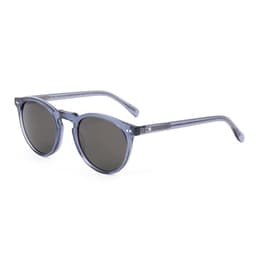
OTIS Omar x Outerknown Eco (Crystal Wave / Neutral Grey)
The most specific hinge disclosure we have found on any frame we track: OTIS publishes barrel hinges from a named Italian hinge maker on its Omar Eco features page, alongside a 47.5-22.5-140 fitting and a 4 base lens curve. Barrel hinges are the construction you want on acetate - serviceable, re-screwable, and nothing to wear out but the screw.
Price as of October 16, 2026. #ad How we’re funded
Frame material: Eco-acetate (OTIS states it is derived from cotton seeds and plant matter). Specs read from the listing on September 7, 2026.
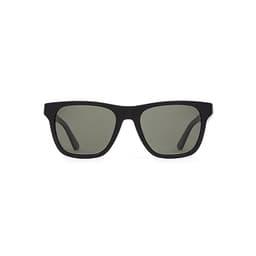
OTIS Guilt Trip X Eco (Black / Grey Polarized)
The same construction with the detail that actually matters for longevity: OTIS states stainless steel screws in the hinges. Screws are the part that backs out and the part that corrodes, so a stated stainless screw is a better durability signal than any marketing adjective on the frame itself.
Price as of October 16, 2026. #ad How we’re funded
Frame material: Eco-acetate (OTIS states it is derived from cotton seeds and plant matter). Specs read from the listing on September 22, 2026.
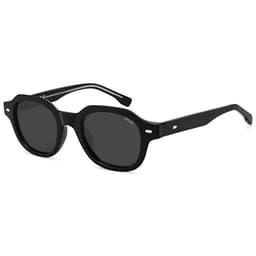
SOJOS Retro Polygon Round (Italian Acetate)
The budget benchmark, and a useful one: the listing states handmade construction with metal hinges rather than moulded-in plastic ones. That single sentence is the difference between a frame an optician can tighten and a frame that is disposable when the temple goes loose - and almost nothing else at this price says it.
Frame material: Cellulose acetate (Italian, per listing). Specs read from the listing on July 21, 2026.
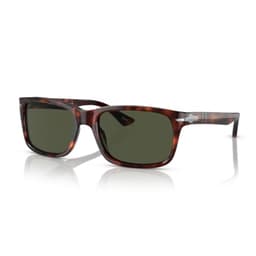
Persol PO3048S Rectangular
The other end of the market, where the hinge is the brand. Persol's heritage pages describe its arrow-shaped hinge and the Meflecto flexible stem it patented in the 1930s - a flexing temple engineered into the frame rather than a spring dropped into the hinge. It is the only frame here where the hinge design is a reason to buy it.
Price as of October 16, 2026. #ad How we’re funded
Frame material: Italian cellulose acetate. Specs read from the listing on July 21, 2026.
Frequently asked questions
What is a spring hinge on sunglasses?
A hinge with a small spring and sliding barrel inside the temple end, which lets the temple flex outward past its normal stopping point and pull back. It makes a frame more forgiving of a head that is wider than the frame was cut for and more tolerant of being pulled on and off one-handed. It is also more parts in the place a frame is most likely to fail, and it cannot be re-screwed back to tightness the way a plain barrel hinge can.
Do acetate sunglasses have spring hinges?
Some do, but it is not the default, and it is rarely advertised. Of the 41 frames in our registry, not one listing states a spring hinge - two state barrel hinges and one states metal hinges rather than moulded-in plastic ones. Spring hinges are far more visible in optical eyewear and metal frames, where the frame is worn all day and put on and taken off constantly. On a thick acetate sunglass front, the barrel hinge set into the acetate is the traditional construction and the serviceable one.
Is a spring hinge better than a barrel hinge?
It is more forgiving, not more durable, and the two should not be confused. A spring hinge buys comfort on a frame that is slightly too narrow and survives being yanked off one-handed. A barrel hinge has one moving part and one screw, so a loose one is tightened in thirty seconds and a stripped one can be re-set by an optician. If you want a frame to last a decade and to be adjustable to your face, the barrel hinge is the better bet. If your frame never fits quite wide enough, the spring is doing a job.
Why do sunglasses hinges get loose?
Almost always the screw rather than the hinge. A hinge screw backs out slowly under thousands of open-close cycles, and the cycle is harder on the hinge if you fold the right temple first - frames are built to nest left temple first, so the other order twists the hinges slightly every time. A drop of thread locker or a correctly sized jeweller's screwdriver fixes most of it. If the screw spins without tightening, the thread has gone and that is an optician's job.
Can a broken acetate hinge be repaired?
Usually yes, and this is one of acetate's real advantages. The hinge is a separate metal part set into the acetate, so an optician can often re-seat or replace it, warming the acetate to work it - the material is a thermoplastic, which is the same property that lets a frame be adjusted to your head. A moulded frame with the hinge formed into the plastic has no equivalent repair. Our page on whether acetate frames can be repaired covers the realistic cases and costs.
Is there a standard for how strong a frame hinge has to be?
There is a standard for spectacle frames - ISO 12870 sets requirements and test methods for frame construction and durability - but it explicitly does not apply to sunglasses with afocal filters, which is what a non-prescription pair is. ISO 12312-1 covers the lens side of sunglasses instead. So for the pair you are buying, no published hinge endurance figure exists, which is exactly why the few sellers who state the construction at all are worth paying attention to.
Sources
- Persol — Heritage: frame material, bridge, Meflecto and Arrow — Persol on its Turin origins (1917), cellulose acetate passing through thirty manual processes, the Meflecto flexible stem patented in the 1930s, and the arrow-shaped hinge (accessed September 15, 2026)
- ISO 12870:2024 — Ophthalmic optics — Spectacle frames — Requirements and test methods — The spectacle-frame construction and durability standard. Not a biodegradability standard, and not applicable to sunglasses with afocal filters (ISO 12312-1 applies there) (accessed September 7, 2026)
- Specialty Vision — Eyeglass Frame Materials (optometry-practice reference) — On titanium frames: very strong, lightweight and corrosion-resistant, suited to a thin, light profile and small or delicate styles; hypoallergenic, which matters for patients with a nickel allergy; corrosion resistance handles sweat, humidity and daily handling without pitting; a higher cost than basic metals. On blended-nylon frames: commonly used for sports and safety eyewear including wraparound styles, handles impact and motion better than standard plastics, and resists sweat and moisture well. On plastic frames: the most popular choice for affordability and styling, but they break more easily than metal and may fade in color over time, while Italian zyl acetate is known for its quality, hand-polished finishes and multi-layer color effects, and lasts many years with proper care (accessed October 11, 2026)
- Daicel Corporation (Material SBU) — Cellulose Acetate — Manufacturer detail on the raw material: a resin derived from cellulose obtained from wood pulp or cotton; products made from it resist sunlight and particularly UV radiation and do not easily degrade, making them suitable for long-term use; it is inherently flame-retardant with high thermal stability, softening and carbonizing at approximately 230–300°C; and Daicel's cellulose acetate products are certified under the Japan BioPlastics Association's "Biomass Plastic" and "Biodegradable Plastic" schemes, with some certifications applying only to specific grades (accessed October 17, 2026)
- Mazzucchelli 1849 — the cellulose-acetate maker for eyewear — Background on cellulose acetate as the traditional material for spectacle and sunglass frames (accessed July 21, 2026)
Keep reading
Can acetate frames be repaired?
What an optician can fix, including a hinge that has pulled out.
Read the guideHow to adjust acetate frames
The heat adjustment that a hinge makes possible.
Read the guideAre acetate sunglasses durable?
What actually fails on an acetate frame, and in what order.
Read the guideBest hypoallergenic sunglasses
The hinge is the one place metal is unavoidable - here is why it matters.
See the picks