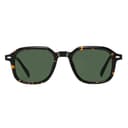
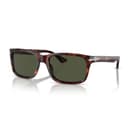
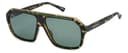
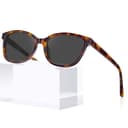
Who rectangle frames suit
A rectangle earns its place by contrast. The best pairings are the softer, rounder face shapes, because the frame’s straight lines and squared corners add the angles those faces lack. A round faceis the classic match: a rectangle visually lengthens and defines it, which is exactly why the SOJOS acetate rectangle is our best-value everyday pick and the Prive Revaux Clevelander is the budget one — both are clean, angular and unisex enough to share. An oval face works well too; it is the most flexible shape of all, and a rectangle keeps its balanced proportions while adding a little structure.
The other reason people reach for a rectangle is that it reads professional. The straight brow line and restrained footprint look composed rather than flashy, which makes a rectangle a safe choice for work, travel or any setting where you don’t want your sunglasses doing the talking. If you want to step the finish up, the Persol PO3048S is the premium end of the shape: Italian acetate, hand-finished, with the color depth and edge polish that separate a splurge frame from a value one. If a hard-cornered rectangle feels too severe for your features, the CARFIA designer frame is a soft square— the same clean, angular idea with the corners rounded off — which flatters a wider range of faces and is the gentler way into the look.
The faces that gain the least from a rectangle are the ones that are already angular. A strong square or rectangular face paired with a matching squared frame can end up looking harder and more severe, because the frame doubles down on angles the face already has instead of adding contrast. It is not forbidden — plenty of angular faces wear rectangles well — but if that is you, a soft square or a rounder shape will usually flatter more. The rectangle is at its best when it is supplying angles a face is missing, not echoing ones it already has.
Rectangle vs square vs wayfarer
These three get muddled constantly, so it is worth being precise. A rectangleis wider than it is tall — a flatter, more horizontal frame with squared corners. A square is close to equal in width and height, so it looks taller and blockier than a rectangle even though both use straight lines and angular corners; the difference is proportion, not shape language. A wayfarer is different again: it is an angled trapezoid, wider at the top than the bottom, with the outer edges canting outward rather than sitting perfectly vertical. That taper is what gives a wayfarer its retro attitude, where a rectangle stays neutral and clean.
In practice, choose by how much presence you want. A rectangle is the most understated of the three, a square is a little bolder and more geometric, and a wayfarer carries the most character. Our wayfarer guidecovers that angled classic in full if the trapezoid shape is closer to what you had in mind. All three flatter a round face for the same underlying reason — they add angles — so the pick comes down to how loud you want the frame to be.
Material changes the read of all three shapes more than people expect. In real acetate, a rectangle’s straight edges look crisp and intentional and the color runs right through the frame, so a tortoise looks layered and warm rather than flatly printed. That substance is what stops a clean, understated shape from looking cheap: the same rectangle in thin injection plastic reads disposable, while in cellulose acetate it reads considered. It is a big part of why a rectangle is one of the shapes most worth buying in genuine acetate rather than an acetate-look imitation.
How to get the width right
The single most important measurement on a rectangle is width. The frame should be about as wide as the widest part of your face, so that the straight top line runs the full span and does its lengthening, defining work. A rectangle that is too narrowis the common mistake: it pinches the face, makes it look wider than the frame, and throws away the very contrast you bought the shape for. Slightly wide is safer than slightly narrow, as long as the frame doesn’t overhang the sides of your face or slip down your nose.
Because none of these listings publishes a full frame width — that measurement is routinely left off fashion listings — use the lens width where it is stated as a rough proxy and check it against a frame you already own that fits. Height matters less on a rectangle, but keep it shallow enough that the frame stays clearly wider than it is tall; the moment it squares up, it reads as a square instead. Finally, if you are choosing between a genuine acetate rectangle and a cheaper acetate-look plastic one, spend on the acetate: our acetate vs plastic comparison explains why the straight lines of a rectangle look sharper, and hold up better over time, in real cellulose acetate.
A couple of finishing checks make the difference between a rectangle that fits and one that merely looks right in the mirror. The temples should sit level and not pinch behind the ears, and because acetate can be gently heat-adjusted by an optician, a frame that is close can usually be fine-tuned rather than returned. Watch the bridge too: a rectangle sitting too low drops the straight top line below your brow and loses some of its lengthening effect. Get the width, the bridge and the temples right and a rectangle becomes the frame you reach for without thinking — which, for an everyday shape, is exactly the point.