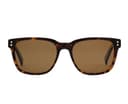
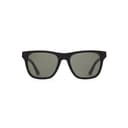
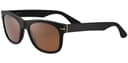
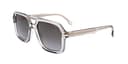
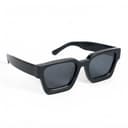
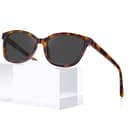
Square vs rectangle, in numbers
The useful way to separate them is the ratio between the two published lens figures. Lens width is the first number in a 55-18-140 fitting. Lens height is published far less often, which is a nuisance, because height is what makes a square a square.
Where we can read both, the pattern is clear. Ray-Ban publishes the Original Wayfarer at 50-22 with a 41 mm lens height, and at 54-18 with a 47.2 mm height — ratios of roughly 0.82 and 0.87, which is why the Wayfarer reads as a deep trapezoid rather than a flat rectangle. A shallow rectangle runs nearer 0.65. A true square sits above 0.85 and sometimes touches 1.0. If a listing gives you only the width, the photograph is the fallback: look at how much of the eyebrow the top rim reaches, because a deep front will sit on or above the brow line.
Our direct comparison of rectangle vs square frames covers the decision in full, and the rectangle roundup is the page to read if you want the shallower cut instead.
Who a square front suits
Round and oval faces.This is the strongest case. A square front introduces straight lines and hard corners where a round face has none, which adds definition along the cheekbone and makes the face read longer. Every frame on this page lists round and oval among the shapes it flatters, and that is not a coincidence — it is what the geometry does. The round-face guide and oval-face guide have the full reasoning.
Heart-shaped faces, with a caveat. A square balances a narrow chin by adding width at the top, but a very deep front on a short face runs into the cheekbone. Depth matters more than width here, so a 55 mm square with a shallow lens beats a 53 mm one with a deep lens.
Square and strong-jawed faces: usually not. Matching a square frame to a square jaw doubles the angle instead of balancing it. A round or soft-square front is the better answer, which is why the square-face guide points the other way, toward round acetate frames.
What a deep front does to fit
Three practical consequences, all of them things people discover after buying.
It touches your cheeks.A deep lens has further to travel before it clears the cheekbone. On a short face, or a face with high cheeks, a square front can rest on the cheek and lift off the nose when you smile. The fix is not a smaller width — it is a shallower lens or a higher bridge. Our guide to how sunglasses should fit covers the contact points to check.
It loads the nose harder. More lens area means more weight carried on the bridge, and a square front puts that weight further forward. This is where frame material stops being an aesthetic question: an acetate frame can be warmed and adjusted by an optician so the pads sit flatter, which spreads the load. A molded frame largely cannot. If a pair has ever slid down your nose by lunchtime, why sunglasses slip down your nose is the relevant page.
It is the best shape for a prescription. A deep lens gives a lens lab room to work, which matters for progressive and multifocal prescriptions that need vertical height to place the reading zone. If you are planning to have these glazed, prescription acetate sunglasses explains what to check before you buy the frame.
Read the material line twice on a square
Square fronts are where combination frames are most common, because a wide, deep front is heavy and designers thin it out by switching to metal at the temples. Carrera's 317/S on this page is exactly that: Carrera's own page states an acetate front with metal inserts on each side, sized 55-20-150. That is a genuinely good frame and a genuinely good price for a designer name — but if the reason you are shopping acetate is that metal irritates your skin, the inserts are the whole story. Nickel is among the most common causes of allergic contact dermatitis, and a rash appears where the allergen touched the skin, so a metal insert at the temple is in exactly the wrong place. Our hypoallergenic sunglasses roundup covers that properly, and acetate and metal frames explains why the construction exists at all.
The second thing to read twice is the lens. Two of the six here are mineral glass rather than plastic — the OTIS pair publishes polarized mineral lenses, and Serengeti's photochromic Foyt is mineral too. Glass resists scratching far better than plastic and is heavier, which on a large square front is a real trade rather than a footnote. Our glass-lens roundup ranks that category on its own, and sunglasses lens materials sets out what each one gives up.
One honest note on the sustainability claims
Three frames here make a plant-based material claim, and they are not equally evidenced. Serengeti says “eco-friendly acetate”; OTIS says its eco-acetate is derived from cotton seeds and plant matter and states the frames are biodegradable in a landfill environment without publishing a standard, a figure or a lab; the Earthly Ones listing says “Eco Bio-Acetate” and names nothing further. For contrast, Mazzucchelli publishes its M49 bioplastic as 68% bio-based with more than 90% biodegradation after 115 days under ISO 14855-2:2018 — that is what a supported claim looks like. We rank these frames on the material and the lens, not on the sustainability wording, and our bio-acetate explainer separates bio-based content from biodegradability, which are different measurements with different standards behind them.