Why glass lenses are still worth wanting
The property that matters is hardness. Glass is dramatically harder than the plastics used for sun lenses, and hardness is what decides whether a lens picks up scratches from the grit on a microfiber cloth, the inside of a bag, or a careless moment on a car dashboard. A plastic lens can be coated to help, but a coating is a thin layer sitting on a soft substrate; once it is breached, the plastic underneath scratches freely. Glass does not need the coating to be hard, because the material itself is. Over a year the difference is subtle. Over five, it is the difference between a lens you look through and one you look at.
Glass also tends to be optically excellent. Because it is cut and polished rather than molded, and because it does not warp or yellow the way some plastics can with heat and UV exposure, a good glass lens keeps colors true and edges crisp for the life of the frame. Our guide to sunglasses lens materials walks through glass, CR-39 and polycarbonate side by side, and the short version is that glass wins on clarity and scratch resistance and loses on everything to do with weight and impact — which brings us to the honest part.
The two real downsides: weight and impact
Glass is heavy. A pair of glass-lens sunglasses in a substantial acetate frame is noticeably heavier on the nose than the same shape in plastic, and that weight shows up as pressure marks and a frame that creeps down your nose on a hot day. This is exactly why OTIS lists mineral glass as heavier in its own material notes, and why the Persol 649 uses a keyhole bridge — the notched cutout spreads the load across more of the nose than a narrow saddle would. If you already find frames slide, glass will not help; read our guide to how sunglasses should fit before assuming a glass pair will sit where you want it.
Glass can also crack. Sunglass lenses sold in the United States have to pass an impact-resistance requirement, and glass sun lenses are tempered to meet it, but tempered glass still behaves differently from polycarbonate when it meets a rock or a dropped set of keys — plastic flexes and dents, glass can fracture. OTIS says as much on its own pages, and its warranty excludes scratched or cracked lenses as wear. For running, cycling, climbing or anything where a lens might take a hit near your eye, plastic is the right call and glass is the wrong one. For driving, walking, travel and the everyday sun that most people actually buy sunglasses for, glass is fine and will outlast the plastic pair several times over.
How the picks were chosen
Only frames whose own listing or maker spec panel states glass qualified. That rule excludes several frames we like, because “premium lenses” on a listing does not mean glass and we will not infer it. It also means both brands here are ones we have already reviewed in full — our Persol review and our OTIS review cover each brand’s whole range and the caveats we attach — so the picks below are a lens-first cut through frames we already know. Both OTIS picks are polarized as standard; the two Persol icons linked here carry Persol’s classic crystal green lens, which is not polarized, and the PO3048S listing does not state polarization either way — see each card.
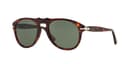
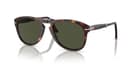
Our best overall is the Persol 649. Persol’s own spec panel lists an acetate frame, crystal lenses and Italian manufacture, and the model has been in production since 1957, when it was designed for Turin’s tram drivers. The classic green crystal lens is not polarized, which is the honest con, and it is a premium price. But it is offered in three eye sizes, the Meflecto temples Persol names in its own description handle the weight of glass gracefully, and it is the single most complete answer to “glass lenses in a frame I will keep for years.”
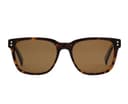
Best value in glass goes to the OTIS Test of Time X Eco. OTIS lists it at 55-18-140 with polarized mineral glass and 100% UVA/UVB, in an eco-acetate square with a 1970s lean, at well under Persol money. Our caveat, spelled out in the review, is the landfill-biodegradability claim OTIS attaches to the frame, which it does not support with a standard or a figure. Buy it for the glass and the shape and ignore the green language, and it is the cheapest properly specified glass lens on this site.
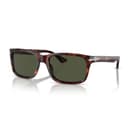
The Persol PO3048S is our best rectangular frame, and the one to pick if a pilot shape is not for you. It is offered in a single 58 mm eye size, which makes it a large frame, so it is a poor fit for a small or narrow face — measure first. For a medium-to-wide face that wants the most beautifully finished acetate here, with Persol’s crystal lens option, it is the most understated of the five and the one that reads best with a suit.
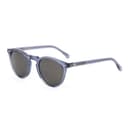
Best for small faces is the OTIS Omar x Outerknown Eco, because it solves the problem glass usually cannot: most makers reserve glass for large men’s shapes, and the Omar is a 47.5 mm round with a 4-base lens curve, which is genuinely small. OTIS publishes two slightly different sizes for the Omar across its own pages, so treat the fit as approximate and compare against a frame you own. Polarized mineral glass, and the same eco-acetate caveat as its sibling.
Finally, the Persol 714 is best folding — the folding version of the 649, with the same acetate, the same crystal lens and a front Persol measures within a millimeter of the fixed model. It costs clearly more, and the fold is the only thing the extra money buys; our 649 vs 714 comparison goes through exactly what that fold is worth. For a glass lens you can carry in a jacket pocket, it is the only option here.
Who should skip glass
Three groups. Anyone who wears sunglasses for sport or on a bike, where impact resistance matters more than scratch resistance. Anyone who already struggles with frames sliding, because the extra weight will make that worse before any bridge design makes it better. And anyone buying on a tight budget: nothing on this page is cheap, and a plastic-lens acetate frame from our affordable acetate roundup protects your eyes exactly as well, because UV protection comes from the lens treatment, not the lens material. Glass buys longevity and clarity. It does not buy safety, and it is not a substitute for a stated UV400 rating.