How we assess a brand we have not handled
We do not own a lab and we do not own these frames, so the only honest method is to judge what the brand publishes. That means reading the product pages, the material pages, the warranty and the returns policy, checking any standard a brand names against what that standard actually covers, and then saying plainly where the published record runs out. The full method is on our how we choose page. It is the same treatment we gave Persol at the top of the market and Gleyemor at the bottom.
OTIS rewards that method better than most brands, because it publishes more than most brands do — and because the one place it publishes least is the exact place its marketing is loudest.
What OTIS actually is
OTIS states it was founded on the coast of Yallingup in Western Australia and released its first collection in 2000, which makes it a genuinely established independent rather than a brand assembled last year around a sustainability angle. Its positioning is surf-adjacent and lifestyle-led rather than optical, and its whole technical identity rests on one decision it has never reversed: glass lenses.
In OTIS’s own words, it has “always used mineral glass lenses in all of our sunglasses, and we plan to keep doing so.” That is a real commitment. Almost every brand in this price band — including the ones on our designer acetate roundup — ships plastic lenses, because plastic is lighter, cheaper and safer to ship. OTIS going the other way is the single fact that makes it worth a page.
The lenses are the reason to buy OTIS
Mineral glass is ground glass rather than a cast polymer. OTIS states its lenses are sourced from natural elements “like sand and soda ash,” are “endlessly recyclable,” and are ground, polished and tested for optical correctness. It also markets the frames as carrying “12x scratch resistant” lenses.
Strip the marketing off and the practical case still stands. The failure mode that actually ends most sunglasses is not a broken frame — it is a lens surface that has been sanded to a haze by three years of pocket lint, dashboards and shirt hems. Glass resists that in a way plastic does not, which is why our lens materials guide treats scratch resistance as the durability spec that matters most for a frame you intend to keep. If you are the person who buys one good pair and wears it for a decade, glass is the correct answer and OTIS is one of the few places to get it at this money.
What glass costs you, in OTIS’s own words
To OTIS’s credit, the trade-off is stated on its warranty page rather than buried: mineral glass “is NOT scratch proof” and “can scratch or crack under extreme pressure, severe temperature, and weather fluctuations, heavy or rapid impact or if they’re just simply not cared for properly.” That is the honest version. Glass is harder than plastic and more brittle than plastic at the same time. It is also heavier, which you will notice on the bridge of your nose over a long day and which matters more if you have a low or shallow nose bridge.
So: not the frames to take up a ladder, on a bike, or anywhere a dropped pair lands on concrete. Very much the frames for driving, walking and the ten years of ordinary wear that would frost a plastic lens.
L.I.T. and the 430 nm number
OTIS sells several lens grades — standard, polarized, Reflect and its top-tier L.I.T. lens, which it says stands for Light Improvement Technology. On the L.I.T. lens OTIS publishes something almost nobody in this category publishes: a specific high-energy visible light figure. It states the lens blocks 100% of UV-A and UV-B and provides HEV protection up to 430 nm, against what it calls the industry standard of 400 nm. It also names Japanese polarization filters, a hydrophobic coating, an anti-reflective layer and polycarbonate seam edging to prevent delamination.
Two things are worth saying about that. First, it is a real number rather than an adjective, and a brand that publishes a number can be held to it — that is more than most “blue light” eyewear marketing offers, as our UV420 explainer sets out. Second, do not confuse it with eye safety. UV400 already covers the entire ultraviolet band; the extra 30 nm is visible violet light, and the evidence that blocking it protects your eyes is not settled. Treat 430 nm as a comfort and contrast feature you may or may not value, not as a protection upgrade. The frames on this page are the fixed-tint models, which OTIS states block 100% of UVA, UVB and HEV light and rates at filter category 3.
The eco-acetate claim, and why we will not repeat it
This is the part of the OTIS story that does not survive being read closely, and it is the reason this review exists rather than a simple recommendation.
What OTIS publishes
OTIS states its eco-acetate is “derived from cottonseeds and plant matter” and that the frames are “100% biodegradable, 100% recyclable and 100% eco-friendly.” On its eco-acetate collection page it goes further: the frames are “biodegradable and recyclable when placed into a landfill environment.” Its model feature pages add that the acetate component is “100% recyclable and 100% biodegradable,” that the frames are “fully compliant to ISO1870,” and that they have “undergone exhaustive tests at specialized laboratories.”
Three problems with that
One: no laboratory, figure or date is named. “Exhaustive tests at specialized laboratories” is not a citation. A brand that can name its hinge supplier by brand — and OTIS does, naming Vissottica — can name a test house.
Two: the standard cited does not cover the claim. There is no ISO standard numbered 1870 that governs frame biodegradability. The nearest real number is ISO 12870, and that is the ophthalmic-optics standard for spectacle frames: construction requirements and test methods for durability, dimensional stability and the like. It explicitly does not apply to sunglasses with afocal filters, which is what these are — ISO 12312-1 covers those. Whichever number was intended, a frame-construction standard cannot substantiate a claim about what happens to the material at end of life.
Three: landfill is the wrong environment. The published test basis for cellulose acetate biodegradation is industrial composting— ISO 14855-2, run at elevated temperature with active microbial populations and oxygen. Mazzucchelli, the Italian mill that supplies much of the industry, measures its M49 bio-acetate that way and reports over 90% biodegradation in about 115 days under those conditions. A modern sanitary landfill is compacted, sealed and largely anaerobic. It is close to the opposite environment. Our bio-acetate explainer covers the distinction in full, and it is the single most misused claim in this category.
What we do with that
We still recommend the frames — for the lenses, the shapes and the warranty. We do not repeat the biodegradability claim, and we would not have you pay a premium for it. If the environmental argument is what you are buying, the frames on our best bio-acetate sunglasses roundup are ranked specifically by how well each brand substantiates its own claim, and OTIS does not rank first there for exactly this reason. And the honest position we take on the whole category is on are acetate sunglasses eco-friendly: the greenest frame is almost always the one you keep for fifteen years, which, circling back, is an argument for glass lenses rather than against them.
Fit and sizing: what OTIS does and does not publish
OTIS is better than average here and inconsistent at the same time. Its model feature pages publish a full size in millimeters and, unusually, a base lens curve — the front curvature of the lens, where a higher number wraps more. Almost no fashion eyewear brand publishes base curve at all, and it is genuinely useful: a 4 base sits flatter across a narrow face, a 6 base wraps more and suits a wider one.
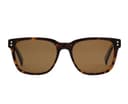
- Test of Time X: 55-18-140, 6 base curve. A larger 1970s square with real presence.
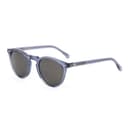
- Omar: 47.5-22.5-140, 4 base curve. Genuinely small, which is rare in a glass-lensed frame.
- Omar X:52-22.5-140. The oversized version of the same round, which OTIS describes as a “slightly larger fit than the standard OMAR.”
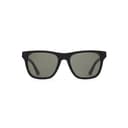
- Guilt Trip X: 57-19-130, 6 base curve. The widest front here and the shortest temples, which is what OTIS means by a larger fit.
Two cautions. OTIS’s Omar Eco features page lists the Omar at 47.5-22.5-140 while a product page for another Omar colorway lists 50-23-140, so the smaller figure is best treated as approximate. And the fittings vary more across the range than the shapes suggest — the Guilt Trip X pairs a 57 mm front with 130 mm temples where the other two run 140 — so measuring a frame you already own and comparing is still the only safe way to buy any of them, the method in our sunglasses sizing guide. The spec tables above say “Not published” where OTIS genuinely does not publish, which is the point of them.
Warranty and returns, read properly
OTIS offers a lifetime warranty against defects in materials and workmanship. That is materially better than the 24 months Ray-Ban and Persol offer or the 12 months the budget acetate brands offer, and it is a real reason to prefer OTIS at similar money.
Read the exclusions, though, because they carve out the thing most likely to happen. Scratched lenses are not covered. Neither is “damage to lenses, frames, and other components due to normal wear and tear and/or mishap/misuse.” So the lifetime warranty covers a hinge that fails on its own, not the lens you cracked. Given that glass is the whole proposition, that is worth knowing up front.
Returns on OTIS’s own store are ordinary rather than generous: 30 days, unused and in original packaging, with the cost of return shipping deducted from your refund, and no refunds at all on sale items. Buying through Amazon instead puts Amazon’s returns policy in charge, which for most people is the easier path — the same conclusion we reached comparing SOJOS and CARFIA.
What you actually pay, and where
OTIS sits in the same money as a mid-tier designer frame: its own store lists the models here around the $200 mark at full price, and the Test of Time X at a higher list again. Amazon prices on the frames above ran below that on the day we checked, which is why they are the listings we link.
But do not assume one channel always wins. On the same day, OTIS’s own store was running the Time Horizon and the Omar X at roughly half their list price on sale — below the Amazon price on those models — while Amazon was the cheaper source for the Test of Time X. The buy buttons on this page show the live Amazon price and the date it was read; if you are spending this much, it costs nothing to open OTIS’s own site in another tab first. We would rather tell you that than pretend our link is always the best price. That principle is written down on our editorial policy page, and the practical version of it is in how to buy sunglasses online.
One structural warning: OTIS on Amazon is largely third-party sellers, and stock is thin. Most OTIS listings we checked showed only one to four units left, and the plain black rectangle this page first picked — the Time Horizon Eco — went “currently unavailable” on Amazon within two weeks of this page going up, which is why the Guilt Trip X holds that slot now. OTIS still sells the Time Horizon on its own store, so the model is alive; there is simply no Amazon listing left to point you at. On our last check the three frames above were all buyable: one in stock, one down to its last few units, and the Guilt Trip X shipping in about a week rather than straight away. Availability at this end of the catalog moves fast, so treat the live buy buttons as the source of truth.
Who OTIS is for, and who should skip it
Buy OTIS ifyou want glass lenses, you keep sunglasses for years rather than seasons, and you value a lifetime defect warranty. On that brief it is close to unmatched under $200. The Test of Time X is the one to start with: it is the cheapest of the three, the size is published, and the 1970s square shape is the most wearable thing in the range. If round frames usually swallow your face, the Omar at 47.5 mm is the rarest thing here — a genuinely small frame with glass in it.
Skip OTIS if you are hard on sunglasses, if weight on the nose bothers you, or if you are buying it for the environmental claim. On the first two, a lighter acetate frame with plastic lenses from our best acetate sunglasses roundup will serve you better and cost less. On the third, the claim is not supported by anything OTIS has published, and you should not pay for it.
If the mineral glass is the reason you are here, our roundup of the best glass lens sunglasses puts OTIS against the other brands on this site that state glass lenses.
There is now a third brand in that conversation, and it is the one to read next if glass is your reason: Serengeti states borosilicate mineral glass from Corning across its range and is the only brand we cover offering a photochromic glass lens rather than a fixed tint. Our Serengeti review covers what it publishes, what it does not, and why the discount on one frame is the whole value case.