How to Buy Sunglasses Online
Buying frames you cannot try on is mostly a measurement problem, not a taste problem. Five checks that turn it from a gamble into a reasonable decision.
How this is funded:we earn a commission if you buy through our links, at no extra cost to you. It never changes which product we recommend, and we’ll tell you when we’d skip one. Full disclosure.
Buying sunglasses without trying them on feels like a gamble, and for most people it is — but not for the reason they think. The problem is almost never taste. People are usually right about the shape they like. The problem is size, and size is a solvable, measurable thing.
Start with a pair you already own
The single most useful thing you can do before opening a shopping tab is measure a frame that already fits you. Look on the inside of a temple arm and you will usually find three numbers, something like 52-18-145:
- 52— lens width in millimeters, the horizontal width of one lens.
- 18— bridge width, the gap between the lenses across your nose.
- 145— temple length, from hinge to the tip behind your ear.
Our sizing guidegoes through what each number changes. If nothing is printed — common on fashion frames — get a ruler and measure the total width of the frame front, hinge to hinge. That one figure is the most portable piece of information you can carry into a listing, because it decides whether a frame fits your head at all.
Width first, shape second
This is the order people get backwards. They read that angular frames suit a round face, find an angular frame, and buy it in whatever size the seller stocks. Then it sits too wide, slides down, and they conclude the shape advice was wrong.
Get the width within a few millimeters of a frame you know works, then apply the shape logic from our face-shape guides. A well-fitting frame in a merely acceptable shape looks better than a perfect shape in the wrong size, every time. If your face is at either end of the range, our guides to small faces and wide faces narrow the search considerably.
Read the listing for what it will not say
A listing is an argument the seller has chosen to make. What it omits is as informative as what it claims.
- Frame material.Look for “cellulose acetate.” The bare word “plastic” usually means injection-molded, which is a genuinely different material — see acetate vs plastic. A frame that will not name its material has told you something.
- UV level. Search the text for the digits 400. “UV protection” with no number states no level at all.
- Measurements. Their absence turns fit into pure chance.
- Polarization.Worth having for driving and water, and easy to verify once it arrives — see polarized vs non-polarized.
Judge the photographs
Ask for one angled shot and one on-face shot, in your head, before you buy. An angled photograph showing the temple and hinge reveals edge finish and hinge quality; a straight-on front view on a white background reveals almost nothing, which is precisely why cheap listings use it exclusively.
An on-face photograph tells you the one thing measurements cannot: how deep the frame sits vertically, which is what decides whether the bottom rim rests on your cheeks when you smile. If a listing has no face shot at all, search the brand and model — someone has usually posted one.
Check the returns before the price
Fit is genuinely hard to predict at a distance, so treat the return policy as part of the product. Three specifics: the return window, whether worn or opened items are accepted, and who pays return shipping. That last one quietly decides whether returning a budget pair is worth the effort at all.
Keep the packaging until you have worn the pair outdoors for a full day. Frames feel different after an hour than they do in the first ten seconds, and the fit problems that matter — pinching at the temples, sliding down the nose, the rim touching your cheeks — are the ones that only show up with time. Our guide to how sunglasses should fit is the checklist to run on day one.
When the parcel arrives
Five minutes of checks saves a return window. Weigh the frame in your hand — acetate feels substantial where injection plastic feels hollow. Look at whether the color is layered through the material or printed on the surface. Check the hinges are metal set into the frame. Those are the first three of the five acetate checks, and together they will tell you within a minute whether the listing was honest about what it sold you.
Two low-risk frames to start with
If you are buying blind for the first time, start somewhere forgiving: a neutral shape, a stated material, a stated UV level and a price that does not punish a mistake. Both of these clear that bar.
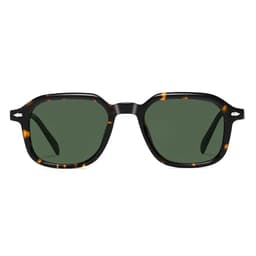
SOJOS Acetate Rectangle (Handmade, Polarized)
The safest first online buy here: an angular acetate rectangle in neutral colorways, unisex, with acetate and UV400 both stated. Flattering on round and oval faces, and understated enough to suit most wardrobes.
Frame material: Cellulose acetate. Specs read from the listing on July 21, 2026.
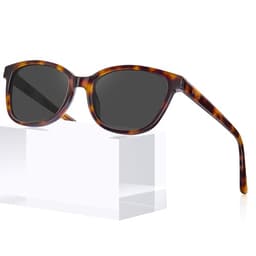
CARFIA Designer Acetate (Women's, Polarized)
The other safe route: a soft squared shape the seller pitches as suiting most faces, which is unusually true here. A sensible choice when you are unsure of your face shape as well as your size.
Frame material: Cellulose acetate. Specs read from the listing on July 21, 2026.
Frequently asked questions
How do I know what size sunglasses to buy online?
Take the numbers from a pair you already own and like. Most frames have three figures printed inside a temple arm, in the form 52-18-145 - lens width, bridge width and temple length in millimeters. If yours has none, measure the total width of the frame front from hinge to hinge with a ruler and use that. Then match a listing within a few millimeters of that total width. Frame width is the measurement that decides whether a pair fits at all, and it is the one most buyers never check.
What are the red flags in a sunglasses listing?
Four stand out. No stated frame material, or the single word plastic where you were expecting cellulose acetate. No stated UV level - vague phrasing like sun protection with no UV400 or 100% UVA/UVB anywhere. No measurements at all, which makes fit pure chance. And photographs that are all straight-on front views on white, which conveniently hide edge finish, hinge quality and how the frame actually sits. None of these proves a bad frame, but each one is information the seller chose not to give you.
Can I return sunglasses if they don't fit?
It depends entirely on the seller, which is why this is a before-you-buy check rather than an after-the-fact hope. Confirm the return window, whether worn or opened items are accepted, and who pays return shipping - that last one quietly decides whether returning a cheap pair is even worth doing. Because fit genuinely is hard to predict at a distance, a generous return policy is usually worth more than a small saving on the price.
Should I buy sunglasses from a marketplace or a brand site?
Both work if you read carefully, and the trade-off is fairly consistent. A brand's own site usually publishes better measurements, clearer material information and better photography, but has a narrower range and often costs more. A large marketplace has range, competitive pricing and easy returns, but listing quality varies wildly between sellers - which is exactly why the checks on this page exist. Whichever route you take, judge the individual listing rather than the platform.
Sources
- American Academy of Ophthalmology — Recommended Types of Sunglasses — AAO on choosing sunglasses that block 99–100% of UV-A and UV-B (UV400) (accessed July 21, 2026)
- ISO 12312-1:2022 — Eye and face protection — Sunglasses for general use — The international standard for general-use sunglasses: UV filtering, filter categories and transmittance (accessed July 21, 2026)
Keep reading
Sunglasses sizes explained
How to read 52-18-145 and measure your own fit properly.
Read the guideHow should sunglasses fit?
What good fit feels like, so you can judge a delivery in five minutes.
Read the guideHow to measure your face shape
The shape half of the decision, from a single photo and a tape measure.
See the methodHow to tell if frames are real acetate
The checks to run the moment the parcel arrives.
Check on arrivalHow to check if sunglasses really block UV
What to do when a listing's UV claim is vague.
Read the guide