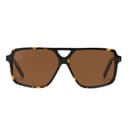
Why acetate aviators are rare
The aviator’s whole character comes from thin metal. A slim wire rim is what keeps a large teardrop lens light on the face and holds that delicate, curved silhouette without looking heavy. Acetate works the opposite way: it is cut from a solid sheet of cellulose acetate, and to carry a lens that size it has to be genuinely thick. That thickness fights the airy, barely-there quality the metal aviator is loved for, which is why most makers never bother translating the shape into acetate at all.
When a brand does make one, it usually squares off the corners and simplifies the teardrop rather than reproducing it literally. That is exactly what our pick is — a squared-off aviator in acetate rather than the usual thin metal. Read it as a cousin of the classic, not a copy: the same broad, top-heavy geometry, rebuilt in a material that changes both the weight and the attitude of the frame.
The best-known exception sits at the very top of the market. Persol has made acetate pilot frames for decades: the 649, which it dates to 1957, and the folding 714 that followed in the 1960s, both with a keyhole bridge rather than a metal bar. They cost many times our pick, and they are what the shape looks like when a maker builds it around acetate from the start. If that is the version you are weighing, our Persol 649 vs 714 comparison covers which of the two to buy.
Part of what gets lost in translation is the metal detailing itself. A classic aviator often carries a slim double or single bridge bar and delicate wire temples — details that only really work in metal. An acetate aviator replaces all of that with a continuous molded body, which looks cleaner and more modern but drops the intricate, engineered hardware that some people love the aviator for in the first place. So it is worth going in with the right expectation: this is a genuinely different frame that happens to share a family resemblance, not a metal aviator with a plastic coat of paint.
What an acetate aviator gets you
The first thing the acetate body adds is presence. Where a wire aviator reads like a piece of hardware, an acetate one reads like a designed object — it has weight and character a metal frame simply can’t match. The second is color: acetate takes warm tortoise, layered and deep neutral tones that thin metal can never carry, so the frame can be a feature rather than an afterthought. This particular pick keeps its colorways neutral and its sizing unisex, which makes it easy to share and easy to wear.
The third thing is genuinely practical. The lenses are polarized, which is a real advantage for driving and open water — polarization cuts the harsh glare that bounces off a road surface, a car hood or a lake. Just keep the priority straight: polarization is a comfort feature, while UV protection is the health one. The frame states UV400, and both the American Academy of Ophthalmology and the U.S. FDA make the same point — it is the UV rating, not how dark or how polarized a lens looks, that protects your eyes. A frame that gives you both is doing the whole job.
There is a longer-term upside worth naming too. Because acetate is a solid, workable material, an acetate frame can be gently heat-adjusted by an optician to fine-tune the fit, and a well-made one holds its shape and finish for years rather than going brittle the way thin injection plastic tends to. That serviceability is a large part of why cellulose acetate became the traditional material for quality frames, and it is a fair thing to weigh against the extra weight when you compare an acetate aviator to a near-disposable plastic one.
The trade-off vs a metal aviator
Be honest with yourself about two things. Because acetate is solid, an acetate aviator sits heavier on the nosethan the metal original, and the fit is fixed by the molded bridge rather than adjustable metal nose pads — so the frame has to suit your nose out of the box. And a squared acetate aviator is simply a bolder look than the classic thin-metal version; it is more fashion than understated. If what you actually want is the weightless, low-key flight-deck feel, the traditional metal aviator is still the right frame, and there is no shame in choosing it.
Who acetate aviators suit
An acetate aviator flatters an oval, square or heart face. An oval facecarries almost any strong shape, which is why it wears a bold acetate aviator especially well — the balanced proportions can take the extra weight and drama without being overwhelmed. A square face benefits from the softened top curve, which takes some of the hard edge off a strong jaw. And a heart face — wider at the brow, narrower at the chin — suits the aviator because the shape is broadest at the top and tapers downward, echoing and balancing the face.
The main faces to be cautious with are small or narrow ones. A squared acetate aviator is a large, top-heavy frame, and on a delicate face it can swamp the features rather than frame them. If that is you, the shape is not off the table, but size it carefully and expect to try before you commit.
What to check before you buy an acetate aviator
A few quick checks separate a frame you will actually wear from one that lives in a drawer. First, confirm the lenses are rated UV400 or 100% UV, and treat polarization as a separate bonus rather than proof of protection — a dark, glare-free lens can still be poor on UV if it isn’t rated. Second, think about fit: with a molded acetate bridge there are no adjustable nose pads, so the frame has to sit right straight out of the box, which matters more on a heavier frame like this one. Third, choose a colorway you will genuinely reach for — a neutral tone reads as an everyday frame, while a bolder color pushes the aviator further toward statement. Our pick keeps its options neutral and unisex, which is the safe starting point if you’re unsure.
The acetate alternatives if the aviator isn’t it
If the aviator turns out too heavy or too bold, two acetate shapes do a similar job with less drama. The wayfarergives you an equally iconic, instantly readable frame, but in a shape acetate was actually designed around — so it wears lighter relative to its presence. See our wayfarer guide for the honest pick there. The other option is a clean rectangle: angular lines that add definition to the face without the aviator’s statement, and one of the easiest everyday acetate frames to live with. Either is a gentler entry point if the aviator feels like too much frame.
Whichever direction you go, the material logic stays the same as it does for the aviator: a solid acetate frame gives an iconic shape genuine presence and can be adjusted and kept for years, where a thin plastic version tends to feel disposable. Match the shape to your face first, then let the acetate do what it does best — add weight, color and staying power to a shape you already know suits you.