How we judge a brand we have not handled
We own no lab and we own none of these frames, so the only honest method is to judge what the brand publishes and say plainly where the published record stops. That means reading the product pages, the lens-technology pages and the warranty, checking any standard or number a brand names against what that standard actually covers, and recording a missing measurement as missing rather than estimating it. The full method is on our how we choose page. It is the same treatment we gave Persol at the top of the market, OTIS in the middle, and Gleyemor at the bottom.
Serengeti is an awkward brand for that method, because it is generous with one half of the spec sheet and silent on the other. Nothing below is inferred from a photograph or a reputation.
The lens is the product
Serengeti states its mineral lenses are made from borosilicate optical glass from Corning, and that they come out 20 percent thinner and lighter than other lenses. Three separate technologies are then stacked on that glass, and it is worth keeping them apart because brands routinely blur them together.
Photochromic
This is the one Serengeti is known for. It describes the lens as activated by the amount of UV radiation in the atmosphere: in bright conditions the lens molecules expand and the lens darkens so less light passes through; in dimmer conditions the molecules shrink and separate and the lens lightens again. Serengeti is explicit that the change is gradual rather than instant.
Two consequences follow, and neither is in the marketing. A photochromic lens responds to UV, not to brightness — so behind a car windshield, which blocks much of the UV, it will not darken the way it does outdoors. And because the change is gradual, walking out of a building into full sun leaves you briefly under-tinted. If that trade sounds acceptable, our photochromic sunglasses guide goes through it properly, including the cold-weather behavior.
555nm
Serengeti explains that 555 nanometers marks the center of light’s visible spectrum, on the border of yellow and green, and that in low light this lens lets more yellow and green through to create relaxing conditions for the eyes. In plain terms it is a contrast tint, and it is the reason the brand has a driving reputation rather than a beach one. It is not a UV claim and should not be read as one — Serengeti states UV protection to 400 nm separately, which is the figure that actually matters and the one our UV400 guide explains.
Spectral Control
Serengeti states this filters up to 96 percent of blue light while allowing the beneficial turquoise band through, to reduce what it calls blue blur and visible noise. Treat the comfort claim as a claim. The checkable part is that it is a filtering treatment on the glass, not a coating you can scratch off, and it is applied to the photochromic lenses during manufacture.
Read the listing title: it tells you the filter category
This is the single most useful thing about shopping Serengeti, and the reason the brand earned a place on this site. Serengeti’s Amazon listing titles end with a notation like “Cat 3 to 3” or “Cat 2 to 3.” That is the filter category range of the lens, stated in the title, before you have opened anything.
Under the lens standard, category 2 transmits 18 to 43 percent of visible light and category 3 transmits 8 to 18 percent — category 3 being the everyday sunglasses band. So “Cat 3 to 3” is a fixedcategory 3 lens: it does not shift. “Cat 2 to 3” is the photochromic one: lighter than a standard sunglass lens on a gray morning, as dark as one in full sun. If you want the photochromic behavior Serengeti is famous for, that second number pair is how you confirm you are buying it. Our lens categories guidehas the full 0–4 table and the road-use rules.
One warning that applies to every category: a category 2 lens in low light is still a sunglass lens. None of these is suitable for night driving, and no photochromic lens goes genuinely clear.
Which Serengeti frames are actually acetate
Not all of them, and the catalog does not make it obvious. Serengeti sells a great deal of metal. The Melbourne, for instance, is a good-looking frame with the photochromic Drivers Gradient lens in it — and Serengeti’s own page describes a metal construction, which is why it is not on this page. If you are buying for the material rather than the lens, check the frame description on Serengeti’s product page rather than trusting the shape.
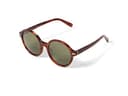
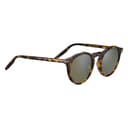
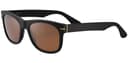
Of the three frames above, Serengeti describes the Raffaele as Italian acetate with a keyhole nose bridge, the Foyt as handcrafted eco-friendly acetate, and the Joan as bio-acetate — “an eco-friendly handmade acetate frame assembled with the Serengeti iconic mineral lens.” All three are genuine cellulose acetate, which means all three can be heat-adjusted by an optician and re-polished when the surface dulls, the way our frame adjustment guide describes.
Two of them use the bio-acetate language, and that deserves the same skepticism we apply everywhere. Bio-acetate is a statement about where the feedstock came from. It is not a statement about what happens to the frame at end of life, and Serengeti does not make a biodegradability claim we could check — which, to its credit, puts it ahead of brands that do make one without support. Our bio-acetate explainer covers the difference.
What Serengeti does not publish, and why it matters
Measurements. On the Raffaele and the Foyt, the Amazon listing gives a size band — “Small-Medium,” “Large” — and nothing else. No eye size, no bridge width, no temple length. For a frame at this money that is a real gap, because the thing most likely to make you return a pair of sunglasses is fit, not optics.
The Joan is the exception and it is why it takes the top slot. Serengeti publishes 53-20-140 for it, plus a base curve of 6 and a medium fit. That is a complete fitting, and it means you can compare it against a frame you already own instead of gambling. If those numbers mean nothing to you yet, our sunglasses sizing guide explains how to read them off the inside of your own temple arm in about a minute.
Serengeti also does not state a filter category for the Joan’s lens in the listing title the way it does for the other two — it names the Mineral Polarized 555nm lens and stops. So on that one frame you get the fitting and lose the category. There is no frame in the range where the published record is complete, and pretending otherwise would be the kind of invention this site exists to avoid.
The warranty, read carefully
Serengeti states it guarantees its products against manufacturing defects for the lifetime of the product, and that scratches and breakage from abuse or aggressive use are not covered. That is a strong headline with an important exclusion, and it is the same shape of promise OTIS makes.
The exclusion is the part to weigh, because glass is the reason you are buying. Mineral glass resists the slow surface hazing that ends most sunglasses far better than plastic does — that is its genuine advantage, and the one our lens materials guide treats as the durability spec that actually matters. But glass is also more brittle and heavier. A hinge that fails on its own is covered. A lens you chipped on a kitchen counter is not. If you are hard on sunglasses, the warranty will not save you, and a lighter plastic-lens acetate frame from our best acetate sunglasses roundup is the smarter purchase.
Price and availability: this is where the money is made or lost
Serengeti is a premium brand and its own store prices it that way. The Joan is listed at $350 on Serengeti’s own page before discounts. The Amazon listing for the Shiny Classic Havana colorway has been running far below that figure, which is the entire reason it is the pick on this page rather than the Raffaele — the Raffaele and the Foyt both sit near full premium money on Amazon too. Buy the Joan at its Amazon price and you are buying mid-range money for a premium-brand glass lens. Buy it at list and the argument is much weaker.
The buy buttons above show the live Amazon price and the date it was read, because we do not store prices. Do not take that as a promise that Amazon is always cheapest: Serengeti runs sales on its own store, and on a discounted colorway the brand can undercut the marketplace. If you are spending this much it costs nothing to open Serengeti’s site in another tab first. That principle is written down on our editorial policy page, and the practical version is in how to buy sunglasses online.
A structural warning that matters more here than for most brands: Serengeti on Amazon is largely third-party sellers, and stock is thin. Searching the catalog on the day this page was written, the majority of Serengeti listings showed one to eleven units left, several returned no price at all, and at least one model was listed by a seller misspelling the brand name. The three frames above were the ones that came back In Stockwith a real price. If one of them has gone by the time you read this, that is the reason — check Serengeti’s own store for the model before assuming it is discontinued.
Who Serengeti is for, and who should skip it
Buy Serengeti ifyou drive a lot, you want one pair that copes with changing light instead of two pairs for two conditions, and you want glass rather than plastic in front of your eyes. On that brief it is close to unmatched, because the photochromic mineral lens is a genuinely unusual combination and the filter category is stated rather than hidden. Start with the Joan if the oversized shape suits you — it is the only frame here with a published fitting and the only one currently sitting at a sensible price.
Skip Serengeti ifyou need to know a frame’s exact measurements before you buy, if weight on the bridge of your nose bothers you, or if you are hard on your sunglasses. Also skip it if you specifically want a polarized lens on the Foyt — the listing we link is the non-polarized variant, and that is stated on the card rather than glossed over. If you want a fixed, known, polarized tint in acetate for much less money, our polarized acetate roundup is the better page for you.
And if you are weighing Serengeti against the other premium Italian-made acetate brand with real glass in it, that comparison has its own page: Serengeti vs Persol.