What Tom Ford publishes, and which parts are copyable
Tom Ford’s product pages are more forthcoming than most luxury houses, which makes this a better comparison than the usual dupe list. Here is what they state, and an honest note on each one about whether money buys it.
Material: acetate, and bio-based acetate on specific models. Most listings read shiny acetate. Bio-based acetate is model-specific — it appears on certain colorways of the Ren and the Quincy and on the Redford — rather than across the line, which is more precise than the vague house-wide eco claims some brands make. Acetate itself is entirely copyable: several frames below state cellulose acetate on their own listings. Our page on acetate vs plastic covers why the material rather than the outline is what reads as expensive.
Lenses by ZEISS, 100% UV protection. Stated on the Icon models — Icon Square, Icon Rectangular, Geometric Icon. This is the first of the two properties you cannot buy cheaply. UV filtering is cheap, so a $40 frame blocks ultraviolet as effectively; what a named optical supplier buys you is tighter tolerance, better coatings and consistency between pairs. The honest substitute at a lower price is not a better plastic lens, it is glass, which is why the top pick on this page has one. Our lens materials guide compares the substrates and best glass lens sunglasses ranks the frames that publish glass.
A metal core visible on the inner temple. Stated on the Icon Round and the Icon Geometric. This is the second property money buys, and it is the one almost nobody writing a dupe list mentions. A wire core running inside an acetate temple does two things: it lets the arm be adjusted to your head and hold the adjustment, and it stops a thin temple snapping at the hinge. Budget acetate temples are solid sheet with no core, which is why they spring back to their original shape after a fitting and why they break where they break.
Made in Italy. Stated on most listings, including the Quincy, Addison and Selby. Partly provenance, partly real: the Italian acetate supply chain and the polishing stages that go with it are the difference you see at the rim edge. Our page on Italian acetate covers what the phrase actually denotes, and why acetate sunglasses are expensive breaks the cost down stage by stage.
Fittings from 47-23-145 to 64-16-120. This is the practical finding and it undermines the way most dupe lists treat Tom Ford as one look. Across the models we read, Tom Ford publishes the Icon Round at 47-23-145, the Toni at 55-16-140, the Selby at 55-19-140, the Icon Geometric at 56-17-145, the Redford at 56-19-145 on a double bridge, the Quincy at 59-13-145, the Ren at 60-20-135, the Raoul at 62-14-140 and the Addison at 64-16-120. That is not a house style, it is a range spanning a small round to a wraparound. Which Tom Ford you mean decides which dupe works, and that is the single most useful thing on this page. Our sizing guide explains how to read those numbers off a frame you already own.
How we ranked these
Five criteria, in this order. Resembling a product shot earns nothing.
1. The listing states cellulose acetate for the front, not just the temples. Four of five picks do; the fifth is included deliberately as the oversized option and its card says plainly that its front is not acetate.
2. Lens substrate. Where a frame publishes mineral glass or crystal lenses, it ranks above an equivalent plastic one, because that is the closest honest analogue to a named optical lens at a lower price.
3. A published measurement. Tom Ford publishes fittings for every model, so a frame that publishes even a lens width is far easier to match against one of them. Only two picks here do, which is itself worth knowing.
4. A stated UV figure, printed by the seller rather than assumed by us.
5. Temple construction, where a seller states it. One frame below publishes a flexible metal-cored temple system. None of the budget frames publish anything about their temples, and we are not going to guess.
Who each pick is for
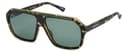
OTIS Test of Time X Eco — best overall. The pick that gets closest on the properties that actually cost money. OTIS builds this on eco-acetate with polarized mineral glass lenses and publishes a 55 mm lens width, which puts it beside the Selby at 55-19-140 rather than in a different category, and glass answers the ZEISS line more honestly than any plastic lens can. Three real cons. OTIS claims the eco-acetate is biodegradable in a landfill environment and publishes no standard, figure or laboratory to support that — the published test basis for acetate biodegradation is industrial composting, so we flag the claim rather than repeat it. Mineral glass is heavier on the nose and less impact-resistant than plastic. And it sells through third-party sellers, so stock and price move more than a first-party listing would. Our OTIS review goes through the brand in detail, including the compliance number on its own pages that does not exist as a biodegradability standard.
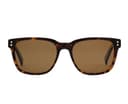
Privé Revaux Clevelander — best budget. If what you want is the blunt squared acetate look for the price of a lens cloth and a coffee, this is the rational purchase: cellulose acetate stated, polarized, 100% UV protection on the listing, and better finished than most of the budget band. Cons, stated plainly: no published measurements at all, so you cannot match it to a Tom Ford fitting before it arrives; a plastic lens that will scratch sooner than glass; and a deliberately understated rectangle rather than the heavy statement front some of the Tom Ford range is known for. Our Privé Revaux review covers the brand and affordable acetate sunglasses ranks the whole budget band on material honesty.
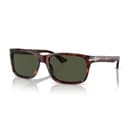
Persol PO3048S — best construction match. This is the pick for the reader whose real question is not “what looks like a Tom Ford” but “what is built like one”. Persol cuts its frames from Italian acetate and hand-finishes them, publishes a 58 mm lens width, and its Meflecto temple system is a flexible metal-cored arm — the same idea as the wire core Tom Ford names on the inner temple of its Icon models, from a house that has been doing it since the 1930s. If you want a frame that can be fitted to your head and hold it, this is the one on the page. Cons: it is the splurge pick rather than the value pick; it runs narrower and more classic than the bolder Tom Ford fronts, so check the width against a wide face; and the listing does not state polarization, so confirm the variant. Our Persol review covers the brand and Persol 649 vs 714 covers the two models whose published measurements are one millimeter apart.
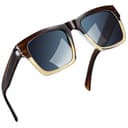
Joopin Oversized Square — best oversized. Tom Ford publishes lens widths up to 62 and 64 mm, and nothing in our acetate registry is cut that big, so pretending otherwise would be the easy lie on this page. This is the honest answer for the oversized end: a big, glamorous polarized UV400 square for pocket money. The material caveat is the whole reason it ranks fourth rather than second — Joopin puts “acetate” in the title, and the listing bullets state acetate temples on a TR90 front. The arms are acetate; the front is molded nylon. It is good value for coverage and it is not an acetate frame, and a light molded front cannot give a big shape the planted feel cut acetate does. Our acetate vs TR90 page covers the difference and oversized acetate sunglasses covers the proportions.
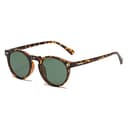
Gleyemor Vintage Round — best small round. Tom Ford’s Icon Round is published at 47-23-145, which is a genuinely small lens on a wide bridge, and most “Tom Ford dupe” lists ignore that end of the range entirely. This is the cheapest frame we track that states hand-crafted acetate in a soft vintage round, with a tortoise and G-15 green pairing and polarized UV400 lenses both stated. Honest cons: the color depth looks flat next to a mid or premium acetate, so expect value rather than richness; there are no published measurements on a frame whose whole appeal here is its size; and no wire core is published or implied. Our Gleyemor review is candid about the brand and round acetate sunglasses covers the shape.
The two things that are not for sale at this price
Most dupe pages end with a shrug about finishing. The specifics matter more than the shrug, and in Tom Ford’s case the brand itself tells you what they are.
The wirecore temple. An acetate arm with a metal wire running through it can be warmed, bent to your head and left that way. A solid acetate arm with no core can also be warmed and bent — acetate is thermoplastic, which is the whole reason an optician can adjust it — but it relaxes back toward its original shape over time, and it is the part that snaps. Of the five picks here, exactly one publishes a flexible metal-cored temple system, and it is the most expensive. If a long-term comfortable fit is what you are buying, that is where the money goes. Our guide to adjusting acetate frames covers what can and cannot be done at home, and acetate frame hinges covers the joint that usually fails first.
The named lens. ZEISS on a Tom Ford listing is not about UV — every frame on this page states UV400 or 100% UV protection, and the FDA’s point is that you cannot judge protection by how dark a lens looks. It is about optical tolerance and coatings. The honest cheaper path is a different substrate rather than a better brand of plastic, which is why glass ranks first on this page. Our UV protection guide covers reading the figure off a listing.
And the third thing, which no dupe can touch: the T. The metal or three-dimensional T on the temple is a trademark. A frame that reproduces it is a counterfeit rather than a dupe, and we will not link to one. Every pick here is sold under its own brand name.
What we left off, and why
We left off every listing with “Tom Ford” in its title. Counterfeit or trademark-squatting, both bad purchases: you do not know what the frame is made of and the listing can disappear along with your returns window.
We left off the wraparound end of the range. Tom Ford publishes the Addison at 64-16-120 — a wide, shallow shield on very short temples — and our registry has no acetate frame in that shape, because the shape is not really an acetate shape. The frames that do it are molded sport wraps, which belong on a different site.
We also left off every “designer-style” listing sold with no stated frame material. On a page whose whole argument is that the material is what you are paying for, a frame that will not say what it is made of cannot be ranked. We say the same thing, with the field left visibly blank, wherever a seller does not publish it.
If it is a different house you are after, three neighbors are built the same way: Prada dupes for the squared Symbole front, Miu Miu dupes for the low-profile rectangle, and CELINE dupes for the thick Triomphe oval. If you want the thin-rimmed, understated end of luxury acetate instead, Oliver Peoples alternatives is the opposite argument to this one.