CARFIA vs Ray-Ban
Both sell real cellulose acetate. One sells it for about $40 with a polarized lens, the other for five times that with published measurements and a frame you can still get parts for in 2040. Here is which difference actually matters to you.
How this is funded:we earn a commission if you buy through our links, at no extra cost to you. It never changes which product we recommend, and we’ll tell you when we’d skip one. Full disclosure.
The verdict up front. If you want a real acetate frame with a polarized lens and you would rather not spend $200, buy the CARFIA — it is honest about its material, the lenses are polarized where Ray-Ban’s classic is not, and it is the better buy for anyone with a small face. If you want a frame whose fit you can verify before ordering and whose parts will still exist in a decade, buy the Ray-Ban. The price gap is roughly five to one, and almost all of it is about longevity, finish and information — not about whether your eyes are protected.
Both brands already have full reviews on this site: our CARFIA review and our Ray-Ban review. This page is narrower — it answers the question people actually type, which is whether the cheap acetate frame is good enough.
The comparison, on the lines that matter
| Property | CARFIA | Ray-Ban |
|---|---|---|
| Frame material (per listing) | Hand-crafted cellulose acetate | Cellulose acetate (RB2140); acetate brow with metal lower rim (RB3016) |
| Polarized as standard | Yes, on every model here | No — the classic RB2140 lens is not polarized |
| UV protection | UV400 stated | 100% UV protection stated |
| Published fitting | Not published | 50-22 and 54-18, 150 mm temples; RB2140F low-bridge in 52-22 and 54-18 |
| Small-face option | Yes — a double-bridge frame built narrow | Only the 50 mm Original Wayfarer, still a deep frame |
| Lens material | Plastic | Plastic on most models; glass on some premium variants |
| Parts and repair | Replace rather than repair in practice | Reference models stay in production; screws, hinges, lenses available |
| Typical price band | Budget — see the live prices below | Premium — see the live prices below |
Every row above is read from the brands’ own listings and spec panels, which is why two of them say “not published.” That is not an oversight on our part — it is the single biggest practical difference between shopping these two brands, and filling the gap with a plausible number is exactly what we will not do.
Material: both acetate, different grades
This is where most comparisons go wrong in one direction or the other. The dishonest pro-Ray-Ban version says budget frames are not really acetate; the dishonest pro-budget version says acetate is acetate and the rest is marketing. Neither holds. CARFIA’s listings state hand-crafted cellulose acetate, and we take sellers at their word when they make a specific material claim — our page on how to tell if frames are real acetate exists precisely because vague listings are the ones to distrust.
What differs is grade and thickness. Premium acetate is cut from thicker sheet, and on a pattern like havana the tortoise runs through the material in layers, so the color has depth when light passes through the edge. Budget acetate tends to be thinner sheet with a shallower pattern, and the giveaway is usually the edge polish rather than the face of the frame. Our page on why acetate sunglasses are expensive breaks down where that money goes, and how acetate sunglasses are made explains why a cut-and-tumbled frame costs more than a molded one in the first place.
One genuine asterisk on the Ray-Ban side: not every Ray-Ban is acetate. The Clubmaster RB3016 is an acetate brow over a metal lower rim, and the New Wayfarer RB2132 is nylon. If the material is the reason you are buying Ray-Ban, the Original Wayfarer RB2140 is the model to ask for — see Original vs New Wayfarer for why that distinction trips so many buyers.
Lenses: CARFIA wins a round here
CARFIA states polarized and UV400 on each of the models we track, with no upgrade tier. Ray-Ban’s classic Original Wayfarer lens is not polarized; the polarized version is a separate, more expensive listing. So on the straight comparison most people make — this $40 frame against that $190 one — the cheaper frame has the more capable lens.
Two caveats keep that from being a knockout. Polarization is a glare feature, not a safety one: it blocks light reflected off flat surfaces like wet roads and water, while UV protection is what guards your eyes, and both frames state full UV protection. And Ray-Ban offers glass lenses on some variants, which resist scratching in a way plastic does not — the thing that eventually retires an everyday pair. Our guides to polarized vs non-polarized and sunglasses lens materials cover both properly.
Fit and information: Ray-Ban wins decisively
Ray-Ban publishes the Original Wayfarer in a 50-22 and a 54-18 with 150 mm temples, lists lens heights, and sells an RB2140F low-bridge fit in 52-22 and 54-18 for faces a standard bridge sits badly on. That means you can measure a frame you already own, compare the numbers and order with confidence — and our 50 vs 54 comparison walks through exactly that decision. CARFIA publishes none of it on the frames we track.
The practical cost of that gap is returns. A frame that is 2 mm too narrow at the front will mark your temples and no adjustment will fix it, as our guide to how sunglasses should fit explains. Where CARFIA pushes back is at the small end: its small-face double-bridge frame is designed narrow rather than shrunk, which is something Ray-Ban’s line does not really offer. If standard frames swamp you, read sunglasses for small faces and start there.
Lifespan: what you are really buying at five times the price
A frame dies in one of four ways: a hinge fails, the front relaxes and stops gripping, the lens scratches past usefulness, or you lose it. Ray-Ban is better placed on the first three. Its reference shapes stay in production for decades, so screws, hinges and replacement lenses stay obtainable; its acetate is thick enough to be heat-reset by an optician more than once; and glass lens options exist. ISO 12870 is the standard that governs how spectacle frames are tested for exactly this kind of durability, and it is worth knowing it does not apply to sunglass filters — those fall under ISO 12312-1.
CARFIA, realistically, is a replace-rather-than-repair frame. That is not a criticism at the price; it is a different ownership model. Two CARFIA frames over six years costs a fraction of one Ray-Ban, and you get two shapes out of it. Where the math turns is if you are the kind of owner who keeps things: then the frame that can be serviced is the cheaper one per year worn. Our page on whether acetate sunglasses are durable and whether acetate frames can be repaired cover the mechanics.
Who should buy which
Buy CARFIA if this is your first serious acetate frame, if you want a polarized lens without paying for an upgrade tier, if your face is small, or if you lose sunglasses often enough that a premium frame would be a bad bet. Also buy CARFIA if you want two or three shapes to find out what suits you — our guide to measuring your face shape is the cheaper way to answer that question, but owning a couple of frames is the fun way.
Buy Ray-Ban if you want one frame for the next ten years, if you need to verify a fitting before ordering, if your bridge or temple fit has been a problem, or if the finish genuinely matters to you — and it is reasonable that it does; a hand-polished layered havana looks better than a budget print and you will see it every time you pick the frame up. Just make sure you are buying the model whose material you actually want: the RB2140 for acetate, not the RB2132 or the RB3016.
The four frames this comparison is actually about
Two from each brand, chosen because they are the models most people are deciding between rather than the most expensive ones. Every material claim below is the one the frame's own listing makes, and prices are live and dated.
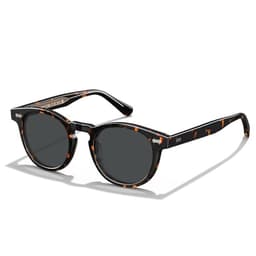
CARFIA Vintage Round (Hand-Crafted Acetate)
CARFIA’s vintage round: hand-crafted cellulose acetate, polarized, UV400, with a keyhole bridge and enough weight to feel like a real frame. The pick if you want the retro shape and the material for the price of a takeout dinner. No measurements published.
Price as of October 5, 2026. #ad How we’re funded
Frame material: Cellulose acetate. Specs read from the listing on September 29, 2026.
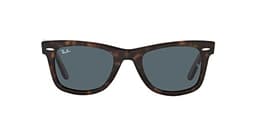
Ray-Ban Original Wayfarer RB2140
Ray-Ban’s all-acetate benchmark. Thick cellulose acetate, layered tortoise on the havana rather than a print, and published in both a 50-22 and a 54-18 fitting with 150 mm temples. The classic lens is not polarized - that is the version you pay extra for.
Price as of October 5, 2026. #ad How we’re funded
Frame material: Cellulose acetate. Specs read from the listing on July 21, 2026.
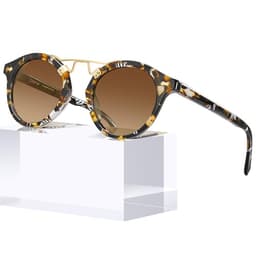
CARFIA Small-Face Double-Bridge (Acetate)
The frame Ray-Ban does not really have an answer to: an acetate double-bridge built for a genuinely small face, polarized, and the cheapest frame in this comparison. Two bridge contact points instead of one, which helps if frames leave a mark.
Frame material: Cellulose acetate. Specs read from the listing on July 21, 2026.
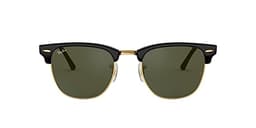
Ray-Ban Clubmaster RB3016
The other Ray-Ban people put up against a budget frame. An acetate brow over a metal lower rim, 51 mm eye - so it is a mixed-material frame rather than a full acetate one, which matters for how it ages. Here for shape comparison, not as our material pick.
Price as of October 5, 2026. #ad How we’re funded
Frame material: Acetate brow with metal lower rim. Specs read from the listing on July 21, 2026.
Frequently asked questions
Is CARFIA as good as Ray-Ban?
On the two things that protect your eyes, effectively yes: both state cellulose acetate frames and full UV protection, and CARFIA's lenses are polarized as standard while the classic Ray-Ban Original Wayfarer lens is not. On everything that decides how long a frame lasts and how well it fits, no: Ray-Ban publishes its fittings, keeps its reference models in production so parts stay available for years, and finishes its acetate to a visibly higher standard. If you want eye protection and a shape you like, CARFIA is enough. If you want a frame you will still be wearing in a decade, pay Ray-Ban.
Are CARFIA sunglasses real acetate?
The models we track state hand-crafted cellulose acetate on their own listings, and that is the standard we hold every frame to - we do not claim acetate for a frame whose seller does not. What a $40 acetate frame gives up against a $200 one is not the material category but the grade: thinner sheet, shallower color depth, less edge polish, and no published measurements. Our guide to telling real acetate from acetate-look plastic has the checks you can run yourself when a listing is vague.
Why is Ray-Ban five times the price?
Three things, and only two of them are about the object. Material and finish: thicker acetate sheet with pattern running through the layers rather than printed on, and hand-polished edges. Serviceability and sizing: reference models that stay in production, published fittings in multiple sizes including a low-bridge version, so screws, hinges and lenses remain available and you can check the fit before ordering. And the name, which is worth exactly what it is worth to you. What the premium does not buy is better UV protection - the FDA is explicit that lens darkness is not an indicator, and a stated UV400 budget lens protects your eyes just as well.
Which brand is better for a small face?
CARFIA, on current line-ups. Its small-face double-bridge frame is built narrow rather than scaled down, and the double bridge spreads weight across two contact points. Ray-Ban's narrowest Original Wayfarer is the 50-22, which is genuinely smaller than the 54-18 but is still a deep 1950s frame, and the RB2140F low-bridge version addresses bridge height rather than overall width. If a standard frame swamps you, start with the CARFIA.
Does CARFIA offer polarized lenses as standard?
On the models we track, yes - CARFIA states polarized and UV400 on each of them, with no premium version to upgrade to. That is a real functional advantage over the classic Ray-Ban Original Wayfarer, which is not polarized; Ray-Ban charges more for its polarized variant. Polarization is not the same as UV protection: it blocks reflected glare off wet roads, car hoods and water, which is a comfort and driving benefit rather than an eye-safety one.
Sources
- Ray-Ban — Original Wayfarer Classic RB2140, Polished Tortoise / G-15 Green (50-22) — Ray-Ban's listing for the 50 mm Original Wayfarer: 50-22 fitting, 41 mm lens height, 150 mm temples, acetate frame, G-15 green lens (accessed September 18, 2026)
- Ray-Ban — Original Wayfarer Classic RB2140, Polished Tortoise / G-15 Green (54-18) — Ray-Ban's listing for the 54 mm Original Wayfarer: 54-18 fitting, 47.2 mm lens height, 150 mm temples, acetate frame, G-15 green lens (accessed September 18, 2026)
- Ray-Ban — Original Wayfarer Classic Low Bridge Fit RB2140F, Polished Black / G-15 Green (52-22) — Ray-Ban's listing for the RB2140F, which Ray-Ban labels its Low Bridge Fit version of the Original Wayfarer, offered in 52-22 and 54-18 (accessed September 18, 2026)
- American Academy of Ophthalmology — Recommended Types of Sunglasses — AAO on choosing sunglasses that block 99–100% of UV-A and UV-B (UV400) (accessed July 21, 2026)
- U.S. FDA — Tips to Stay Safe in the Sun: From Sunscreen to Sunglasses — FDA: lens darkness does not indicate UV protection; look for a 100% UV / UV400 label (accessed July 21, 2026)
- Mazzucchelli 1849 — the cellulose-acetate maker for eyewear — Background on cellulose acetate as the traditional material for spectacle and sunglass frames (accessed July 21, 2026)
- ISO 12870:2024 — Ophthalmic optics — Spectacle frames — Requirements and test methods — The spectacle-frame construction and durability standard. Not a biodegradability standard, and not applicable to sunglasses with afocal filters (ISO 12312-1 applies there) (accessed September 7, 2026)
Keep reading
CARFIA review
The brand on its own terms: what it publishes, what it does not.
Read the reviewSOJOS vs Ray-Ban
The same question with the other big budget acetate brand.
Read the comparisonSOJOS vs CARFIA
If you have already decided against paying Ray-Ban money.
Read the comparisonBest Ray-Ban Wayfarer alternatives
Every budget route to the Wayfarer shape, ranked.
See the picks