Original Wayfarer vs New Wayfarer
The difference people miss is not the shape. Ray-Ban lists the Original Wayfarer RB2140 as acetate and the New Wayfarer RB2132 as nylon - and the Original is a noticeably deeper frame at every size. Here is the whole comparison from Ray-Ban's own figures.
How this is funded:we earn a commission if you buy through our links, at no extra cost to you. It never changes which product we recommend, and we’ll tell you when we’d skip one. Full disclosure.
The verdict first. If you came for the material, buy the Original Wayfarer RB2140 — Ray-Ban lists it as acetate, and it is the frame the Wayfarer reputation is built on. If a Wayfarer has always looked like too much frame on your face, buy the New Wayfarer RB2132: it is lighter, shallower and narrower at the bridge, and Ray-Ban lists its frame material as nylon rather than acetate. That is the whole decision, and almost nobody searching for this comparison has been told the material part.
The figures Ray-Ban publishes
Everything in this table comes from Ray-Ban’s own listings, read on the date in the sources below. Lens height is the row most comparisons omit and the one that actually predicts whether a frame will swamp a face.
| Property | Original Wayfarer RB2140 | New Wayfarer RB2132 |
|---|---|---|
| Frame material (per Ray-Ban) | Acetate | Nylon |
| Published sizes | 50-22 and 54-18 | 52-18 and 55-18 (plus a 58-18 Color Mix variant) |
| Lens height | 41 mm at 50-22; 47.2 mm at 54-18 | 37.6 mm at 52-18; 40.8 mm at 55-18 |
| Temple length | 150 mm | 145 mm |
| Low-bridge version | RB2140F, in 52-22 and 54-18 | RB2132F, in 55-18 |
| Shape, as listed | Square | Square |
| Polarized as standard | No — polarized is a separate listing | No — polarized is a separate listing |
Read the first and third rows together and the real difference appears. At its smallest published size, the Original is 41 mm deep. At its largest common size, the New Wayfarer is 40.8 mm deep. In other words, every New Wayfarer is shallower than every Original Wayfarer, even though two of the New Wayfarer’s stated eye widths are numerically larger. A frame’s eye size alone will mislead you here; our guide to reading sunglasses sizes explains why the three-number fitting needs the fourth number to make sense.
Acetate vs nylon: what actually changes
Cellulose acetate is cut from solid sheet, then milled, tumbled and polished — the process our page on how acetate sunglasses are made walks through. Nylon frames are molded. Three consequences follow, and they are the reasons to prefer one or the other.
Weight and thickness. A molded frame can be made thinner for the same rigidity, so a nylon Wayfarer front is slimmer and lighter than an acetate one. If weight on the bridge is your limiting factor, that is a genuine advantage, not a downgrade.
Color depth. Acetate can be laminated in layers, which is why a havana tortoise on an acetate frame has pattern running through the material and catches light at the edge. A molded frame carries its pattern more superficially. This is the difference people mean when they say a frame looks expensive, and it is covered in why acetate sunglasses are expensive and acetate vs plastic.
Adjustability and repair. Acetate softens with heat, so an optician can change how the frame sits on your face — see adjusting acetate frames. Molded frames tolerate that far less well, which means an acetate frame that does not quite fit can often be made to fit, while a nylon one is more or less what it is. Against that, an optometry frame-materials reference we cite notes the honest counterpoint about plastics in general: they break more easily than metal and can fade over time, so neither material is maintenance-free. Our comparisons of acetate vs propionate and acetate vs polycarbonate cover the molded-plastic family in more depth.
Which one fits your face
Start from lens height rather than eye size. If a Wayfarer has always sat on your cheeks or buried your eyebrows, you need a shallower frame, and the New Wayfarer at 52-18 (37.6 mm) is the shallowest in the family. If Wayfarers have always looked slightly undersized on you — common on longer and broader faces — the Original at 54-18 (47.2 mm) is the deepest, and it is also the one we would choose for an oblong face.
Then look at the bridge. The small Original has a 22 mm bridge against the New Wayfarer’s 18 mm, which is a substantial difference in how wide the frame sits across the nose. A narrow nose in a 22 mm bridge slides; a broad one in an 18 mm bridge pinches. If frames have historically slid down on you, our guide to sunglasses that slip runs through the fixes, and Ray-Ban’s F-suffix low-bridge versions exist for exactly the face a standard bridge sits badly on — the RB2140F in 52-22 and 54-18, the RB2132F in 55-18. Our low nose bridge guide covers who those are for.
Finally, temples: 150 mm on the Original against 145 mm on the New Wayfarer. Five millimeters sounds trivial and is not — a temple that is slightly too short pulls the frame forward and presses behind the ear, which is the complaint most often mistaken for “the frame is too tight.” Our guide to how sunglasses should fit explains how to check it against a pair you already own.
The budget question
If the honest reason you are comparing these two is price — the New Wayfarer typically lists below the Original — then it is worth knowing you are paying less for a different material rather than for less of the same one. At that point the comparison worth making is not RB2140 against RB2132, but RB2140 against a budget acetate frame. Our Wayfarer alternatives roundup ranks those, and SOJOS vs Ray-Ban and CARFIA vs Ray-Ban take the two biggest budget acetate brands head-on. Several of those frames are polarized as standard, which neither classic Ray-Ban lens is.
One last distinction worth filing away, because it catches people out in the same way: the Clubmaster RB3016 is not a full acetate frame either — it is an acetate brow over a metal lower rim. If a Ray-Ban listing does not say acetate, assume it is not, and check before you buy. Our Ray-Ban review goes model by model.
If the acetate is the reason you want a Wayfarer
The Original Wayfarer is the acetate model in the family, so it is the frame to buy if the material is the point - plus the bio-acetate version and the budget route to the same geometry. Prices are live and dated.
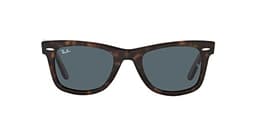
Ray-Ban Original Wayfarer RB2140
The RB2140, the acetate Wayfarer. Published in 50-22-150 (41 mm lens height) and 54-18-150 (47.2 mm lens height), with layered tortoise on the havana rather than a printed pattern. The classic lens is not polarized - that is a separate, more expensive listing.
Price as of October 5, 2026. #ad How we’re funded
Frame material: Cellulose acetate. Specs read from the listing on July 21, 2026.
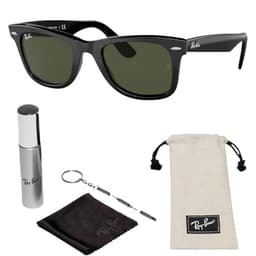
Ray-Ban Original Wayfarer Bio-Based RB2140
The same Original Wayfarer geometry in Ray-Ban’s bio-based acetate, which the brand states is 67% bio-based carbon content measured by ASTM D6866. The pick if you want the acetate frame and the lower-impact material; it costs a little more than the standard version.
Price as of October 5, 2026. #ad How we’re funded
Frame material: Bio-based cellulose acetate (Ray-Ban states 67% bio-based carbon content, ASTM D6866). Specs read from the listing on September 3, 2026.
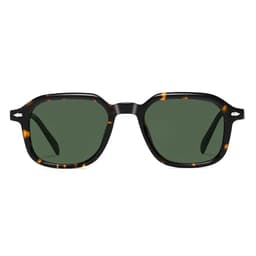
SOJOS Acetate Rectangle (Handmade, Polarized)
The budget route to the same angular geometry in stated cellulose acetate, polarized as standard - which neither classic Ray-Ban lens is. No published measurements, which is the real compromise against a frame Ray-Ban sizes in millimeters.
Price as of October 5, 2026. #ad How we’re funded
Frame material: Cellulose acetate. Specs read from the listing on July 21, 2026.
Frequently asked questions
What is the difference between the Original Wayfarer and the New Wayfarer?
Two differences matter. Material: Ray-Ban lists the Original Wayfarer RB2140 as acetate and the New Wayfarer RB2132 as nylon, so only one of them is the cellulose acetate frame. Size and depth: the RB2140 is published in 50-22 and 54-18 with 150 mm temples and lens heights of 41 mm and 47.2 mm, while the RB2132 is published in 52-18 and 55-18 with 145 mm temples and lens heights of 37.6 mm and 40.8 mm. So the New Wayfarer is a shallower frame with a narrower bridge and shorter temples - a smaller frame in practice, even at a larger stated eye size.
Which Wayfarer is acetate?
The Original Wayfarer, RB2140. Ray-Ban's own listing gives its frame material as acetate, while the New Wayfarer RB2132 is listed as nylon. If you specifically want the cut-sheet cellulose acetate that a Wayfarer is famous for - the layered tortoise, the weight in the hand, the ability to have the frame heat-adjusted - the 2140 is the model to ask for. Ray-Ban also sells a bio-based acetate version of the same frame.
Is the New Wayfarer more comfortable?
For many people, yes, and the figures explain why rather than any marketing claim. It is shallower (37.6 mm lens height at 52-18 against 41 mm at the Original's 50-22), its bridge is 18 mm where the small Original's is 22 mm, and a molded nylon front can be made thinner than a cut acetate one for the same rigidity, so it is lighter. That is a real comfort advantage if a deep, heavy 1950s frame has never suited your face. What you give up is the material.
Which Wayfarer suits a smaller face?
On the published figures, the New Wayfarer at 52-18, because lens height is where a frame visually overwhelms a small face and 37.6 mm is the shallowest option in the family. If you want to stay with acetate, the Original Wayfarer at 50-22 is the smaller of the two Original sizes at 41 mm lens height - still deeper than any New Wayfarer, so try it on if you can. Ray-Ban also publishes low-bridge versions of both (RB2140F and RB2132F), which address bridge height rather than overall size.
Do the two models protect your eyes differently?
No. Both state full UV protection, which is what guards your eyes, and the American Academy of Ophthalmology's advice is to look for 99 to 100% UV-A and UV-B blocking rather than anything about tint or frame. Neither classic lens is polarized; Ray-Ban sells polarized variants of both at a higher price. Polarization reduces reflected glare off wet roads and water - a comfort and driving benefit, not an eye-safety one.
Sources
- Ray-Ban — Original Wayfarer Classic RB2140, Polished Tortoise / G-15 Green (50-22) — Ray-Ban's listing for the 50 mm Original Wayfarer: 50-22 fitting, 41 mm lens height, 150 mm temples, acetate frame, G-15 green lens (accessed September 18, 2026)
- Ray-Ban — Original Wayfarer Classic RB2140, Polished Tortoise / G-15 Green (54-18) — Ray-Ban's listing for the 54 mm Original Wayfarer: 54-18 fitting, 47.2 mm lens height, 150 mm temples, acetate frame, G-15 green lens (accessed September 18, 2026)
- Ray-Ban — Original Wayfarer Classic Low Bridge Fit RB2140F, Polished Black / G-15 Green (52-22) — Ray-Ban's listing for the RB2140F, which Ray-Ban labels its Low Bridge Fit version of the Original Wayfarer, offered in 52-22 and 54-18 (accessed September 18, 2026)
- Ray-Ban — New Wayfarer Classic RB2132, Polished Black / G-15 Green (52-18) — Ray-Ban's listing for the New Wayfarer: frame material given as nylon, square shape, 52-18 and 55-18 fittings with 145 mm temples, lens height 37.6 mm at 52-18 and 40.8 mm at 55-18 (a 58-18 Color Mix variant is also listed), plus an RB2132F low-bridge version in 55-18 (accessed October 5, 2026)
- Mazzucchelli 1849 — the cellulose-acetate maker for eyewear — Background on cellulose acetate as the traditional material for spectacle and sunglass frames (accessed July 21, 2026)
- Specialty Vision — Eyeglass Frame Materials (optometry-practice reference) — On titanium frames: very strong, lightweight and corrosion-resistant, suited to a thin, light profile and small or delicate styles; hypoallergenic, which matters for patients with a nickel allergy; corrosion resistance handles sweat, humidity and daily handling without pitting; a higher cost than basic metals. On plastic frames: the most popular choice for affordability and styling, but they break more easily than metal and may fade in color over time, while Italian zyl acetate is known for its quality and lasts many years with proper care (accessed October 5, 2026)
- American Academy of Ophthalmology — Recommended Types of Sunglasses — AAO on choosing sunglasses that block 99–100% of UV-A and UV-B (UV400) (accessed July 21, 2026)
Keep reading
Ray-Ban Wayfarer 50 vs 54
Once you have chosen the Original, this is the size decision.
Read the comparisonWayfarer acetate sunglasses
The shape in full, from the icon down to the budget picks.
See the picksBest Ray-Ban Wayfarer alternatives
Real acetate in the same geometry, for a lot less.
See the picksAcetate vs propionate
Why a molded frame can be lighter and still feel cheaper.
Read the guide