What the second bar is actually doing
Three things, and only one of them is cosmetic.
1. It braces a wide front.The bridge is the weakest point of any frame: it is the narrowest section carrying the load of two lenses pulling in opposite directions. On a pilot or navigator front — shapes that are wide and flare outward — a single bar has to be thick to resist that, and a thick bar sits in your field of view. Two thinner bars resist it better and occupy less of the sightline. This is why the detail originated on metal aviators and migrated to acetate, not the other way round.
2. It raises the apparent top line. The upper bar sits roughly where your brow is, which visually lifts the whole frame. On a long face that is useful: it fills the space between brow and lens rather than leaving a gap. On a short face the opposite happens and the bar can cut across the brow, which is the single most common reason a double bridge looks wrong in a mirror. It is a face-height question, not a face-width one.
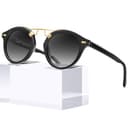
3. It gives a plain front something to look at.This is the cosmetic part, and it is most valuable on black. A black acetate front has no tortoise pattern doing visual work, so the silhouette and the hardware are all you see — which is exactly why the CARFIA black double bridge on this list works as well as it does. Our black acetate roundup makes the same argument across a wider set of frames.
Double bridge vs keyhole bridge vs low bridge fit
Three terms get used as if they were interchangeable and they describe completely different things.
A double bridge is a second horizontal bar across the top of the nose. It is a construction detail and it says nothing about how the frame fits your nose.
A keyhole bridge is the notched cut-out above the nose, shaped like an old keyhole, which rests the frame on the sides of the nose rather than the top of it. Persol's 649 uses one, as does Serengeti's Raffaele. That is a fit feature, and it is often the better answer for a low or flat nose bridge. Our keyhole bridge guide covers it, and sunglasses for a low nose bridge is the page to read if frames slide on you.
A low bridge fit(sometimes “Asian fit” or “alternative fit”) is a different mold of the same model, with taller nose pads and a wider bridge angle. It is a separate product, not a feature you can read off a photograph.
Worth knowing: a double bridge does not help a low nose bridge. The second bar sits above the nose, not on it, so it changes nothing about how the frame rests. If a frame slides down, the thing to look for is a keyhole bridge or taller pads.
How we ranked these four
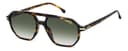
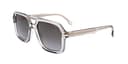
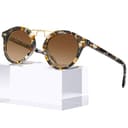
Published fitting first.Both Carreras publish a full three-number fitting, which on a wide-front shape is the difference between a confident purchase and a return. The two CARFIA frames publish nothing measurable, which is why they sit below despite being a quarter of the price — and the honest reason to buy one is the small-face cut, which is genuinely rare in acetate.
Then the material line, read in full. Carrera's 341/S is given as an acetate front and acetate temples with a metal insert running to the temples; the 317/S is an acetate front with metal inserts on each side. Both are combination frames. Read that as a design line and a weight-saving measure, not a compromise — unless metal against your skin is the reason you came to acetate, in which case the CARFIA frames are the all-acetate answer. Our page on acetate and metal frames explains why combination construction exists, and the hypoallergenic roundup covers the skin question.
Then polarization, stated or not.Carrera does not state polarization on either of these models — it describes gradient lens treatments instead, and specifies non-polarized outright elsewhere in the line. So both cards read not published, which is the honest entry. Both CARFIA frames state polarized in the listing title. If polarization is non-negotiable for you, that inverts the ranking, and polarized acetate sunglasses is the better starting page.
Who should skip a double bridge
Three groups, plainly. Short faces. If the distance from your brow to the top of your cheek is small, the upper bar lands on the brow and the frame reads as too tall. A single-bar front in the same shape will suit you better. Anyone who wears a fringe or heavy brows. The bar competes with the brow line rather than complementing it, and the effect in photographs is a frame that looks like it is sitting too high. Anyone needing a progressive lens. The bar itself is fine, but pilot and navigator shapes often taper at the bottom inside corner, which is where a lens lab needs height for the reading zone. Check glazeability first — prescription acetate sunglasses lists the questions to ask.
If what you actually want is the retro character rather than the construction, the double bridge is one of several details that read vintage, and a keyhole bridge or a thick rivet-set front often does it better. Our vintage and retro acetate roundup ranks frames on exactly those details.