How we ranked a color
Ranking frames by colorway sounds like ranking by nothing, and it would be if the colorway did not change what you should look for. It does, in four specific ways, and those four are the criteria this list is built on.
1. The cut has to carry the frame. On a tortoise or a crystal frame, the material does the visual work: the pattern moves through the thickness of the sheet, so even a plainly-cut front looks considered. Black has no pattern. What you see instead is the silhouette, the thickness of the front, the way the rim steps down toward the hinge, and how cleanly the edges are polished. That is why the picks here skew toward frames with a strong, recognizable shape — a wayfarer front, a double bridge, a true round — rather than toward neutral rectangles that read as blank in black.
2. Finish quality is fully exposed. Gloss black is the least forgiving surface in eyewear. It shows dust, fingerprints, the swirl from a dry cloth and the first scratch, all of which a mid-brown tortoise hides almost completely. A matte or satin black hides marks better but shows wear at the contact points sooner, because the matte texture polishes smooth where a temple rubs. Neither is wrong; it is a genuine trade, and it is the first thing to decide before you shop.
3. A black frame sits heavier on the face. Not in grams — in apparent size. A dark front reads larger and more present than the same frame in a warm translucent color, which is why black is the colorway most often bought a size too big. Published measurements therefore count for more here than usual, and they are the reason the OTIS and the Ray-Ban rank where they do: both publish a fitting you can check.
4. Material claims need stating, because the eye cannot check them. Acetate is cut and polished from sheet; injection-molded plastic is poured into a mold. In a warm tortoise the difference is visible in the depth of the color. In black it mostly is not — until the frame needs adjusting, because an acetate frame can be warmed and bent to your head and re-polished when the surface dulls, and a molded frame largely cannot. Our acetate vs plastic comparison sets that out in full, and how to tell if a frame is acetate covers the checks you can run on a pair in your hands.
Gloss, matte or satin black
Three finishes get sold as “black” and they age completely differently.
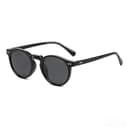
Gloss black is acetate polished to its natural shine. It is the dressiest of the three and the most formal — it is the finish that makes a wayfarer look like a wayfarer. It is also the one that shows every mark, so it rewards a case and a cloth and punishes a coat pocket.
Matte black is the same material with the shine taken off. It is quieter, it photographs flatter, and it conceals dust and fingerprints well. The catch is that the matte texture is a surface treatment on top of the sheet: where a temple tip rubs behind your ear, or where the frame rests on a table, matte slowly polishes toward gloss. The Serengeti Foyt on this list is matte.
Satin or semi-matte splits the difference and is the most forgiving of the three day to day. It is also the least common, because it is harder to hold consistently across a production run.
One practical note for all three: never clean a black acetate frame dry. Dust on a dry cloth is abrasive, and on a dark gloss surface the resulting swirl marks are visible in a way they are not on tortoise. Our guide to cleaning sunglasses has the method, and acetate frame care covers keeping the polish alive over years.
Black lenses are not the same thing as black frames
Almost every page about black sunglasses quietly blends two unrelated decisions: the color of the frame, and the darkness of the lens. They are set independently, and conflating them is how people end up with a pair that is uncomfortable rather than protective.
Lens darkness is the filter category, a standardized 0 to 4 scale describing how much visible light the lens lets through. Category 3 — the normal band for bright sun — transmits between 8% and 18%. Category 4 transmits 3% to 8% and is not permitted for road use. A black frame tells you nothing about which of those you are buying, and a very dark lens tells you nothing about UV: the FDA’s position is that you cannot judge UV protection by how a lens looks, which is why we print the stated figure on every card and leave it blank when a seller does not publish one.
The practical version: pick the frame color for how it looks on you, and pick the lens for the light you are actually in. Our guides to lens tint colors and brown vs grey lenses cover that choice properly, and how to check UV protection covers reading the figure off a listing.
Who each pick is for
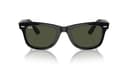
The Ray-Ban Original Wayfarer RB2140 in Black / G-15 is our best overall because it is the one frame here you can buy once. It is thick cellulose acetate in the original 1950s front, Ray-Ban states 100% UV protection, and it is published in 50-22 — the smaller of the two 2140 fittings, pairing a 50 mm lens with the wider 22 mm bridge. The compromises are real: this classic variant is not polarized (Ray-Ban charges more for that), gloss black shows every mark, and at 50 mm a wide face wants the 54 instead. Our RB2140 50 mm vs 54 mm comparison is the page to read before committing to a size, and the wayfarer style guide covers the shape.
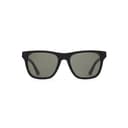
Best for a larger face is the OTIS Guilt Trip X Eco in Black / Grey Polarized, and it earns that on published numbers rather than on feel: OTIS gives the whole fitting as 57-19-130, which is the only complete measurement block among the black frames we could verify. It is also the only one here on polarized mineral glass, which is flatter optically and more scratch-resistant than plastic. The costs are weight — glass is heavier on the nose — and the 130 mm temple, which is short for a 57 mm front and may not suit a deep head. Our OTIS review has the range in full.
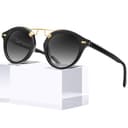
Best for a small face is the CARFIA small-face double bridge in black acetate. Small black acetate frames are genuinely hard to source — black is cut most often in medium and large, because that is where it sells — and CARFIA states black acetate, polarized and small-face sizing in the listing itself. The honest gaps: this colorway does not publish a UV figure where its tortoise sibling states UV400, and no measurements are given on a frame whose entire pitch is its size. Confirm both before you rely on them.
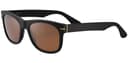
Best for changing light is the Serengeti Foyt Large in Matte Black, which is the most technically interesting frame on the page. Serengeti describes the Foyt as handcrafted eco-friendly acetate, and this variant’s listing states a non-polarized photochromic mineral 555nm lens moving between filter category 2 and category 3 — so one pair tracks an overcast morning into full afternoon sun. It is premium money, photochromic glass is heavy, and Serengeti sells polarized Foyt lenses separately, so read the variant name. Our Serengeti review and photochromic guide cover the lens.
Best budget is the Gleyemor vintage round in Black / Grey. Black is the colorway where a budget acetate frame is least outgunned, for the reason this page opened with: there is no layered pattern for a cheap sheet to get wrong. The listing states an acetate frame and polarized lenses, and that is about where the published information stops — no measurements, no UV figure on this ASIN even though Gleyemor states UV400 on siblings. Treat it as a low-cost way to find out whether a black round suits you, not as a frame to keep for a decade. Our Gleyemor review covers the brand, and affordable acetate sunglasses ranks the whole budget band on material honesty.
What we left off, and why
Several frames in our registry are almost certainly available in black and are not listed here, because the specific listing we verified is a different colorway. That is deliberate. A frame’s ASIN is tied to a variant, and the variant is what we can check — so recording “also comes in black” from a thumbnail would be exactly the kind of inference this site exists not to make. If you want a particular registry frame in black, the frame’s own page is the place to start and the seller’s variant picker is the place to confirm it.
We also left off the large field of sub-$20 black frames whose listings say “acetate style”, “acetate finish” or nothing at all about the material. In black, those are indistinguishable from the real thing in a photograph, which is precisely why the stated-material bar matters more on this page than on any other. Our cheap sunglasses that look expensive roundup ranks the budget band on how a frame reads instead, and says openly which of its picks are not acetate.
Finally, a word on where black is the wrong choice. If your coloring is warm — golden or olive skin, warm brown or auburn hair — a true black front can look harsh against it, and a deep tortoise or a warm havana will usually flatter more for the same money. Our guide to frame color for skin tone covers that properly, and tortoise vs black is the direct comparison if you are deciding between the two.