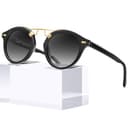
What QUAY publishes, and what it does not
We went looking for a frame material on QUAY’s own pages before writing a word of this, because the whole premise depends on it. Here is what we found.
No page we read states acetate. Not one. What QUAY does publish is specific and consistently molded: the Reckless is given as injection plastic with stainless steel hinges; the Tag Me as premium injection with a two-tone frame front and arms; the All In as a combo injection plus reinforced-metal frame; the All In Mini as a metal and PC injection frame; and the shield range as lightweight, durable plastic. “PC” is polycarbonate. That is a clear, honest description of an injection-molded frame, and we want to be fair to QUAY here: it is not hiding anything, and it never claims acetate. Plenty of cheaper brands do claim it and then put acetate only in the temples.
Lenses look like polycarbonate by implication rather than statement. QUAY’s prescription pages offer a high-index upgrade described as thinner and lighter than standard polycarbonate, which tells you what the default is without saying so outright. Many styles are sold polarized, and the Reckless states polarized, category 3 — a real spec, and more than most fashion brands publish. Our lens category guide explains what a category 3 lens is and which categories are suitable for driving.
Published lens widths, 53 to 60 mm. This is the most useful thing on QUAY’s site for anyone shopping elsewhere, so here is the set we read: Call the Shots 53, Wired Medium 54, Tag Me 55, Wired Standard 56, Take It Back 56, All In Large 56, Main Character 57, Nightfall 58, Ever After 58, High Key 60. Write down the number for the pair you own or have been eyeing — it is the only reliable way to shop a frame whose seller does not publish measurements, and most of the picks below do not. Our sizing guide explains how to read it off a pair you already have.
No warranty or returns terms appeared in the pages we read, so we are not going to state any. If service matters to your decision, check QUAY’s own policy pages directly rather than taking a number from a page like this one.
What you actually gain by switching to acetate
Four things, and only four. This is a short list on purpose, because the honest case for acetate is narrower than the marketing suggests.
1. It can be adjusted, and it holds the adjustment. This is the big one. Cellulose acetate is thermoplastic — Daicel, which makes the raw material, publishes a softening range for it — which is why an optician can warm an arm or a nose area and reshape it to your face in about a minute, usually for free. An injection-molded nylon or polycarbonate front has far less give, and a frame you cannot adjust is a frame that either fits out of the box or does not. If QUAY frames have ever slid down your nose or pinched behind your ears, that is the actual fix. Our guide to adjusting acetate frames covers what is safe to do at home, and sunglasses slipping down your nose covers the problem directly.
2. The color goes through the material, not onto it. Acetate is cut from a sheet in which the pattern has been built up through the block, so a tortoise is tortoise all the way through and a scuff does not expose a different color underneath. Molded frames are colored in the mix or coated; a deep scratch on a coated frame shows. Our page on acetate vs plastic covers this in detail and tortoise shell acetate covers why the pattern looks different on the two.
3. It can be re-polished. A cloudy or lightly scratched acetate frame can be tumbled or buffed back by an optician. A molded frame generally cannot, because there is no depth of material to work into. Over three or four years that is the difference between a frame that ages and one that just looks old. Our acetate frame care guide covers upkeep and can acetate frames be repaired covers what a repair shop can realistically do.
4. Weight gives a big shape authority. The bold oversized shapes QUAY is known for are exactly where the material shows most. A wide molded front is light, which sounds like an advantage and reads as cheap, because the frame has no physical presence to match its visual size. The same silhouette cut from acetate sits planted on the face. Our page on thick frame sunglasses makes this argument with the frames in front of it, and are acetate sunglasses heavy is honest about the trade-off in the other direction.
And the things you give up, because they are real. Acetate is heavier on the nose. It is less flexible, so it is more likely to snap than bend in an accident — if you are buying a frame to be thrown in a beach bag or worn running, a molded frame is the better engineering choice and we say so on sunglasses for the beach. And QUAY’s merchandising is genuinely good: a specific trend shape in a specific colorway is often easier to find there than in acetate at all.
How we matched these
Shape first, then material, then evidence. For each QUAY silhouette we found the closest frame in our registry whose own listing states cellulose acetate, then ranked on what the seller publishes rather than on how the product shot looks.
1. The listing states cellulose acetate for the front. All five picks do, which is the entire point of the page.
2. The silhouette matches a QUAY shape that people actually buy — the cat-eye, the retro aviator, the round, the squared classic, and the small fit.
3. A stated UV figure, printed by the seller. Four of five picks state one; the fifth does not, and its card says so rather than borrowing the figure from a sibling listing.
4. Polarization where it is offered, since QUAY sells polarized versions of most of its range and dropping to a non-polarized lens would be a downgrade, not an upgrade. Our polarized vs non-polarized guide explains what polarization does and does not do.
Who each pick is for
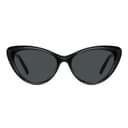
SOJOS Acetate Cat-Eye — best cat-eye. QUAY publishes the Call the Shots cat-eye at a 53 mm lens, which is a moderate, wearable cat-eye rather than an extreme one, and this is the acetate equivalent: cellulose acetate stated, polarized, UV400, metal hinges rather than molded-in ones, usually under $40. Honest cons: the color depth does not match a designer frame, it is sold in one size so a very small face may find it bold, and there are no published measurements — so use the 53 mm figure above as your reference point and check it against a pair you own. Our cat-eye acetate guide covers the shape and SOJOS review covers the brand’s ceiling.
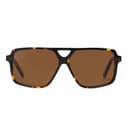
SOJOS Square Aviator — best aviator. The All In and High Key are QUAY’s retro aviators, published at 56 and 60 mm, and QUAY builds them as combo injection and metal. This is the same idea in acetate: a squared-off aviator with a body rather than a wire, polarized, UV400 stated, which makes it a real driving frame and not only a look. Cons: a squared acetate aviator is a bolder read than the classic thin-metal version, it is heavier on the nose than the wire original, and once again no measurements are published. Our aviator acetate guide covers the shape and acetate sunglasses for driving covers the lens side.
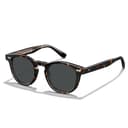
CARFIA Vintage Round — best retro round. For the rounder end of QUAY’s range, a hand-crafted acetate round with a keyhole bridge, polarized and UV400 both stated, at a budget price. The keyhole is a heritage detail that also lifts the frame slightly off the nose, which some people find more comfortable. Cons: it is noticeably heavier than a molded round, the substantial build is not for everyone, and the finish is good for the price rather than designer-grade. Our keyhole bridge guide covers the detail and the CARFIA review covers the brand.
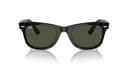
Ray-Ban Original Wayfarer, black — best buy-once. The honest answer for a reader who has replaced a molded frame two or three times and is tired of it. This is the RB2140 — the acetate Wayfarer, not the nylon RB2132 New Wayfarer — in original black with the G-15 green crystal lens, at the 50 mm eye size. It is the frame with a real service path behind it, and the one most likely to still be on your face in five years. Cons, and they matter: this classic variant is not polarized and Ray-Ban charges more for the version that is, which is a genuine step down from a polarized QUAY; gloss black acetate shows dust, fingerprints and the first scratch far more than a patterned frame; and at 50 mm it is the small 2140, so a wide face wants the 54. Our Wayfarer 50 vs 54 comparison settles that one, and black acetate sunglasses ranks the colorway.
CARFIA Small-Face Double-Bridge — best for a small face. QUAY’s published lens widths start at 53 mm and run to 60, which is a line built for medium and large faces. If every frame you try sits wide on you, that is the explanation. This one states black acetate and small-face sizing in its own listing, is polarized, and uses a double bridge to break up what would otherwise be a flat black front. One con we want to be plain about: no UV figure appears in the listing data we read, so confirm it on the product page before relying on it — we are not going to borrow the number from its tortoise sibling. There are also no published measurements on a frame sold on its sizing, and it is simply too small for a medium or wide face. Our sunglasses for small faces guide covers the fit logic.
Is QUAY bad? No — and that is not the question
We are not going to run the usual hit piece here, because QUAY does not deserve one. An injection-molded frame is light, flexible, cheap to produce in a dozen colorways and hard to break. For a frame that lives in a car door or a gym bag, those are the right properties, and we recommend molded polycarbonate frames ourselves on the pages where they win — see Knockaround and goodr, both of which we say plainly are not acetate.
The real question is what you are buying the frame for. At $65 to $125, QUAY sits in a band where real acetate is available — several picks above cost less — so the comparison is not luxury against budget, it is two materials at roughly the same money. If you want a shape for this season, buy the shape. If you want a frame you can have fitted, re-polished and keep, buy acetate. Our page on are expensive sunglasses worth it makes that argument in both directions, and how to tell if frames are acetate covers checking a claim for yourself.
What we left off, and why
We left off the shield and flat-top shapes. QUAY publishes the Nightfall as a flat-top shield at 58 mm, and there is no acetate shield in our registry because a wrapped single-lens front is not really an acetate construction — the frames that do it well are molded sport wraps. Pretending otherwise would be the easy way to fill a slot.
We left off the prescription side. QUAY sells Rx versions of much of its range, and we do not supply lenses, so recommending an acetate frame as a prescription substitute would be misleading about what you would actually have to do. Our page on prescription acetate sunglasses explains the route honestly.
And we left off every “looks like QUAY” marketplace listing with no stated frame material. On a page whose entire argument is the material, a seller who will not say what the frame is made of has disqualified itself.
If you came here from a luxury frame rather than a fashion one, three neighbors are built on the same method — the target brand’s published specs first, then our frames ranked against them: Prada dupes, Tom Ford dupes and Warby Parker alternatives.