Why polarization is the entire product on the water
Everywhere else, a polarizing filter is a comfort feature. On the water it is a vision feature, and that difference is worth understanding properly because it is the one thing that justifies spending anything at all.
Light reflecting off a flat horizontal surface comes back strongly polarized in the horizontal plane. A polarizing filter is oriented to block exactly that plane, so it removes most of the light bouncing off the surfaceof the water — the hard white sheen — while passing the light coming up through it. The result is not a dimmer view. It is a different view: you see structure, weed beds, drop-offs, the shadow of a fish, a tailing fin. Without it you are looking at a mirror.
That is why a dark non-polarized lens is close to useless for fishing while a lighter polarized lens works. Darkness and polarization are separate specifications, set independently — our polarized vs non-polarized guide covers both, and how to tell if sunglasses are polarized gives three ten-second tests you can run on a pair you already own. Every pick on this page states polarized lenses; we did not infer it from a dark photo.
One practical consequence worth knowing before you buy: a polarizing filter also interferes with LCD screens. A chartplotter, a phone at the wrong angle or a fish finder in portrait orientation can dim or black out through polarized lenses. It is rarely a reason not to buy them for fishing — it is a reason to tilt your head rather than assume the screen has failed.
Glass or polycarbonate: the real decision
This is the choice that actually separates a $30 frame from a $300 one, and the category’s own leaders are instructive here. Costa’s published pages describe its 580G as a glass lens with the mirror encapsulated between two glass layers and a molecular bond coating on the outer surfaces, which Costa states is about 20% thinner and 22% lighter than average polarized glass, and lists as scratch-resistant; its 580P is a polycarbonatelens with the same coating. Maui Jim states that its polarizing film blocks 99.9% of horizontal glare and that its lenses block 100% of UVA and UVB, and describes its SuperThin Glass as its highest-clarity, most scratch-resistant option while its lighter materials trade clarity for impact resistance. Those are both brands’ own published claims rather than independent testing, and we quote them as such — but they agree on the shape of the trade.
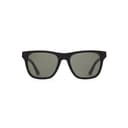
Mineral glass gives the clearest optics and by far the best scratch resistance, which matters because a fishing frame gets wiped with a wet shirt all day. It is heavier, and it can shatter. On a boat that is a real risk and not a theoretical one. Our glass pick, the OTIS Guilt Trip X, is the honest answer for someone fishing from a bank, a pier or a calm skiff.
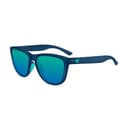
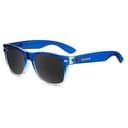
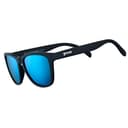
Polycarbonateis lighter, cheaper and essentially unbreakable in normal use, which is why it dominates sport eyewear. It scratches more easily and its optical clarity is a step below glass. Three picks here are stated polycarbonate — both Knockarounds and the goodr — and all three brands say so on their own pages. We are not going to relabel them acetate to suit this site’s name. See acetate vs polycarbonate and sunglasses lens materials.
The rule we would actually give someone: if losing or breaking the pair would ruin your day, buy polycarbonate. If you fish from solid ground and you care about reading water, buy glass.
Filter category: how dark you actually want to be
Lens darkness is graded 0 to 4 by the share of visible light that passes: category 0 passes 80–100%, category 1 passes 43–80%, category 2 passes 18–43%, category 3 passes 8–18% and category 4 passes 3–8%.
For open water in full sun, category 3 is the band you want— dark enough for glare coming off the surface and off a light-coloured deck, not so dark that you lose detail in shadow under a bank. Category 4 is glacier and high-altitude specification, it is not legal for driving anywhere we are aware of, and it is too dark for a dawn start. Our filter categories guide sets out the whole scale.
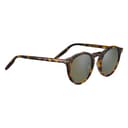
Two picks here publish a category figure: the OTIS Guilt Trip X at category 3, and the Serengeti Raffaele at category 3, which Serengeti pairs with a stated UV protection to 400 nm on a Mineral Polarized 555 nm lens. The two Knockarounds and the goodr state UV400 and polarized but publish no darkness figure at all, and their cards say so. If you want to compare two pairs numerically rather than by eye, those are the only two that let you.
Tint is a separate question from darkness. Amber and copper tints raise contrast against green water and are traditional for inshore and freshwater fishing; grey is neutral and better for very bright offshore glare. The honest limitation here is that no frame in our registry publishes a brown or amber lens as a stated specification— the brown words on these listings are frame colorways, not lens tints — so we will not award a best-amber-lens slot from a product photograph. Our lens tint colors guide and brown vs grey lenses explain what each tint does.
Salt, spray and the things nobody publishes
Here is where we have to be straight about the limits of this page. The features a dedicated fishing brand advertises — corrosion resistance, hydrophobic coatings, frames rated for saltwater and sand, floating frames, retention systems — are mostly not stated on any listing we track.
Costa, for instance, publishes that its co-injected nylon frames resist corrosion, heat and cold and hold up in saltwater and sand. Maui Jim publishes hydrophobic and oleophobic coating layers. None of our five picks states either. That does not mean they fail in salt; it means no seller has claimed they do not, and we are not going to invent a durability rating. What we can say is which materials are structurally sensible: molded polycarbonate and nylon do not corrode because there is no metal to corrode, and three of the five picks have no stated metal in the frame at all.
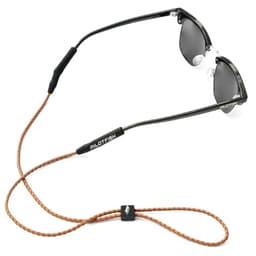
Nothing we track floats.If a frame goes over the side it is gone, and that is the single most likely way you will lose a pair of fishing sunglasses. A retainer cord costs a few dollars and solves it completely — which is why the kit below is on this page and not on a page of its own.
Rinse them. Salt dries into hinges and into the lens-to-frame seam and it is abrasive. Fresh water and a soft cloth at the end of the day does more for a fishing frame than any coating. Our how to clean sunglasses page has the safe routine and the household habits that scratch lenses, and scratched sunglasses is honest that a scratched lens cannot be repaired.
Where acetate does and does not belong on the water
One of our five picks is an acetate frame, and it is there on purpose: the Serengeti Raffaeleis Italian acetate with a keyhole bridge and a mineral polarized lens, and the OTIS is an eco-acetate frame carrying glass. So the honest position is not “never acetate” — it is never acetate for the abuse, sometimes acetate for the lens it carries.
Acetate’s real advantages are the wrong advantages for a boat. It can be heat-adjusted by an optician, which is excellent for a frame you wear every day and irrelevant for one you wear twenty times a year — see how to adjust acetate frames. Its colour runs through the sheet so scuffs do not show a different layer underneath. It is repairable at the hinge. Against that: weight, chipping, and heat relaxation on a deck in July. Our are acetate sunglasses durable? page does not pretend otherwise, and acetate vs TR90 sets the two materials side by side without picking a universal winner.
If you want the acetate frame and the glass lens and you are fishing from solid ground, buy one of the two glass picks and accept the weight. If you are on a boat, buy the molded frame and keep the acetate for the drive home.
How we ranked these five
Stated polarization first, with no exceptions. A non-polarized lens cannot do the job this page is about, so every pick states polarized on its own listing.
Then the lens substrate, ranked for the realistic use rather than for the spec sheet: polycarbonate at the top because most people fishing will knock their sunglasses about, glass immediately below it for optics, with the breakage risk named.
Then a published filter category, which only the two premium picks offer, and a stated UV figure, which all five carry in some wording — best UV400 sunglasses ranks the registry on how precisely each one is worded.
Then fit and retention.A frame that slides when wet is unusable, so the goodr is ranked on its no-slip build rather than on its optics, and the Fort Knocks is here as the wider fit — see best large sunglasses if that is the deciding factor. Then price, spread from about $30 to $320, because a first pair and a keep-for-a-decade pair are different purchases.
For adjacent use cases, sunglasses for the beach covers sand, coverage and eco frames, and sunglasses for golf is the other outdoor page where polarization is a genuine question rather than an automatic yes.