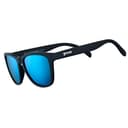
The four things a golf lens has to do
1. Hold up across four hours of changing light. A round starts and ends in different light, and the back nine of an afternoon tee time is a different lens problem from the front. A fixed dark lens is too dark at the end; a fixed medium lens is not enough at noon. This is the single strongest argument for a photochromic lens in golf, and it is why the top pick is one. Serengeti describes the mechanism rather than the marketing: lenses activated by atmospheric UV radiation, molecules expanding to darken in bright light and shrinking as light drops. Our photochromic sunglasses guide covers how that behaves and where it fails — notably behind a windscreen, which matters on the drive to the course and not on it.
2. Stay on your face. Golf is a sweating, bending, head-turning sport. A frame that walks down your nose over a putt is worse than no frame. Molded frames with rubberised temple tips win here outright; acetate temples do not grip. See sunglasses slipping down your nose.
3. Survive being taken off and put on forty times. Most golfers do not putt in sunglasses. That means the frame spends the round on a hat brim, in a pocket or on a bag, which is an impact and scratch problem rather than an optics one. Molded nylon flexes; acetate chips; glass can break. See acetate vs polycarbonate and scratched sunglasses.
4. Actually block UV. Four hours of unshaded exposure, often at altitude, often reflected off bright sand and water. Eye-health bodies are consistent that cumulative UV exposure is implicated in cataract and in growths on the eye surface, and that eyelid skin is a common skin-cancer site. Every pick here states a UV figure; best UV400 sunglasses ranks the registry on how precisely each one is worded, and how to check UV protection covers why you cannot test it yourself.
Polarized or not, on a golf course
This is the question golfers actually argue about, so here is what is verifiable and what is preference.
Verifiable: polarization removes reflected glare.Light bouncing off a flat horizontal surface — a water hazard, wet fairway, a cart windscreen — comes back strongly polarized, and the filter removes most of it. If your course has water on half the holes, that is a real comfort gain.
Verifiable: polarization interferes with LCD screens. This is physics, not opinion. A laser rangefinder display, a GPS watch face or a phone held at the wrong angle can dim dramatically or black out entirely through a polarized lens. If you range every shot, test your device through the lenses before you commit.
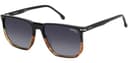
Preference, with a mechanism behind it: reading a green.Some golfers report that polarized lenses flatten the subtle surface sheen they use to read slope and grain on a putting surface. The mechanism is plausible — that sheen isreflected, polarized light, and removing it removes a cue — but we have not tested it and we are not going to cite a study we have not read. Treat it as a reason to try both rather than a settled fact. That is why a stated non-polarized pick is on this page: Carrera gives the 329/S lens as a grey shaded gold mirror gradient, non-polarized, with UV protection 100, at a 58 mm eye size on a published 58-18-145 fitting.
Our polarized vs non-polarized guide covers both sides properly, and non-polarized sunglasses is the page if you have already decided.
Lens tint and filter category for golf
Tint and darkness are two different specifications, and only one of them has a scale.
Darknessis the filter category, 0 to 4: category 0 passes 80–100% of visible light, category 1 passes 43–80%, category 2 passes 18–43%, category 3 passes 8–18% and category 4 passes 3–8%. For a golf round, category 2 to 3 is the useful range— which is exactly what Serengeti publishes for the Foyt. Category 4 is for glaciers and is not legal for driving anywhere we are aware of, so it is a poor choice for a frame you also wear to the course.
Tint is colour, and it changes contrast rather than protection. Brown and amber tints increase contrast against green, which is the reason they are traditional for grass sports; grey tints are neutral and show colour as it is. Neither affects UV filtering, which is set independently. Our lens tint colors guide and brown vs grey lenses work through it, and the honest caveat for this page is that not one frame in our registry publishes a brown or amber lens as a stated specification, so we are not going to award a “best brown lens for golf” slot on the basis of a product photograph.
Why there is no all-acetate pick at the top of this page
Because the material’s strengths are the wrong strengths here. Cellulose acetate is worth paying for when you want deep layered colour, a frame an optician can heat-adjust to your head, and a surface that can be re-polished in ten years — see what acetate is and are acetate sunglasses durable? None of those matters over four hours on a course, and two of acetate’s weaknesses matter a lot: weight and chipping.
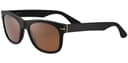
What the top pick does is split the difference. Serengeti states the Foyt as a handcrafted eco-friendly acetateframe with a mineral glass lens, so you get the frame material this site is about with the lens technology golf needs — at a price, and with glass’s own caveat, which is that it can break rather than scratch. Serengeti’s stated guarantee covers manufacturing defects for the lifetime of the product and excludes scratches and breakage from abuse, which on a glass lens is the exclusion that matters. Our Serengeti alternatives page covers what you give up by spending less, and glass lens sunglasses ranks the substrate.
How we ranked these five
Changing-light performance first, because it is the variable unique to a four-hour outdoor round, and only one pick answers it with a stated category range.
Then stated polarization, in both directions. Three picks state polarized; one is stated non-polarized on purpose; the Foyt is offered both ways. No pick has its polarization inferred from a photograph.
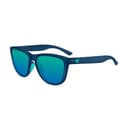
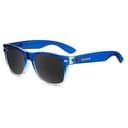
Then frame behaviour.Molded polycarbonate for the frames that will live in a pocket, with the material named as the seller names it — Knockaround and goodr both state polycarbonate on their own pages and we are not going to relabel them acetate to suit this site’s name. See our Knockaround review and our goodr review.
Then fit, then price.One wider frame for a larger face, one published 58 mm eye size, and a spread from about $30 to $300 — because a first golf pair and a frame for someone who plays weekly are not the same purchase. If you want something closer to this site’s core, start from sunglasses for the beach or acetate sunglasses for driving, which are the two use cases where acetate genuinely wins.