How to Tell If Sunglasses Are Polarized
Three tests you can run in under a minute with a laptop screen or a second pair of shades - and why passing them still tells you nothing about UV protection.
How this is funded:we earn a commission if you buy through our links, at no extra cost to you. It never changes which product we recommend, and we’ll tell you when we’d skip one. Full disclosure.
A polarized lens has a filter in it that blocks light vibrating in one direction — the horizontal direction that glare off water, wet roads and car hoods mostly comes in. A plain tinted lens has no such filter; it just makes everything darker. The two can look identical in the hand, a “polarized” sticker costs nothing to apply, and the difference is worth real money, so it is worth a minute to check. Here are the three tests that actually work, the one common way the main test fails, and the thing no test can tell you.
Test 1: the LCD screen test
This is the definitive check, and the physics is simple. Most LCD screens — laptops, desktop monitors — emit light that is already polarized in one direction. A polarized lens has its own filter set in one direction. Hold the lens flat against the screen and rotate it, and at the angle where the two directions cross, the lens blocks the screen’s light almost entirely: the screen dims dramatically or goes black, then brightens again as you keep turning. A plain tinted lens cannot do this. It darkens the screen by the same amount at every angle, because tint does not care about direction. Constant darkening means tint; darkening that swings with angle means polarization.
The one way this test fails is the screen, not the lens. Many phone screens are OLED, and OLED panels do not emit strongly polarized light, so a genuinely polarized lens can show no change at all against a phone. If you only have a phone and see nothing, you have learned nothing. Find a laptop. Also keep the lens flat to the screen while you rotate — tilting it forward or back changes what you see for reasons unrelated to polarization.
Test 2: two pairs
If you already own one pair you are sure is polarized, you do not need a screen. Hold one lens from each pair over the other and rotate one of them. Two polarized lenses crossed at 90 degrees block nearly all light between them and go black; rotate back and the light returns. If either lens is not polarized, the overlap simply gets darker in the ordinary way and never blacks out. This is the test to run at a market stall or in a store, and it works in daylight.
Test 3: the reflection test
Least precise, but useful when you have nothing else. Find a strong reflection — sun on water, a wet road, the hood or windshield of a parked car — and look at it through the lenses. Now tilt your head to one side. Through a polarized lens the glare drops sharply as you tilt, because you are rotating the filter away from the horizontal direction the glare is polarized in. Through a tinted lens nothing changes except the angle of your neck. Our polarized vs non-polarized guide explains why horizontal surfaces are the whole point of polarization, and when a non-polarized lens is actually the better choice.
What passing does not tell you
Nothing above says a word about UV protection, and that is deliberate, because polarization and UV protection are separate lens treatments that happen to be sold together often enough that people assume one implies the other. It does not. A lens can be polarized and block almost no ultraviolet, and a lens can block all UV without being polarized. The screen test proves polarization only. UV protection cannot be seen, felt or tested at home; the only things that establish it are a stated UV400 or 100% UVA/UVB rating on the listing, temple or sticker, and, if you want certainty, an optician’s UV meter. Our guide to checking UV protection covers exactly that, and our UV400 explainer covers what the number means.
This matters because the failure mode is not neutral. A dark lens with no UV protection opens your pupils to light it is not filtering, which is worse than wearing nothing. So the order of operations is: confirm the UV rating from the listing first, because that is the part that protects your eyes, and then run the screen test for polarization, because that is the part that affects what you see. Every frame we recommend on this site states both on its own listing, and the three below are the ones to start with if you would rather skip the test entirely.
Three frames that state polarized on the listing
If you would rather not run the test at all, these state polarization and a UV400 rating plainly on their own listings, which is the standard every frame on this site is held to. One is real acetate at a budget price, one is a designer acetate cat-eye, and one is the cheapest honest polarized pair we link.
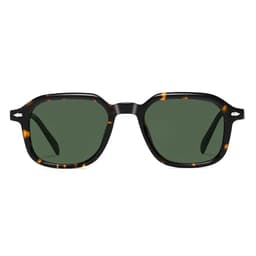
SOJOS Acetate Rectangle (Handmade, Polarized)
Stated cellulose acetate, polarized, UV400, handmade with metal hinges, at a budget price. The frame we default to for a round face, and an easy first polarized pair.
Price as of September 17, 2026. #ad How we’re funded
Frame material: Cellulose acetate. Specs read from the listing on July 21, 2026.
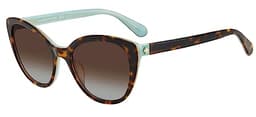
Kate Spade Amberlee/S Cat-Eye
A polarized acetate cat-eye from a designer name, mid-tier money. The upswept shape lifts a heart or square face, and the listing states both polarization and the UV rating.
Price as of September 17, 2026. #ad How we’re funded
Frame material: Cellulose acetate. Specs read from the listing on July 21, 2026.
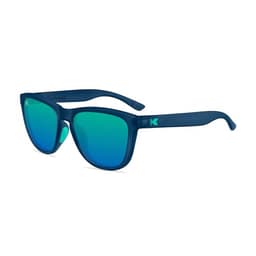
Knockaround Premiums (Polarized)
Not acetate - injection-molded polycarbonate, stated plainly - but genuinely polarized and UV400 at the lowest price here. The knockabout pair to run the screen test on for fun.
Price as of September 17, 2026. #ad How we’re funded
Frame material: Polycarbonate (not acetate). Specs read from the listing on July 21, 2026.
General guidance, not eye-care advice. Acetate Club is written by an eyewear enthusiast, not an optician or optometrist. Sunglasses are sun protection, not a substitute for an eye exam — if you have a vision or eye-health concern, or need prescription lenses, see a qualified professional.
Frequently asked questions
How can I tell if my sunglasses are polarized without a screen?
Use a second pair you know is polarized. Hold one lens from each pair together and rotate one of them: two polarized lenses crossed at 90 degrees block almost all light and go black. Without a second pair, look at a reflection on water, a wet road or a car windshield, then tilt your head sideways - a polarized lens makes the glare drop sharply as you tilt, while a plain tinted lens changes nothing.
Why does the polarized test not work on my phone?
Because many phone screens are OLED, which does not emit strongly polarized light, so a genuinely polarized lens may show no change against it. The test relies on the screen's light already being polarized in one direction, which is true of most LCD laptop and desktop monitors. If the phone test fails, repeat it on a laptop before concluding anything.
Does polarized mean UV protected?
No, and this is the mistake that matters. Polarization is a filter that blocks glare reflected from flat surfaces. UV protection is a separate treatment that blocks ultraviolet light, and a lens can have either one without the other. The screen test proves polarization only. For UV, rely on a stated UV400 or 100% UVA/UVB rating; no home test can detect it, and a dark lens without a UV rating is worse than no sunglasses because it opens your pupils to light it is not filtering.
Can sunglasses be labeled polarized and not be?
Yes, which is why the test exists. A polarized sticker costs nothing to apply. The LCD screen test takes a minute and cannot be faked: a lens that blacks out the screen at an angle is polarized, and a lens that only dims it evenly is tinted. If a pair fails the test, treat every other claim on its label with the same suspicion, and return it if it was sold as polarized.
Sources
- American Academy of Ophthalmology — Recommended Types of Sunglasses — AAO on choosing sunglasses that block 99–100% of UV-A and UV-B (UV400) (accessed July 21, 2026)
- U.S. FDA — Tips to Stay Safe in the Sun: From Sunscreen to Sunglasses — FDA: lens darkness does not indicate UV protection; look for a 100% UV / UV400 label (accessed July 21, 2026)
- MD Anderson Cancer Center — 9 things to know about sunglasses, eye protection and cancer — On UV protection over lens darkness, wraparound coverage and polarization vs UV (accessed July 21, 2026)
- ISO 12312-1:2022 — Eye and face protection — Sunglasses for general use — The international standard for general-use sunglasses: UV filtering, filter categories and transmittance (accessed July 21, 2026)
Keep reading
Polarized vs non-polarized
What polarization does, when it helps and when it does not.
Read the guideHow to check UV protection
The half of the question no home test answers.
Read the guideBest polarized acetate sunglasses
Every polarized acetate frame we recommend, in one place.
See the picksUV400, explained
What the number means and why it matters more than tint.
Read the guide