The two numbers that decide a large fit
A frame fitting is three figures stamped inside the temple — lens width, bridge width, temple length. For a bigger head, the first and third do the work.
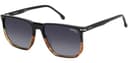
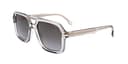
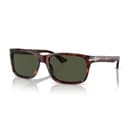
Lens width sets how wide the frame sits across your face. Adult eyewear mostly runs 48 to 58 mm per lens; 56 mm and up is a large fit, 52 to 54 mm is the middle of the market, and anything at or below 50 mm is cut narrow. In our registry the published figures at the top end are 58 mm on the Carrera 329/S, 58 mm on the Persol PO3048S and 57 mm on the OTIS Guilt Trip X. Nothing we track publishes more than 58 mm, which is worth knowing before you go looking for 62 mm acetate: in this material, at these prices, it mostly does not exist.
Temple length is the figure nobody talks about and the one that actually hurts. A temple too short for your head pulls the frame forward off the nose and leaves a pressure mark behind each ear by mid-afternoon; it is the commonest reason a frame that looked right in the photo is unwearable by 3pm. Only three frames in our registry publish it, and all three are Carreras: 150 mm on the 317/S — the longest figure we track — and 145 mm on both the 329/S and the 341/S. If your complaint is pressure behind the ears rather than width across the face, the 317/S is the pick that addresses it.
Bridge width matters less here but is not irrelevant: a wide face with a narrow bridge gets a frame that sits too high. The published bridges on this page run 18 mm (329/S) to 20 mm (317/S). Our sunglasses sizing guide explains how to read a 58-18-145 stamp, and how to measure your face shape gives the tape-measure method.
The home check takes a minute and costs nothing: measure across your face from temple to temple, just in front of your ears, in millimetres. Halve it, subtract roughly 10 to 11 mm for a bridge, and you have an approximate target lens width. A 150 mm face points at roughly a 58 mm lens; a 130 mm face points at 54 mm and this page is not for you.
Large is not oversized, and it is not thick either
Three words get used interchangeably in this market and they describe three different frames. Getting them straight saves a return.
Large is overall size relative to your head: wide lenses, long temples, enough spread that the arms are not splayed outward when you put it on. That is what this page ranks.
Oversizedis proportion relative to your face as a style choice — a deliberately outsized lens for drama, which is a look that works on small faces too. See oversized acetate sunglasses.
Thick-framedis about the rim itself, not the frame’s overall dimensions: a chunky acetate profile can sit on a 50 mm lens. See thick frame sunglasses.
A frame can be all three, or any one of them. The practical consequence: if you have a big head, an oversized frame with a 52 mm lens will still pinch, and a thick frame with a 140 mm temple will still mark your ears. Buy the fit first and the look second — our sunglasses for wide faces guide works through the fit question without product claims, and best small sunglasses is the mirror image of this page for the opposite problem.
What goes wrong on a too-small frame
It is not only comfort, which is why this is worth getting right rather than living with.
The temples splay and the frame walks forward. Arms forced wider than they were built for act as springs pushing the frame off your face, so it slides every time you look down. Our sunglasses slipping down your nose page covers the fixes.
Coverage fails at the sides.A frame too narrow for your face leaves a gap at each temple, so light — including UV — comes in from the side and around the top. Eye-health bodies are consistent that cumulative UV exposure is implicated in cataract and in growths on the eye surface, and that eyelid skin is a common site for skin cancers, so side coverage is a protection question and not a styling one. See how to check UV protection.
Hinges take the strain and fail early. A frame held open past its designed spread loads the hinge every time you wear it. On acetate that shows up as a loosened barrel or a stripped screw, and sometimes a crack at the hinge box. Our acetate frame hinges page explains which hinge types survive and can acetate frames be repaired? covers what is fixable.
The one real advantage acetate has here
Four of the six picks are stated cellulose acetate or an acetate front, and on this particular problem the material earns its place for a concrete reason: acetate is thermoplastic, so it can be widened.An optician can warm the temples and bend them outward, and the frame holds the new shape — which means a frame that is close but tight can be made to fit, permanently, in about five minutes. Molded nylon frames such as TR-90 spring back to the shape they were injected in and cannot be adjusted that way.
That is the single most useful thing to know if you have a large head and keep ending up between sizes: buy the acetate frame one notch below what you think you need and have it opened out, rather than hunting for a bigger frame that does not exist. See how to adjust acetate frames for what to ask for and what not to try at home, and acetate vs TR90 for where molded nylon is genuinely the better material anyway.
The honest counterweight: a large acetate frame is a heavy frame. More material means more grams on your nose, and the bigger the frame the more the weight matters. Our are acetate sunglasses heavy? page sets out the comparison, and most comfortable sunglasses ranks on comfort rather than size.
What the registry cannot give you at this size
Three gaps, stated rather than papered over.
Nothing above 58 mm. If a 58 mm lens is still not enough, no frame we track answers you, and we are not going to pretend a frame with no published measurement might. The honest route is an optical shop with a tape measure.
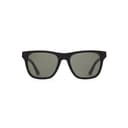
No large frame that publishes a fitting AND states polarization.The Carreras publish the fitting — and Carrera states the 329/S as not polarized (a grey shaded gold mirror gradient) and does not state polarization on the 317/S at all. The NEVEN and the Knockaround state polarized and publish nothing. The Persol and the OTIS split the difference: the Persol publishes 58 mm but Persol does not state polarization on this model, while OTIS states polarized glass with filter category 3 and publishes 57 mm. If polarization is non-negotiable, start from polarized acetate sunglasses.
One unconfirmed material. The NEVEN Doc Robbins is built as an L/XL rectangle and is the most direct answer to a large head on this page, but its listing states no frame material at allwhile NEVEN’s sibling Legend and Tombstone listings state TR-90. We record that as unconfirmed rather than assuming acetate — see our NEVEN review.
How we ranked these six
A published figure beats a claim. The two Carreras, the Persol and the OTIS all print a lens width, so they lead. A frame you can size before buying is worth more on this page than one that merely looks substantial.
Then temple length, where it is published. The 317/S at 150 mm is ranked second for that reason alone, caveats on its metal inserts and unstated polarization included.
Then a stated material, with combination frames named as combinations rather than called acetate. Carrera states metal inserts on each side of the 317/S, which matters if nickel on your skin is why you came to acetate — see hypoallergenic sunglasses.
Then a price spread, deliberately: about $35, $45, $52, $62, $171 and $333. A first frame that actually fits and a keep-for-a-decade frame are different purchases. For the price-first version of this list see best sunglasses for men under $100, which covers four of these picks under a $100 ceiling and excludes the two premium ones; this page ignores price until the end and ranks on fit.