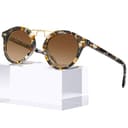
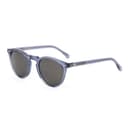
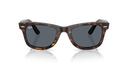
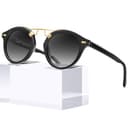
What counts as small, in millimetres
A frame fitting is three numbers stamped inside the temple: lens width, bridge width, temple length. For a smaller face only the first two matter much.
Lens width. Adult eyewear mostly runs 48 to 58 mm per lens. Anything at or below about 50 mm reads as a small fit; 52 to 54 mm is the middle of the market; 56 mm and up is a large or oversized frame. In our registry the smallest published figure is 47.5 mm on the OTIS Omar, followed by 50 mm on the Ray-Ban RB2140 and 51 mm on the Clubmaster RB3016. Everything else either sits at 54 mm and above or publishes nothing.
Bridge width.This is the gap between the lenses, and on a narrow face it decides everything. Too wide and the frame hangs off the nose and slides; too narrow and it pinches. The published bridges in our registry run from 17 mm (Carrera 341/S) to 21 mm (Persol 649) — and a 17 mm bridge on a 54 mm lens is a very different frame from a 21 mm bridge on the same lens. Our sunglasses sizing guide explains how to read the stamp, and how to measure your face shape gives the tape-measure method for your own width.
The quick home check costs nothing: measure the distance between your temples, just in front of your ears, in millimetres. Divide by two and subtract roughly 10 to 11 mm for a bridge, and you have an approximate target lens width. It is rough, it is not a substitute for trying a frame, and it will stop you buying a 58 mm frame for a 125 mm face.
Why a double bridge helps a narrow face
Two of our five picks are double-bridge frames, and that is deliberate rather than stylistic. A double bridge adds a second horizontal bar above the nose. On a narrow or lower-bridged face it does two useful things.
First, it spreads the contactrather than concentrating the frame’s weight on one small saddle, which is the mechanism behind most sliding. Second, it breaks up the vertical space above the eye, so a frame with a reasonably deep lens does not read as a slab on a short face. Our double bridge sunglasses roundup covers the style properly, and keyhole bridge sunglasses covers the other bridge geometry that helps — a notched bridge that rests on the sides of the nose rather than the top.
The related failure to name: a frame that is too big does not just look wrong, it stops working. Lenses sit too far from the eye, light leaks in at the top and sides, and the temples bow outward so the frame walks forward every time you look down. That is a protection problem as well as a fit one. See sunglasses slipping down your nose.
Small is not the same as small-faced, and not the same as a child’s frame
Three different things get called small in this market, and conflating them is how people end up with the wrong frame.
A small fitis an adult frame cut narrow — adult temple length, adult lens depth, less width. That is what this page ranks.
A small-face frame is the same thing marketed at the problem, and it is usually the more reliable buy because the seller has at least thought about it. CARFIA names it in the product title on two of our picks.
A narrow-lens trend frame— the very slim rectangular look — is a style, not a fit. It can be wide and still have shallow lenses, which is no help at all on a narrow face and is worse for coverage. We do not have a frame in the registry that publishes a rim thickness or lens depth, so we do not rank that look, and we are not going to pretend otherwise. Our sunglasses for small faces guide works through the fit question without product claims, and heart-shaped faces and oval faces cover shape rather than size.
Acetate, and why it is the right material for this problem
Four of our five picks are stated cellulose acetate or an acetate frame with glass lenses, and there is a practical reason beyond material snobbery. Acetate is thermoplastic: an optician can warm the temples and bridge area and bend them, and the frame holds the new shape. On a smaller face that is the difference between a frame that nearly fits and one that fits — you can have the temples brought in, which is the single most effective fix for sliding. Molded nylon frames like TR-90 cannot be adjusted that way; they spring back.
See how to adjust acetate frames for what is safe to do at home (very little) and what to ask an optician for, and acetate vs TR90 for where molded nylon is genuinely the better material. The counter-argument is weight: acetate is heavier per unit volume than nylon, and on a smaller frame that matters less than people expect because there is simply less of it.
How we ranked these five
A published figure beats a claim. The OTIS at 47.5 mm and the Ray-Ban at 50 mm are the only two picks you can size without trying them on, which is why both are ranked high despite costing more than the rest of the page.
A stated small-face design beats an inferred one. The two CARFIA frames do not publish a lens width, but the seller states the frame is cut for a small face and builds a double bridge into it. We rank a stated design intent above our own guess from a product photo.
Then material and protection.Every pick states UV400 or 100% UV except where noted on the card, and four state acetate. Where a seller states nothing, the card says so — see best UV400 sunglasses for the whole registry ranked on that question.
Then a price spread. About $15 to $191, because a first small frame and a keep-forever small frame are different purchases. For the opposite problem, sunglasses for wide faces and sunglasses for a big nose are the pages to read.
For the opposite problem, our best large sunglasses roundup works the same way from the other end of the registry, and explains why a large fit is not the same thing as an oversized look.