Find your number first — it takes thirty seconds
Pick up a pair of sunglasses or glasses that sits comfortably on you and look inside the left temple arm. You will find something like 54-20-140. The middle figure is the bridge width in millimetres: the gap between the two lenses, measured at the narrowest point. That is your number. Standard bridges run from about 14 to 22 mm, and the difference between an 18 and a 22 is the difference between a frame that pinches and one that does not. Our sunglasses sizing guide explains the full spec and measuring your face covers the rest of the fitting.
If every pair you own is uncomfortable and you have no reference figure, assume you want 20 mm or more and start from the picks that publish it. And be aware of the asymmetry in the market: a wider bridge usually comes attached to a wider lens, so a 22 mm bridge frame will also be a physically bigger frame. That is a real trade-off, not a flaw, and it is why the CARFIA pick is on this list.
The two bridge designs that actually help
The keyhole bridge. Shaped like an old-fashioned keyhole: the acetate is cut away in the centre so there is no contact at all across the top of the nose, and the frame rests on the two flat planes either side instead. Three things follow. The weight is spread over a larger area, so no single strip takes the load. The frame sits slightly higher and further forward, so the lenses stay off your cheeks and out of your eyelashes. And a prominent nasal bridge is simply accommodated rather than pressed against. This is the single most useful feature on this page and it is covered in full in our keyhole bridge guide.
The double bridge. A second bar across the top of the frame, borrowed from classic aviators. It adds a second contact band and stiffens the front, which spreads the load the same way a keyhole does by a different route. It is also a stronger visual statement, which some people want and some do not.
What does not help: adjustable nose pads, on an acetate frame, because full acetate frames rarely have them — pads are a metal and combination-frame feature. Our acetate and metal frames page covers that option, and acetate vs metal the broader trade. Squeezing the temple arms inward does not help either; it is the fix most people try first and the one that works least well, as why sunglasses slip explains.
The picks, and who each suits
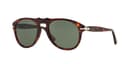
The Persol 649 is our best overall: a keyhole bridge and the Meflecto flexible temple system, both named by Persol in the model’s own description, on an acetate frame handmade in Italy with crystal lenses — published in 52-20, 54-20 and 56-20 with 140 mm temples. For a wide nose, the 56-20 is the single most useful fitting on this site. The compromises: premium money, it does not fold, and the standard Havana / Green is not polarized. Our Persol review covers the brand and 649 vs 714 the two pilot models.
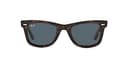
Widest published bridge is the Ray-Ban Original Wayfarer RB2140, and this is a detail most buyers miss: Ray-Ban publishes it in 50-22as well as 54-18, and the 50-22 pairs the site’s widest bridge with a smaller lens. If your nose is wide but your face is not large, that is an unusually good combination and hard to find anywhere else. Ray-Ban also lists an RB2140F Low Bridge Fit in 52-22 and 54-18 for anyone whose bridge sits low as well as wide. Thick cellulose acetate, 100% UV stated, not polarized in this variant, premium money, and the 1950s depth runs large. Our Ray-Ban review, wayfarer guide and low nose bridge guide go further.
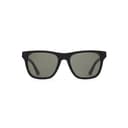
Best for a wide face too is the OTIS Guilt Trip X Eco, which publishes its whole fitting at 57-19-130. The 19 mm bridge is only moderately wide, but the 57 mm front is the widest here by a clear margin — so this is the pick when a prominent nose comes with a face that standard frames squeeze. Polarized mineral glass rated category 3 with 100% UVA/UVB stated. The honest notes: 130 mm temples are short for that width, so it fits wide rather than deep; glass adds weight; and scratched or cracked lenses are excluded from the warranty. See our OTIS review and sunglasses for wide faces.
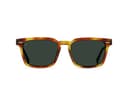
Best mid-price keyhole is the RAEN Adin 54: hand-finished Italian acetate, a keyhole bridge, a published 54 mm eye size, at roughly a third of legacy-designer money. The softened-round shape also flatters an angular face. RAEN does not publish the bridge figure, which is the limitation — you get the right design without the number — and the 54 suits a medium face. Our RAEN review has the brand.
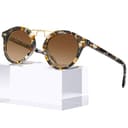
Best for a small face is the CARFIA Small-Face Double-Bridge, and it exists for the combination the rest of this list cannot serve: a prominent nose on a small face. Going wider usually means going bigger, and on a small face that looks wrong. A double bridge spreads the load across two contact bands instead of needing a wider gap, on a frame genuinely cut small, in polarized real acetate at budget money. No measurements are published, and it will be too small for a medium or large face. See sunglasses for small faces.
The free fix worth doing before you buy anything
Acetate can be heated and re-set. An optician can open the bridge angle of an acetate frame a little, change the pantoscopic tilt so the lenses sit further off your cheeks, and re-bend the temples — usually in a few minutes, often at no charge, and on a frame they did not sell you. No molded nylon or TR90 frame can be adjusted this way, which is a real and under-appreciated reason to buy acetate if your face is not a standard shape. If a frame is nearly right, that adjustment beats buying a different one. Our page on adjusting acetate frames covers what can and cannot be changed, and how sunglasses should fit gives you the four checks to take to the appointment.