How we assess a brand we haven’t handled
We do not buy units or test lenses, so we do not claim hands-on results. What we can do reliably is read the published specification, confirm the stated frame material, and reason honestly about fit and value. For an indie like RAEN the value question is the whole game: the brand is not selling you a heritage logo, so the fair test is whether the money buys genuinely better material and finish than its price suggests, or whether the “Italian acetate” claim is thinner than it sounds. Here is what a RAEN Adin actually delivers on that test.
What RAEN gets right
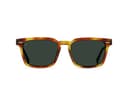
Three things, and they are real rather than marketing. First, real Italian acetate at an indie price: RAEN cuts its higher frames from Italian cellulose acetate — Mazzucchelli-grade sheet, the same family of material the legacy names use — rather than printing a pattern onto a molded budget frame. That is the single biggest reason a RAEN reads as more expensive than it is. Second, hand-finishing: the frames are hand-finished, and the polish and the way the material catches light are exactly what separate a frame like this from a molded one. Third, the Moab Tortoisecolorway on the Adin is a beautifully mixed pattern with real depth — layered warmth you can see into, not the flat printed look you get on a cheaper tortoise. The soft-round shape, covered in detail below, rounds it out with a silhouette that flatters more faces than a perfect circle does.
It is worth dwelling on why the material point matters so much at this price. Anyone can call a frame “acetate,” because acetate is simply the plastic family; what is rare below the legacy tier is Italian sheet that is cut and polished rather than injection-molded. Molding is cheap and fast and produces a flat, uniform surface; cutting from sheet and hand-finishing is slower and costlier, and it is what gives the edges their polish and the pattern its depth. RAEN choosing the harder, more expensive method on its higher frames — and then not charging legacy-designer money for it — is the whole reason the brand is interesting. You are paying for the process, not the badge, and the process is the part that actually shows on your face.
The trade-offs
Being upfront is the point of this site, so here is the honest cost. The first trade-off is availability. RAEN is a smaller-run brand, so at any given moment it stocks fewer colorwaysthan a legacy name that produces at scale — the Moab Tortoise or a particular finish you want may be out of stock, and you cannot always count on the full range being available when you buy. The second is sizing. The Adin runs a 54mm eye size, which suits a medium face nicely but can read small on a large or wide face, so a bigger face should size up or check the measurement against a frame they already own. Neither is a flaw exactly; they are simply the reality of an indie that makes in smaller batches and builds the Adin around a medium fit rather than trying to fit everyone.
It is worth naming what the price does not change, too. A RAEN will not make a shape that does not suit your face suit it, and the soft-round, flattering as it is, still has to match your proportions — so the usual fit rules apply. Treat the money as buying material and finish on a frame whose shape and size already work for you; it is not a shortcut past the basics of picking the right frame in the first place. If you are unsure whether a round shape is yours at all, it is worth weighing the Adin against the rest of the field before you commit, rather than buying the shape on looks alone.
RAEN vs a legacy designer
This is the comparison that matters most, and the honest answer is genuinely good news for RAEN. What you give up against a legacy name is the heritage and the resale name— a Persol or a Ray-Ban carries decades of reputation and a silhouette people recognize on sight, plus the broad availability that comes with producing at scale. What you keep is the part that actually touches your face: comparable material and hand-finishing for markedly less money. And the thing the premium never buys, at any price, is better eye protection — UV protection is lens-based, so a RAEN with UV-rated lenses protects your eyes exactly as well as a frame that costs three times more. We lay that trade-off out in full in are expensive sunglasses worth it, and if you want to understand the material itself — what “Italian acetate” genuinely means and why it commands a premium — start with Italian acetate, explained. For a direct look at the benchmark RAEN is undercutting, our Persol review is the natural companion.
The Adin in detail
The Adin 54 is a soft, squared roundwith a keyhole bridge — and the “soft” part is what makes it work. A perfect circle can be a hard shape to wear; it emphasizes roundness and clashes with an angular face. The Adin rounds the corners without going fully circular, so it keeps the character of a round frame while staying forgiving on square and angular faces. That squared softness is why it suits square, oval and heart shapes rather than only the narrow band of faces a true circle flatters. The keyhole bridge adds a classic, slightly vintage note that reads considered rather than trend-chasing.
The material is where the value lives. Italian cellulose acetate, hand-finished, gives the Adin the color depth and edge polish of a far more expensive frame — and on the Moab Tortoise that means a mixed pattern with real depth, layered warmth you can see into rather than a flat surface print. It is the kind of finish that, in a shop, you would guess cost several times what a RAEN actually does.
That finish also changes the value math over time. Because the Adin is cut from Italian acetate and hand-finished rather than molded from a cheaper plastic, it is built to be kept and worn for years rather than replaced each season — and priced per year of use, a frame you hold onto works out closer to a budget pair than the sticker suggests. The difference with RAEN is that you reach that longevity withoutthe legacy-designer outlay, which is exactly what makes the indie route compelling: you get the buy-for-years material at a fraction of the buy-for-years price. That only holds if the soft-round is a shape you will still want in a decade — but a restrained, slightly vintage round tends to age far better than a trend silhouette, so the odds are in your favor.
The one number to check before you buy is the 54mm eye size. It is squarely a medium fit: ideal on a medium face, potentially small on a large or wide one. That is not a fault — the Adin is built around a medium proportion on purpose — but it does mean a bigger face should size up or measure carefully first. If square is your shape, the soft, squared-off geometry is a large part of why the Adin tends to work where a true circle would fight your features, so the fit is as much about that shape as about the millimeters.
Who should buy RAEN
Buy RAEN if you want genuine Italian acetate and hand-finishing without paying legacy-designer money, you have a medium face the 54mm Adin will fit, and you like the idea of a soft-round that flatters square, oval and heart shapes. The Moab Tortoise in particular is a standout at the price, and the whole proposition is the rare one where an indie really does deliver most of the material quality of the big names for a fraction of the cost. Think twiceif you have a notably large or wide face — size up or check the eye size first — if you specifically want the heritage silhouette and resale name that only a legacy brand carries, or if you need a guaranteed colorway in stock right now, since a smaller-run brand cannot always promise that.
One more way to frame the decision: a RAEN is best thought of as a frame you buy for the material and the shape, not as a status object. If what you actually want from sunglasses is a recognizable heritage silhouette that signals the brand across a room, a legacy name earns its premium in a way RAEN deliberately does not try to. But if what you want is well-made Italian acetate on a flattering shape, and you would rather not pay for a logo’s reputation, RAEN is close to the clearest value in the category — and the Adin is the model that makes that case most plainly. For the wider context of where RAEN lands among the big names, our best designer acetate sunglasses roundup is the next stop.