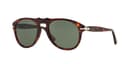
What you are actually paying Persol for
Four things, and they are worth separating, because a substitute can deliver some of them and not others.
1. The acetate, and the labour in it. Persol’s own heritage page describes cellulose acetate passing through thirty manual processes. You cannot audit that claim, but you can see its consequence: the bevel on the rim, the thickness of the front where it meets the hinge, the depth of the Havana pattern through the sheet rather than printed on it. This is the property a good independent brand can genuinely match, because the Italian sheet makers sell to everyone. Italian acetate covers what that supply chain is, and how to tell if a frame is acetate covers the checks that work in your hands.
2. The crystal lens. Persol’s product pages state crystal — mineral glass, not plastic. Glass is far harder than the plastics used for sun lenses, which is why a Persol lens survives a decade of casual cleaning that would haze a polycarbonate one. It is also heavier and it will shatter rather than scratch under a hard impact. Two frames below are on glass; three are not. Our glass-lens roundup ranks that field in full, and lens materials explains the trade.
3. Meflecto, and the keyhole bridge. The flexing temple is patented and has no equivalent on any frame we can buy, so nothing on this page replaces it. The keyhole bridge — the notch that rests on the sides of the nose instead of across the top — is widely copied, and is worth looking for if a saddle bridge has ever pinched you. Both the RAEN and the Serengeti use one, and the keyhole bridge guide explains why it matters more than the shape of the frame for comfort.
4. Service, and the name. Luxottica’s stated warranty covers material and manufacturing defects for two years from delivery and excludes lens scratches and abuse — good, and not unusual. Beyond that you are paying for a 1917 Turin brand and for the resale value that comes with it. That is a real thing to want. It is simply not a thing a $40 frame can offer at any level of quality.
Who each pick is for
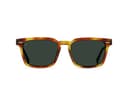
The RAEN Adin 54 is our best overall alternative because it competes on the first property rather than the fourth. RAEN states Italian cellulose acetate and 100% UV protection, the Adin is a true round in a 54 mm eye, and the finish is the part people notice when they handle one next to a mass-market frame. The honest gaps: the lens is plastic rather than glass, there is no Meflecto, and RAEN does not publish a polarization figure on this colorway, so if you need polarized lenses you should confirm the variant before you buy. Our RAEN review covers the brand.
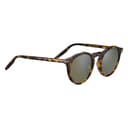
The Serengeti Raffaele is the best glass-lens alternative, and on paper it is the closest thing to a Persol on this page: Serengeti states Italian acetate, a round frame, a keyhole nose bridge, and a Mineral Polarized 555nm lens in filter category 3 — the standard bright-sun band, which the College of Optometrists puts at 8–18% light transmission. It also does something Persol does not: it polarizes the glass. The costs are weight, price close to Persol’s own, and a lens tuned for contrast that some people find too warm. Our Serengeti review and Serengeti vs Persol go further.
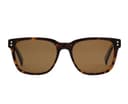
Best mid-price glass is the OTIS Test of Time X Eco. It is the cheapest route to a polarized mineral glass lens in an acetate frame that we can verify, and OTIS publishes more detail than most — 100% UVA/UVB, and an eco-acetate it states is derived from cotton seeds and plant matter. The compromises: the squared front is a different look from a 649, the frame is eco-acetate rather than Italian sheet, and glass on a budget hinge is a heavier assembly than it sounds. Our OTIS review has the range.
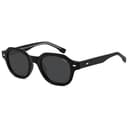
Best budget is the SOJOS Retro Polygon Round, and it is here for one specific reason: its listing claims Italian acetate, which almost nothing at this price does. It is polarized and states UV400. What it does not have is published measurements, a glass lens, or a finish that survives comparison in the hand — the edge polish and the hinge are exactly where the money went missing. Treat it as a way to find out whether a round frame suits you before spending ten times as much. Our SOJOS review and affordable acetate roundup cover the budget band properly.
Finally, the Persol 649 Original is on its own list as when to just buy the Persol, because for some buyers every alternative above is a false economy. If you want Meflecto, if you want crystal glass in a 1957 shape designed for Turin’s tram drivers, or if you want a frame an optician will still service in fifteen years, nothing here substitutes. Persol publishes the 649 in 52-20, 54-20 and 56-20, so it is also one of the few premium frames you can size confidently. Our 649 vs 714 comparison is the page to read before choosing between the two originals.
What we left off, and why
We left off every frame whose pitch is that it looks like a Persol. The marketplace is full of $25 round acetate-look frames shot at the same angle as a 649, and in a photograph they are indistinguishable. In the hand the difference is the rim bevel, the hinge, and whether the color is in the sheet or on it — none of which a listing photo can show you. Rather than rank those on resemblance, we rank on what a seller is willing to state in writing.
We also left off the obvious premium cross-shops that people name in the same breath as Persol but which are not in our registry, because we will not write a spec table for a frame we have not read a listing for. If you are shopping that tier more broadly, our designer acetate roundup is the right page, and Oliver Peoples alternatives covers the thinner, quieter end of the same market. If it is specifically the Ray-Ban comparison you are weighing, Ray-Ban vs Persol puts the two side by side.