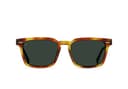
What Versace publishes, including the part that cuts against itself
Versace’s own listings give a frame material and a three-number fitting, which is more than many houses bother with, and reading them turns up one fact no dupe roundup elsewhere mentions.
Material: acetate on the core styles — but not on all of them. The Classic Top is given as an acetate frame with acetate temples and Medusa hardware. The Signature logo styles are acetate with the Versace logo on the temples. Then, read the same day: a squared Low-Bridge model given as an injected frame rather than acetate, and a Special Project pilot given as a metal frame with an acetate nose bridge. So at Versace prices you can still buy a molded frame, and the only way to know is to read the material line on the exact model. That is the same advice we give at $35, and it is the reason this site exists. Our page on acetate vs plastic covers what actually differs, and how to tell if frames are acetate covers checking a pair you already own.
Fitting: 53-18-145 on the Classic Top; 53 to 56 mm across the Signature styles. Bridges run 17 to 21 mm and temples are usually 140 mm. In plain terms: a normal-to-slightly-wide lens, a normal bridge, and temples at the short end of ordinary — most frames in our registry that publish a temple length run 140 to 150 mm, so Versace sits at the bottom of that band. If you have been buying 54-18-150 frames, these will sit a touch closer to your face. Our sizing guide explains how to read those three numbers off a pair you already have, which is the only reliable way to shop frames whose sellers publish nothing.
The Low-Bridge Fit, which is the most useful thing on Versace’s site. Versace publishes Low-Bridge Fit variants across several shapes — squared, oval and cat-eye. That is a separate frame geometry for a lower nose bridge and wider-set eyes, not a different size, and it is the single feature on this page that budget acetate almost never offers. If sunglasses slide down your nose or sit on your cheeks no matter the width, that is the fit you have been missing, and it is worth knowing that it is nearly impossible to dupe. Our guides to sunglasses for a low nose bridge and sunglasses slipping down your nose cover the workarounds that do exist.
Lens and hardware. The hardware is the brand: the Medusa head, the logo plate, the relief lettering on the temple. Those are trademarks, and they are the one property on this page that money is genuinely buying. On the lens side, read the specific listing — Versace does not state polarization uniformly across these styles, and four of our five picks are polarized, which is another of those cases where the cheaper frame carries the extra feature. Our polarized vs non-polarized guide explains what polarization does and does not do, and how to check UV protection covers reading the figure that actually matters for your eyes.
How we ranked these
Five criteria, applied in this order. Looking like a campaign image earns nothing.
1. The listing states cellulose acetate for the front, not just the temples. All five picks do — which, given that Versace itself sells an injected frame, means every pick below is on firmer material ground than one of the originals.
2. The shape matches a Versace silhouette people actually buy — the Signature Cat-Eye, the Signature Squared, the Classic Top.
3. A stated UV figure, printed by the seller rather than inferred by us.
4. Polarization where it is offered. Four of five picks have it.
5. Finish, where there is evidence for it. Only one pick publishes Italian acetate, and it is ranked last not because it is worst but because it is the most expensive and the least logo-forward — which is the opposite of what most people searching this term want.
Who each pick is for
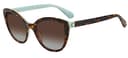
Kate Spade Amberlee — best overall. The honest answer to the impulse behind this search. If what you want is a designeracetate frame in an upswept shape, with polarized lenses and 100% UV protection stated, this is it at a fraction of luxury pricing — and it is a real designer frame rather than a copy of one, so nothing about owning it requires explanation. Honest cons: Kate Spade is a different house with a different design language, so it will not read as Versace to anyone looking for Versace; no measurements are published, so you cannot check it against the 53-56 mm range above; and the hardware is restrained where Versace’s is the entire point. Our Kate Spade review covers the brand and designer acetate sunglasses puts it in context.
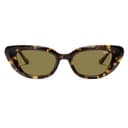
SOJOS Aria Cat-Eye — best budget. The Signature Cat-Eye look for the price of a lens cloth and lunch: cellulose acetate stated, polarized, UV400 printed on the listing. For a shape people buy on impulse and wear for a season or two, this is the rational purchase, and it is the pick we would steer most readers of this page toward on value grounds. Cons: no published measurements; visibly simpler hinges and edge polish; and the slight genericness of a silhouette sold by a dozen sellers at once. Our SOJOS reviewis candid about the brand’s ceiling and cat-eye acetate sunglasses covers the shape and the faces it suits.
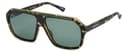
Privé Revaux Clevelander — best squared.Versace’s men’s range is squared rather than upswept — the Signature Squared and the Classic Top at 53-18-145 — and this is the clean acetate answer to it: cellulose acetate stated, polarized, 100% UV protection on the listing, and better finished than most of the budget band. Cons: no published measurements on a frame you would want to check against a 53 mm eye; a plastic lens that will scratch sooner than glass; and a deliberately plain front, where the Versace equivalent is carrying visible hardware. Our Privé Revaux review covers the brand.
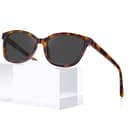
CARFIA Designer Acetate — best for a smaller face.Versace’s fittings start at 53 mm, which is already a normal-to-wide lens, and the bigger Signature styles run to 56. If a 53 mm frame has ever sat wide on you, start here: a polarized cellulose acetate frame with UV400 stated, cut smaller and softer than the rest of this page. Cons: no published measurements on a frame whose main argument is its size; a softer, rounder front than the hard squared Versace line; and a finish that is good for the price rather than designer-grade. Our CARFIA review has the detail and sunglasses for small faces covers the fit logic.
RAEN Adin 54 — best finish. The pick for a reader whose real complaint about budget frames is how they read rather than how they are shaped. RAEN states Italian acetate, and the color depth and edge polish are a visible step up from the frames above — closer to what you are actually paying for at luxury prices, minus the logo. Cons, and they are the reason it is fifth rather than first: it is the most expensive pick here; it is a round at 54 mm rather than a squared or upswept Versace shape, so it is not a lookalike and we are not presenting it as one; and it carries no decorative hardware at all. Our RAEN review covers the brand and Italian acetate covers what the phrase denotes.
What a dupe cannot copy
Three things, and on this brand the first one does more work than usual.
The hardware.More than any house on this site, Versace’s identity is metal on acetate — the Medusa head, the logo plate, the relief lettering running down the temple. Those are trademarks. A frame that reproduces them is a counterfeit rather than a dupe, and we will not link to one. It also means the gap between a dupe and the original is more visible here than it is for a plain luxury rectangle: you can match an acetate front easily, and you cannot match the one feature people recognize across a room.
The Low-Bridge Fit. Covered above, and worth repeating because it is the rare case where the expensive frame offers something functional that the cheap one does not. A separate frame geometry costs tooling, so budget sellers do not build it. If that is your fit, a dupe is not a substitute and we would rather say so than sell you one.
The finishing and the service. Luxury acetate goes through far more tumbling and hand-polishing, which shows at the rim edge and the endpiece, and a luxury frame comes with a warranty and a repair path where a marketplace frame comes with a return window. We make the ranked version of that argument on cheap sunglasses that look expensive and the honest both-ways version on are expensive sunglasses worth it.
The injected-frame problem, and why it matters more than the price gap
This deserves its own section, because it reframes the whole question people are asking when they search for a dupe.
The usual assumption is that the luxury frame is the real material and the cheap frame is the compromise. On the pages we read, that is not reliably true. Versace’s own catalog contains a squared Low-Bridge model given as an injected frame and a pilot given as metal with an acetate nose bridge, sitting alongside Classic Top and Signature styles given as acetate front and temples. Every pick on this page states cellulose acetate for the front.
So the material question does not track price — it tracks the specific model, at every price. What price tracks is finishing, hardware, fit options and service, which are real things and worth money to some buyers. What it does not reliably buy is the substance of the frame. The practical rule is the same one we would give at any budget: read the material line on the model you are actually buying, not the brand page, and if a seller will not state it, treat that silence as the answer. That is the whole thesis of why acetate sunglasses are expensive, which breaks the cost down stage by stage.
What we left off, and why
We left off every listing with “Versace” in its title. Those are either counterfeits or marketplace sellers borrowing a trademark for search traffic, and both are bad purchases for the same two reasons: you have no idea what the frame is made of, and the listing is one complaint away from disappearing along with your returns window.
We left off the metal pilot. Versace publishes a Special Project pilot as a metal frame with an acetate nose bridge at 63-12-145, and our registry has no metal frames, because this is an acetate publication. Saying so is more useful than quietly ranking an all-plastic frame against a metal one.
And we left off the crystal and jewel-set styles entirely. Applied stones are decoration, not construction, and nothing honest in the budget band reproduces them — the cheap versions use glued plastic that comes away. If that detail is what you want, a dupe will disappoint you more than usual.
If it is a different house you are after, four neighbors are built the same way — the target brand’s published specs first, then our frames ranked against them: Gentle Monster dupes for the oversized square, Prada dupes for the squared Symbole front, Tom Ford dupes for the heavy oversized square, and Miu Miu dupes for the low-profile rectangle. If the frame you are replacing is a molded fashion one rather than a luxury one, QUAY alternatives makes the material argument at the same money.
Two more houses publish their fittings, and both pages are built on the figure the house exposes rather than on its outline. Our Dior dupespage is built on the bridge, which runs 17 to 22 mm across Dior’s line, and finds the same injected-versus-acetate inconsistency this page finds at Versace — one model sold as bio-acetate with no standard named. Our Coach dupes page is built on lens height, 25 to 48 mm, which is the one figure that tells you whether a narrow front is wearable.