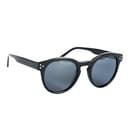
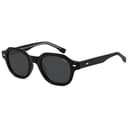
The three things no seller tells you under $50
1. The size.Not one of these six frames publishes a lens width, bridge width or temple length. That is not a flaw in the selection — it is the state of fashion eyewear, where listings publish colorways and omit millimetres. The practical consequence is that you are buying on photographs and shape names, so the single most useful thing you can do before ordering is measure your own face: temple to temple, just in front of the ears, then halve it and subtract about 10 to 11 mm for a bridge. A 125 mm face wants roughly a 52 mm lens; a 135 mm face wants 56 mm. Our sunglasses sizing guide and how to measure your face shape cover the method. Where a seller does state a small-face design — as CARFIA does on two models — that is worth more than our guess from an image, and the ranking reflects it.
2. How dark the lens is.None of the six states a filter category. Lens darkness is graded 0 to 4 by how much visible light passes — category 0 passes 80 to 100%, category 1 passes 43 to 80%, category 2 passes 18 to 43%, category 3 passes 8 to 18% and category 4 passes 3 to 8% — and in this band nobody prints the number, so you cannot compare two pairs except by eye. Our filter categories guide explains what each band feels like outdoors.
3. What happens in two summers.Cheap frames fail at the hinge more often than anywhere else, and at $25 to $50 a replacement usually costs less than a repair. That is a legitimate way to buy sunglasses — it is just worth deciding on purpose rather than discovering it. Our acetate frame hinges page explains which hinge types last and do acetate frames turn yellow? covers the other way a budget frame ages.
What you CAN have under $50, and it is more than you think
Real cellulose acetate, on every pick.All six state it — one of them states Italian acetate and another states a bio-acetate. That matters for three concrete reasons rather than snobbery: acetate is thermoplastic, so an optician can warm the temples and bend them to your head, which is the single best fix for a frame that slides; the colour runs through the sheet, so a scuff does not reveal a different layer underneath; and it is the frame material least associated with contact reactions on skin. See what acetate is, Italian acetate and how to tell if a frame is acetate.
Stated polarization, on every pick. All six state polarized lenses, and the claim is easy to check once the parcel arrives: hold the lenses in front of a white LCD screen and rotate the frame about 90 degrees. A polarized lens darkens markedly at one angle; an unpolarized tinted lens does not change. Full method in how to tell if sunglasses are polarized.
A stated UV figure — on five of the six. Five picks state UV400. The exception is the CARFIA small-face double bridge in black: its listing states no UV level at all, and we record that rather than inferring one from the brand’s other models, which do state UV400. Treat it as the frame to buy for the fit and the material, not for a protection claim. This is also the part where price genuinely does not buy you more: the UV filter is the cheap part of a lens, it does not wear out the way a mirror coating does, and a $25 frame that prints UV400 is making the same claim as a $300 one. Our best UV400 sunglasses page ranks the whole registry on exactly how precisely each seller words that claim, and how to check UV protection explains why you cannot test it at home.
One genuine bio-acetate option. The Earthly Ones round states Eco Bio-Acetateon the frame at about $40, which is unusual at this money — most bio claims in this band are vague. Note what bio-based does and does not mean: it describes the feedstock, not biodegradability, and nobody on this page claims the frame breaks down. See what bio-acetate is and best bio-acetate sunglasses.
Picking a shape when the listing will not give you a size
With no millimetres to work from, shape is the lever you have. Here is the short version of what each pick is for.
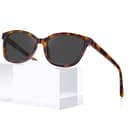
A soft square or rounded rectangle is the safest shape in eyewear. It follows the brow line, it adds no width at the temples, and it flatters round, oval and heart-shaped faces without reading as a statement. That is why the top pick is one.
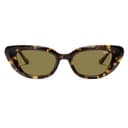
A cat-eyelifts the outer corner and adds angle, which balances a rounder or softer jaw. The cat-eye here is deliberately the softened version rather than a full flick — the strongest upswept shape in our registry sits on the no-ceiling page instead. See cat-eye frames.
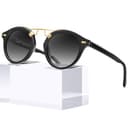
A double bridge on a smaller frameis the answer if sunglasses slide down your nose. The second bar spreads the frame’s contact instead of concentrating its weight on one small saddle, which is what sliding actually is. See double bridge sunglasses and best small sunglasses.
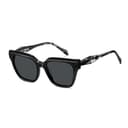
An oversized squarebuys coverage as well as drama — more lens area means less light around the edges. The pick here states acetate for the frame and the temples, which is rarer in this band than the photographs suggest. See oversized acetate sunglasses.
A round is the most shape-neutral option and the cheapest way to try a silhouette before committing to it, which is exactly the job the budget pick does. See round frames. If you want the shape decided properly first, our face-shape pages for round, oval, square and heart-shaped faces each rank frames for that face.
Why two picks are sold as unisex, and why they are still here
Four of the six frames are listed as women’s by their own seller. Two — the bio-acetate round and the budget round — are listed as unisex, and we would rather say that than quietly relabel them.
They earn their slots on specifics rather than on filling a gap. The budget pick is the cheapest frame in our registry stating Italian cellulose acetate, polarized lenses and UV400 together, and a round is one of the most genuinely shape-neutral silhouettes in eyewear because a circle emphasises neither brow nor cheekbone. The bio-acetate pick is the only frame under $50 we track that names a bio-based material on the frame rather than gesturing at sustainability in the marketing copy.
The honest caveat is sizing, as always: neither publishes a measurement, and a frame cut to sit in the middle of the adult range can read large on a small face. If that is a risk you would rather not take, the four women’s-labelled frames above are all under $50 and all state a women’s fit. Our best unisex sunglasses page covers what the label does and does not mean on a spec sheet.
How we ranked these six
A stated women’s fit first.Four of the six are listed as women’s by their own seller; two are listed as unisex and their cards say so. We did not relabel anything to fill a slot.
Then a stated material.All six state cellulose acetate or bio-acetate, and where the statement is more specific than that — Italian acetate, or acetate for the frame andtemples — the ranking gives credit for the precision.
Then stated polarization, which all six carry, and then a stated UV figure, which five of six carry. The one that states nothing is ranked below the frames that do, and the gap is named on its card and in the prose above rather than left for you to discover.
Then shape coverage, so the page answers more than one face: a soft square, a softened cat-eye, a small-face double bridge, an oversized square, a bio-acetate round and a budget round. Then price, spread from about $25 to just under $50.
For the no-ceiling version of this list see acetate sunglasses for women; for the same ceiling without the women’s filter see polarized sunglasses under $50 and affordable acetate sunglasses; and if you are buying in late November, Black Friday sunglasses deals explains how to tell a real discount from a reset list price.