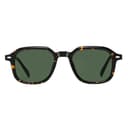
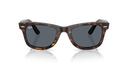
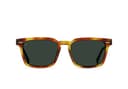
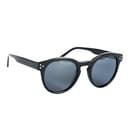
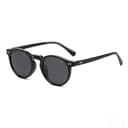
The two numbers that decide whether a frame is actually unisex
Forget the word and read the fitting. A frame fitting is three numbers — lens width, bridge width, temple length — and two of them do the work here.
Lens widthis the single best proxy for how wide a frame sits. Adult faces mostly take something between about 48 mm and 58 mm per lens, and the middle of that band, roughly 50 to 54 mm, is where a frame stops reading as cut for a particular face. Ray-Ban publishes the RB2140 in this page’s variant at 50 mm; RAEN publishes the Adin at 54 mm. Those two picks sit at either end of the neutral band, which is why one works better on a smaller face and the other on a larger one, and why we have not pretended a single frame suits everyone.
Temple length decides comfort rather than looks. A short temple on a larger head pulls the frame forward and leaves marks behind the ears; a long temple on a smaller head slides. Almost nothing in the budget market publishes it. Our sunglasses sizing guide explains how to read a 52-18-145 stamp and how to measure your own, and how should sunglasses fit covers what a correct fit feels like rather than looks like.
The honest finding for this page: three of our five picks publish no measurement at all.That is not a flaw in the selection, it is the state of the market — fashion listings publish colorways and omit millimetres. Where nothing is stated the card says so, and the shape argument has to carry the pick.
Which shapes actually read neutral
Shape is the half of the unisex claim that cannot be measured, so here is the reasoning rather than a number.
Rectangles and soft squares are the most neutral shapes in eyewear. They follow the brow line, they do not add width at the temples, and they have been sold to everyone for decades. The SOJOS Acetate Rectangle is here for exactly that. Rectangle frames and square frames go deeper on the difference, which is mostly lens depth.
The wayfareris the other genuinely shared shape — an angular trapezoid that was never marketed as men’s or women’s eyewear, which is half the reason it has outlasted everything around it. See wayfarer frames.
Round frames are neutral in a different way: they read as intellectual or vintage rather than gendered, and because they are symmetrical in both axes they do not emphasise brow or cheekbone. Two picks here are round, at opposite ends of the price range. See round frames.
What does notread neutral, whatever a listing says: a deep cat-eye, a true oversized frame, and a sport wrap. Those are all legitimate frames and we rank them elsewhere — cat-eye and oversized— but putting them on a unisex page would be padding it.
Buying one pair to share: what actually goes wrong
People buy a unisex frame for a real reason — a shared pair in a car, a gift when you do not know the recipient’s taste, one frame for a couple who swap. Three things go wrong, and they are all fit, not style.
The bridge.Two faces rarely share a nose. A frame that sits correctly on a higher bridge slides down a lower one all day. If that is your situation, the answer is usually a keyhole bridge or adjustable pads rather than a different shape — see sunglasses for a low nose bridge and sunglasses slipping down your nose.
Temple spread. Here acetate has a concrete advantage over molded nylon, and it is the reason four of these five picks are acetate frames. Cellulose acetate is a thermoplastic: warm it and it bends, and it holds the new shape. An optician can widen or narrow the temples in a few minutes, so one frame can actually be fitted to two heads in turn. Molded TR-90 springs back to the shape it was injected in. Our pages on adjusting acetate frames and acetate vs TR90 cover that honestly, including where nylon wins.
Lens darkness. If one of you drives at dusk and the other wants the darkest lens available, a shared pair is the wrong purchase and no amount of unisex labelling fixes it. Two cheap pairs beat one shared pair here, which is part of why the budget pick at about $14 is on this page at all.
How we ranked these five
Stated unisex audience first.Every pick is listed as unisex by its own seller. We did not relabel a women’s or men’s listing as unisex to fill a slot, which is why some obvious budget frames are absent.
Then a stated material.Four of the five state cellulose acetate or bio-acetate. That matters on a shared frame for the adjustability reason above, and because acetate is the frame material least likely to cause a contact reaction on skin — relevant when two people wear the same pair. See hypoallergenic sunglasses.
Then stated protection. Four state UV400 or 100% UV; the cards quote the exact wording. Best UV400 sunglasses ranks the whole registry on that question alone.
Then price spread, deliberately. One frame at about $14, three between $35 and $135, one at $191. A shared frame that gets dropped in a footwell is a different purchase from a frame you keep for a decade, and we have not pretended one price answers both. For the gendered versions of this page, see acetate sunglasses for men and acetate sunglasses for women.