What polarization actually does, and what it does not
A polarizing filter blocks light waves oscillating in one plane. Light reflected off a flat horizontal surface — water, wet asphalt, a car hood, snow — comes back strongly polarized in that plane, so the filter removes most of it. That is why polarized lenses kill the hard white sheen on a lake and leave the rest of the scene looking normal.
Three things it is not. It is not UV protection: the two are independent, and a polarized lens with no UV filter would be legal to sell and bad for your eyes. It is not darkness: a polarized lens can be light or very dark, and the filter category scale that describes darkness runs separately. And it is not always an upgrade. A polarizing filter interacts with LCD screens, so it can black out a car dashboard, a phone at the wrong angle or an aircraft instrument panel, and some people find it affects depth perception on uneven ground. Our polarized vs non-polarized guide covers both sides, and non-polarized sunglasses is the page for when you specifically do not want it.
How to verify a polarization claim yourself in ten seconds
Under $50 the claim is worth checking, and you can check it without equipment.
The screen test. Put the lenses in front of an LCD screen showing a white page, then rotate the frame roughly 90 degrees. A polarized lens darkens markedly or goes near-black at one angle. An unpolarized tinted lens stays the same brightness all the way round.
The two-lens test. If you own another polarized pair, hold the two lenses face to face and rotate one. Where both are polarized you get a dark cross at 90 degrees.
The reflection test. Look at a bright reflection on glass or water, then tilt your head sideways. Polarized lenses let the glare back in as you tilt. Full method in how to tell if sunglasses are polarized.
What you cannottest at home is UV filtering. There is no household method; it takes an optician’s photometer. So treat the stated UV figure as a claim you are trusting the seller on, and prefer the sellers who print a specific one — see best UV400 sunglasses and how to check UV protection.
Acetate or polycarbonate under $50: an honest split
This is the real decision in this price band, and the answer depends on what you are doing.
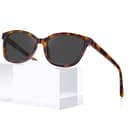
Cut cellulose acetate is a sheet material. It can be heat-adjusted by an optician so a frame that nearly fits can be made to fit, it takes deep layered colour (a real tortoise rather than a printed one), and it is the frame material least associated with contact reactions. It chips rather than flexes, and it relaxes if you leave it on a hot dashboard. Three picks here are stated acetate. See what acetate is and how to tell if a frame is acetate.
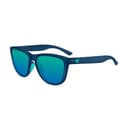
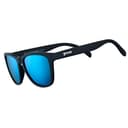
Molded polycarbonate and TR90are injected materials. They flex and spring back, which is why they dominate sport eyewear, they are lighter, and they survive a gym bag. They cannot be heat-adjusted, and the colour is surface-level. Two picks here are stated polycarbonate — both Knockaround and goodr say so on their own pages, and we are not going to relabel them acetate to fit this site’s name. See acetate vs polycarbonate and acetate vs TR90.
The practical rule: if the frame will live on your face in town, buy acetate; if it will live in a bag, a boat or a run belt, buy molded. Both are on this page on purpose.
What $50 does not buy, stated plainly
A published fitting.Not one of the six picks publishes a lens width, bridge or temple length. That is the single biggest cost of shopping this band: you are buying on photos and shape names. If a published measurement matters to you, the cheapest frames in our registry that print one start around $45 — see sunglasses for men under $100 and sunglasses sizing.
A filter category figure. None of the six states one, so you cannot compare how dark they are except by eye. See filter categories.
Mineral glass.Every lens in this band is plastic. Glass starts around $145 in our registry — see glass lens sunglasses.
A serviceable hinge, reliably. Cheap frames fail at the hinge more often than anywhere else, and at $14 to $40 a replacement is usually cheaper than a repair. Our acetate frame hinges page explains which hinge types survive.
How we ranked these six
Stated polarization first. Every pick is stated polarized by its own seller. We did not infer polarization from a dark lens or a product photo, which rules out a good deal of this price band.
Then a stated frame material.Acetate, polycarbonate or a named combination — stated, with the exact wording on the card. One pick, the Joopin, is a TR90 front with acetate temples, which is a combination and labelled as one.
Then a stated UV figure, then shape coverage so the page answers more than one face: a rectangle, two squares, a round, a soft square for a smaller face and an oversized. Then price, deliberately spread from about $14 to just under $50.
If you are buying in late November, our Black Friday sunglasses deals page explains how to tell a real discount from a reset list price, and sunglasses gifts under $50 covers the same band as a gift rather than a purchase.