Acetate Club

Best Green Lens Sunglasses

G-15 and Persol's crystal green are the two oldest tints in eyewear and still the most color-neutral. The five frames whose sellers actually state a green lens, from $14 to $363.

By Stephen V.Last updated How we pick

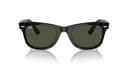
Our pick is the Ray-Ban Original Wayfarer RB2140in Polished Tortoise with the G-15 green lens — the tint Ray-Ban made standard, on the acetate model of the Wayfarer family, in the pairing most people picture when they picture sunglasses. Ray-Ban publishes it in two fittings (50-22 with a 41 mm lens height and 54-18 with a 47.2 mm height), so you can measure before you buy. If you want the same tint in glass rather than plastic, the Persol 649 pairs its Havana acetate with crystal green lenses and Italian manufacture. The budget pick is the Gleyemor Vintage Round at about $14, which states hand-crafted acetate and a G15 green lens — the cheapest honest way to try the tint.

Green is the tint with the longest history in eyewear and the least marketing around it, which is why it is worth a page. G-15 is a grey-green that darkens the scene without pushing colors around much; Persol's crystal green is a glass lens in a similar family. Everything below has a listing or brand page that states a green lens— nothing is here because a product photograph looked green, which is a real problem in this category because tint renders differently in every product shot. Where a seller does not publish a measurement or a filter category, the card says not published, and prices are live and dated on every button.

How this is funded: we earn a commission if you buy through our links, at no extra cost to you. It never changes which product we recommend, and we’ll tell you when we’d skip one. Full disclosure.

Quick picks

Ranked on frame material, fit and value. Select a row to jump to the full write-up. We have not handled these frames in person — here is exactly what we do instead.

#ProductBest forPrice
1
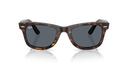
Ray-Ban Original Wayfarer RB2140

Ray-Ban Original Wayfarer RB2140

The frame that defined acetate eyewear, and still the benchmark. The RB2140 is thick cellulose acetate cut in the original 1950s shape — the Havana colorway is real layered tortoiseshell, not a printed pattern. If you buy one acetate frame for life, it's this.

Best overall
$133.70 · View on Amazon

$191.0030% off

Price as of November 21, 2026. #ad How we’re funded

2
Ray-Ban Original Wayfarer RB2140 (Black / G-15 Green, 50 mm)

Ray-Ban Original Wayfarer RB2140 (Black / G-15 Green, 50 mm)

If you want black acetate and you only want to decide once, this is the frame. It is the RB2140 — the acetate Wayfarer, not the nylon one — in the original black with the G-15 green crystal lens, at the smaller 50 mm eye size. Black is where this shape is least forgiving and most recognizable: there is no tortoise pattern doing the work, so the cut of the acetate and the thickness of the front are all you see.

Best in black
3
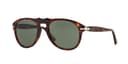
Persol 649 Original PO0649 (Havana / Green, 54 mm)

Persol 649 Original PO0649 (Havana / Green, 54 mm)

The original Persol icon, and the better buy of the two for most people. It is the same Havana pilot shape as the folding 714, with the Meflecto temples Persol names in its own description, a wider size range and a clearly lower price. Unless you will actually carry your sunglasses folded, this is the one.

Best glass lens
$363.00 · View on Amazon

Price as of November 21, 2026. #ad How we’re funded

4
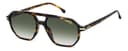
Carrera 341/S (Havana Gold, Pilot Double Bridge, 54 mm)

Carrera 341/S (Havana Gold, Pilot Double Bridge, 54 mm)

The smallest and priciest of the three, and the one that answers the obvious objection to an acetate pilot: at 54 mm it is cut for a normal face rather than the oversized aviator proportion. Carrera states acetate front and temples here, with a metal insert running back to the temples — read that as a design line, not an all-acetate frame.

Best mid-price
$108.21 · View on Amazon

Price as of November 21, 2026. #ad How we’re funded

5
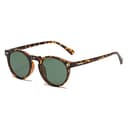
Gleyemor Vintage Round (Tortoise Acetate)

Gleyemor Vintage Round (Tortoise Acetate)

The same hand-crafted acetate round in tortoise with a G15 green lens — the most classic pairing in eyewear. It isn't a Persol and doesn't pretend to be, but a stated-acetate frame in a proper vintage colorway at this price is a lot of frame for the money.

Best budget
$11.19 · View on Amazon

$13.9920% off

Price as of November 21, 2026. #ad How we’re funded

The picks in full

#1Best overall

Ray-Ban Original Wayfarer RB2140

The frame that defined acetate eyewear, and still the benchmark. The RB2140 is thick cellulose acetate cut in the original 1950s shape — the Havana colorway is real layered tortoiseshell, not a printed pattern. If you buy one acetate frame for life, it's this.

Strengths

  • Genuine thick cellulose acetate — the Havana is layered tortoise, not a flat print
  • The reference wayfarer shape; angular lines add definition to a round or oval face
  • Ray-Ban lenses carry full UV protection and the frame is endlessly serviceable

Who should skip it

  • This classic variant is not polarized — you pay extra for the polarized version
  • The deep 1950s fit sits large on very small faces
Frame materialCellulose acetate
Frame shapeWayfarer
Lens protection100% UV protection (per Ray-Ban)
PolarizedNo
Lens width50 mm
Suits face shapesOval, Round, Heart

Spec note. The Original Wayfarer (RB2140) is the acetate model in the Wayfarer family; the lighter New Wayfarer (RB2132) is listed by Ray-Ban as nylon. If you specifically want acetate, the 2140 is the one.

Specs and material read from the product listing, on July 21, 2026. “Not published” means the seller does not state that figure.

#2Best in black

Ray-Ban Original Wayfarer RB2140 (Black / G-15 Green, 50 mm)

If you want black acetate and you only want to decide once, this is the frame. It is the RB2140 — the acetate Wayfarer, not the nylon one — in the original black with the G-15 green crystal lens, at the smaller 50 mm eye size. Black is where this shape is least forgiving and most recognizable: there is no tortoise pattern doing the work, so the cut of the acetate and the thickness of the front are all you see.

Strengths

  • The RB2140 is the acetate model in the Wayfarer family; Ray-Ban lists the lighter RB2132 New Wayfarer as nylon
  • Ray-Ban publishes this one in the 50 mm eye size, which is the smaller of the two 2140 fittings
  • G-15 green is the original Ray-Ban tint — it darkens the scene without pushing colors around

Who should skip it

  • This classic Black / G-15 variant is not the polarized one; Ray-Ban charges more for that
  • Gloss black acetate shows dust, fingerprints and the first scratch far more than a patterned frame
  • At 50 mm it is the small 2140 — a wide face wants the 54
Frame materialCellulose acetate
Frame shapeWayfarer
Lens protection100% UV protection (per Ray-Ban)
PolarizedNo
Lens width50 mm
Suits face shapesOval, Round, Heart

Spec note. Ray-Ban publishes the RB2140 in 50-22 and 54-18; this listing is the 50 mm, which pairs the smaller lens with the wider 22 mm bridge. The Black / G-15 Green is the classic non-polarized combination — Ray-Ban sells polarized G-15 and polarized grey versions of the same frame under their own names, so read the title before you buy.

Specs and material read from the product listing, on October 11, 2026. “Not published” means the seller does not state that figure.

#3Best glass lens

Persol 649 Original PO0649 (Havana / Green, 54 mm)

The original Persol icon, and the better buy of the two for most people. It is the same Havana pilot shape as the folding 714, with the Meflecto temples Persol names in its own description, a wider size range and a clearly lower price. Unless you will actually carry your sunglasses folded, this is the one.

Strengths

  • Persol lists the Havana / Green in 52-20, 54-20 and 56-20 — the only one of the pair offered in a 56
  • Persol names the Meflecto flexible temples, the keyhole bridge and the arrow in the model's own description
  • Acetate frame and crystal lenses per Persol's spec panel, handmade in Italy

Who should skip it

  • Premium money, even as the cheaper of Persol's two pilot icons
  • The standard Havana / Green is not polarized; Persol's polarized versions cost more
  • It does not fold, so it needs a full-size case — the one thing the 714 does that this cannot
Frame materialAcetate, handmade in Italy (per Persol)
Frame shapeAviator
Lens protection100% UV protection (per listing)
PolarizedNo
Lens width54 mm
Suits face shapesOval, Square, Heart

Spec note. Persol's spec panel for the Havana / Green lists an acetate frame, crystal lenses and Italian manufacture, with a 54-20 fitting and 140 mm temples. Persol dates the model to 1957, when it was designed to protect Turin's tram drivers from dust and glare.

Specs and material read from the product listing, on September 15, 2026. “Not published” means the seller does not state that figure.

#4Best mid-price

Carrera 341/S (Havana Gold, Pilot Double Bridge, 54 mm)

The smallest and priciest of the three, and the one that answers the obvious objection to an acetate pilot: at 54 mm it is cut for a normal face rather than the oversized aviator proportion. Carrera states acetate front and temples here, with a metal insert running back to the temples — read that as a design line, not an all-acetate frame.

Strengths

  • Carrera states acetate front and acetate temples, with a published 54-17-145 fitting
  • A pilot double bridge at 54 mm — most pilots in this shape run far wider
  • Carrera advertises 100% UV protection, and the model is offered prescription-ready

Who should skip it

  • A metal insert runs to the temples, so this is a combination frame rather than all-acetate
  • The most expensive of the three Carreras here, for the smallest frame
  • Polarization is not stated on the colorway we read, and the 54-17-145 fitting was published on the Black Gold variant while this ASIN is Havana Gold
Frame materialAcetate front with acetate temples, with a metal insert to the temples (per Carrera)
Frame shapeAviator
Lens protection100% UV protection (per Carrera)
PolarizedNot published
Lens width54 mm
Suits face shapesOval, Square, Heart

Spec note. Carrera describes the 341/S as a pilot with a double bridge and a metal insert running to the temples, offered in versions with mirrored lenses or multi-layer temples and fittable with prescription lenses; the Black Gold colorway page publishes 54-17-145 with an acetate front and acetate temples, and the Havana Gold page states acetate front and temples with green shaded lenses but no dimensions. The Amazon listing title for this ASIN states 54/17/145, which is consistent with the Black Gold figures and is how the fitting is recorded here.

Specs and material read from the product listing, on November 1, 2026. “Not published” means the seller does not state that figure.

#5Best budget

Gleyemor Vintage Round (Tortoise Acetate)

The same hand-crafted acetate round in tortoise with a G15 green lens — the most classic pairing in eyewear. It isn't a Persol and doesn't pretend to be, but a stated-acetate frame in a proper vintage colorway at this price is a lot of frame for the money.

Strengths

  • Stated hand-crafted acetate in the classic tortoise and G15 green combination
  • Polarized and UV400 both stated at the very bottom of the price range
  • The soft vintage-round shape softens a square or angular face

Who should skip it

  • Color depth looks flat next to a mid or premium acetate — expect value, not richness
  • No published measurements, so check the fit if you have a narrow face
Frame materialCellulose acetate (hand-crafted, per listing)
Frame shapeRound
Lens protectionUV400
PolarizedYes
Lens widthNot published
Suits face shapesSquare, Oval

Spec note. A G15 lens is the gray-green tint Ray-Ban made standard; it darkens the scene without shifting colors much, which is why it pairs so consistently with tortoise frames.

Specs and material read from the product listing, on August 19, 2026. “Not published” means the seller does not state that figure.

What G-15 actually is

G-15 is a grey-green lens tint. Ray-Ban publishes it by name on its own product pages for the Original Wayfarer, in both the Polished Tortoise and the Black colorways, and it has been the brand's default tint for decades. The practical description is narrow and worth getting right: it is a neutral-leaning filter that cuts brightness while shifting the color of the scene relatively little, which is why a green lens is the one most often paired with a warm tortoise frame — the frame supplies the warmth and the lens stays out of the way.

Persol's crystal green is a different thing wearing a similar color. “Crystal” in Persol's language means mineral glass rather than plastic, and the 649's product page gives the frame as acetate with crystal lenses, made in Italy, in 52-20, 54-20 and 56-20 fittings. Glass resists scratching far better than any plastic lens and weighs more; on a 54 mm front that is a trade you notice by the end of a day. Our lens materials guide sets out what each one gives up, and the glass-lens roundup ranks that category on its own terms.

Tint color and lens darkness are two different settings

This is the confusion the category runs on, and it is worth separating before you buy anything. Tintis the color of the filter — green, grey, brown, amber. Darknessis the filter category, a standardized 0 to 4 scale describing how much visible light gets through: category 0 transmits 80–100%, category 1 is 43–80%, category 2 is 18–43%, category 3 is 8–18% and category 4 is 3–8%. A green lens can be any of those. Two frames can both say “green” and differ by a factor of five in how much light they stop.

The practical consequence: for road use, filters shall be categories 0 to 3, and anything transmitting under 75% is unsuitable for twilight or night driving — which rules out essentially every real sunglass lens after dark, green included. Our guides to filter categories and night driving cover that properly.

And the third setting, independent of both: UV protection. The FDA's point is that you cannot judge a lens by how it looks — darkness is not a measure of UV filtering, and neither is color. Read the stated figure instead. Every card here prints the UV claim the seller actually makes and leaves it blank where no claim exists. Our explainer on how to check UV protection covers what to look for on a label, and UV400 explained defines the figure itself.

Green vs grey vs brown

All three are legitimate general-purpose tints and the differences are smaller than the marketing suggests.

Grey is the most neutral of the three: it reduces brightness with the least color shift of any tint, which is why it is the default on most sport and driving lenses. If your priority is seeing colors as they are, grey is the conservative answer.

Brown and amberwarm the scene and lift contrast, which many people prefer in variable or flat light. The trade is a visible color shift — useful outdoors, distracting if you are judging color. Our direct comparison of brown vs grey lenses works through it.

Greensits between them, which is exactly why it has lasted: it darkens like a grey and keeps a little of the warmth of a brown. There is nothing mystical about it, and we are not going to tell you it “enhances contrast” or “sharpens vision” — nobody in this category publishes a transmission curve, and we do not run optical tests. What we can say is what the sellers state and what the filter-category bands mean. For the broader picture, lens tint colors is the overview page.

How we ranked these five

First, is the green lens stated? That is the entry requirement, and it eliminates most of the category. Ray-Ban names G-15 on its own pages for both Wayfarer colorways here. Persol gives the 649 as Havana with green crystal lenses. Carrera's Havana Gold page for the 341/S states green shaded lenses (and does not publish dimensions for that colorway, which is why the card carries the fitting from the Black Gold page and the listing title instead, and says so). The Gleyemor listing states a G15 lens.

Second, what the frame is.This is an acetate site, and the material line decides the ranking among frames that make the same lens claim. The two Ray-Bans are cellulose acetate — and specifically the RB2140, which is the acetate model in the Wayfarer family; Ray-Ban lists the lighter RB2132 New Wayfarer as nylon. The Persol is acetate handmade in Italy. Carrera's 341/S is an acetate front and acetate temples with a metal insert running to the temples, which is a combination frame and is stated as such on the card.

Third, polarization — and here the news is mostly bad. The classic green variants of these frames are generally not polarized. Ray-Ban charges more for the polarized versions of the same frames; the standard Persol Havana / Green is not polarized either; Carrera does not state polarization on the 341/S at all. Only the Gleyemor budget pick states polarized. If polarization is non-negotiable, start from polarized acetate sunglasses instead, and read polarized vs non-polarized for what you are actually choosing between. Our non-polarized roundup makes the case for the other side, which is a real case rather than a consolation prize.

Who should skip a green lens

Anyone who needs maximum neutrality — grey is the better choice for judging color. Anyone shopping primarily on contrast in flat light, where brown and amber are the conventional answer. And anyone buying for driving who wants one pair for day and dusk: no category 3 lens of any color is suitable after dark, so the tint is not the variable to optimize. If you are buying specifically for the road, acetate sunglasses for driving is ranked for that, and mirrored vs gradient lenses covers the other treatment decision you will be offered.
Frequently asked questions

What are the best green lens sunglasses?

The Ray-Ban Original Wayfarer RB2140 in Polished Tortoise with the G-15 green lens. G-15 is the grey-green tint Ray-Ban made standard and names on its own product pages, the RB2140 is the acetate model in the Wayfarer family rather than the nylon RB2132, and Ray-Ban publishes two fittings - 50-22 with a 41 mm lens height and 54-18 with a 47.2 mm height. For the same tint in glass, the Persol 649 pairs Havana acetate with crystal green lenses. The Gleyemor Vintage Round at about $14 is the budget answer and states both acetate and a G15 lens.

What is a G-15 lens?

A grey-green lens tint that Ray-Ban made its default and still names on its product pages. It darkens the scene while shifting the color of what you see relatively little, which is why it pairs so consistently with warm tortoise frames - the frame supplies the warmth and the lens stays out of the way. G-15 describes the color of the filter, not how dark it is; darkness is the separate filter-category rating.

Are green lenses better than grey or brown?

No - they are a different balance, not a better one. Grey is the most neutral and shifts color least, which is why it dominates sport and driving lenses. Brown and amber warm the scene and lift apparent contrast, at the cost of a visible color shift. Green sits between the two, which is the reason it has lasted. We will not claim a green lens sharpens vision or enhances contrast: nobody in this category publishes a transmission curve, and we run no optical tests.

Do green lenses block more UV?

No. Tint color and UV protection are set independently, and so is darkness. The FDA's guidance is that you cannot judge a lens by how it looks - a dark lens is not necessarily a UV-filtering one, and neither is a green one. Read the stated UV figure on the listing, which is what every card on this page prints, with a blank where the seller makes no claim.

Are green lens sunglasses polarized?

Usually not, in the classic versions. Ray-Ban sells polarized G-15 as a separate, more expensive variant of the same frame; the standard Persol Havana / Green is not polarized; Carrera does not state polarization on the 341/S at all, so that card reads 'not published'. Of the five picks here only the Gleyemor budget frame states polarized in its listing. Read the product title carefully - the polarized and non-polarized versions often share a model name.

Can I drive at night in green lens sunglasses?

No, and that is not about the color. Filters for road use shall be categories 0 to 3, and any lens transmitting less than 75% of visible light is unsuitable for twilight or night driving - which excludes essentially every real sunglass lens regardless of tint. A category 3 green lens transmits between 8% and 18%. For driving generally, our acetate-for-driving roundup is ranked on that use, and our night-driving guide covers what to do instead.

Sources

  • Ray-Ban — Original Wayfarer Classic RB2140, Polished Tortoise / G-15 Green (50-22) — Ray-Ban's listing for the 50 mm Original Wayfarer: 50-22 fitting, 41 mm lens height, 150 mm temples, acetate frame, G-15 green lens (accessed September 18, 2026)
  • Ray-Ban — Original Wayfarer Classic RB2140, Polished Tortoise / G-15 Green (54-18) — Ray-Ban's listing for the 54 mm Original Wayfarer: 54-18 fitting, 47.2 mm lens height, 150 mm temples, acetate frame, G-15 green lens (accessed September 18, 2026)
  • Ray-Ban — New Wayfarer Classic RB2132, Polished Black / G-15 Green (52-18) — Ray-Ban's listing for the New Wayfarer: frame material given as nylon, square shape, 52-18 and 55-18 fittings with 145 mm temples, lens height 37.6 mm at 52-18 and 40.8 mm at 55-18 (a 58-18 Color Mix variant is also listed), plus an RB2132F low-bridge version in 55-18 (accessed October 5, 2026)
  • Persol — 649 Original, Havana frame with green lenses (PO0649 24/31) — Persol's product page: 52-20, 54-20 and 56-20 sizes; acetate frame, crystal lenses, made in Italy; keyhole bridge, arrow and Meflecto; designed in 1957 for Turin's tram drivers (accessed September 15, 2026)
  • Persol — Heritage: frame material, bridge, Meflecto and Arrow — Persol on its Turin origins (1917), cellulose acetate passing through thirty manual processes, the Meflecto flexible stem patented in the 1930s, and the arrow-shaped hinge (accessed September 15, 2026)
  • Carrera — sunglasses (official product pages) — Carrera's own product pages, used as the MATERIAL provenance for the three Carrera registry entries, because the Amazon listing titles state the fitting but not the frame material and Carrera sells injected frames alongside acetate ones. 329/S: full-rim geometrical (octagonal) frame, acetate front and acetate temples, 58 mm lens / 18 mm bridge / 145 mm temple, grey shaded gold mirror gradient NON-polarized lens, UV protection 100, supplied with a storage case. 317/S: square double-bridge navigator, acetate front with metal inserts on each side, 55-20-150, gradient lens treatment, UV protection 100. 341/S: pilot with a double bridge and a metal insert running to the temples, acetate front and acetate temples, 54-17-145 published on the Black Gold colorway (the Havana Gold page states acetate front and temples with green shaded lenses but no dimensions), 100% UV protection advertised on the US page, offered prescription-ready. 3017/S, read the same day and NOT featured: cat-eye, acetate front and temples, 55-19-140 in Havana, UV Protection 100, gradient treatment, filter category 3, RXAble, with metal frontal rivets and a relief C on each temple. No page read states an injection-molding process for any of these models — Carrera names the material only (accessed November 1, 2026)
  • The College of Optometrists — Tints and driving (BS EN ISO 12312-1 filter categories) — Category bands: 0 = 80-100% transmission, 1 = 43-80%, 2 = 18-43%, 3 = 8-18%, 4 = 3-8%; filters for road use shall be categories 0-3; under 75% transmittance is unsuitable for twilight or night driving (accessed September 21, 2026)
  • U.S. FDA — Tips to Stay Safe in the Sun: From Sunscreen to Sunglasses — FDA: lens darkness does not indicate UV protection; look for a 100% UV / UV400 label (accessed July 21, 2026)
  • American Academy of Ophthalmology — Recommended Types of Sunglasses — AAO on choosing sunglasses that block 99–100% of UV-A and UV-B (UV400) (accessed July 21, 2026)
  • ISO 12312-1:2022 — Eye and face protection — Sunglasses for general use — The international standard for general-use sunglasses: UV filtering, filter categories and transmittance (accessed July 21, 2026)

Keep reading