Sunglasses for Night Driving: The Honest Answer
There is no sunglass lens that belongs in a car after dark, and the reason is a single published number rather than an opinion. What that number is, why yellow 'night driving glasses' do not get around it, and what genuinely helps with dawn, dusk and low winter sun.
How this is funded:we earn a commission if you buy through our links, at no extra cost to you. It never changes which product we recommend, and we’ll tell you when we’d skip one. Full disclosure.
The honest answer is no, and we would rather say it plainly than sell you something. There is no sunglass lens — no color, no coating, no brand — that belongs in a car after dark. This is not caution; it follows from a published figure.
The College of Optometrists’ guidance on tints and driving states that filters for road use shall be categories 0 to 3, and that a filter transmitting under 75% of light is unsuitable for twilight or night driving. Now put the sunglass categories next to that threshold. Category 1 transmits 43-80% of visible light. Category 2 transmits 18-43%. Category 3 — the band almost every pair of sunglasses you own sits in — transmits 8 to 18%. A category 3 lens is roughly five to nine times too dark for the twilight threshold, and the lightest tinted lens on the market only just reaches it. That is the entire argument, and no tint color changes a transmittance figure.
If you came here because night driving has become genuinely difficult, the rest of this page explains why a lens is the wrong lever, and what the right ones are.
Why a tint cannot fix night glare
The intuition is reasonable: oncoming headlights are painfully bright, so dim them. The problem is that a tint is not selective. It dims the headlights and the unlit road, the cyclist in dark clothing, the kerb and the black ice by exactly the same proportion. The headlights remain the brightest thing in the scene — they were always going to be — and everything you actually needed to see has gone further toward invisible. Your pupils then dilate to compensate, which increases the scatter from those same headlights inside your eye. The net effect of dimming a night scene is usually worse glare discomfort and considerably less information.
This is the opposite of how a tint works in daylight, where there is plenty of light to give away and dimming it genuinely helps. The filter category system exists precisely to encode that: it is a statement about how much light you can afford to lose.
On yellow “night driving” glasses
These are sold widely and we are not going to tell you they work or that they do not, because we could not find a statement from an issuing authority that settles it, and this site does not publish claims it cannot cite — see our editorial policy. What we can do is apply the rule we can cite, which is more useful than an opinion.
The transmittance threshold does not care what color a lens is. A yellow lens light enough to transmit 75% or more of visible light is, by definition, barely tinted — you would struggle to see that it was yellow at all. Conversely, any yellow lens dark enough to visibly warm the scene and “cut” blue headlight glare is below the threshold the guidance sets for twilight driving. So the version that complies is the version that does nothing visible, and the version that does something visible does not comply. That is the shape of the trade, from the only number we can source.
There is a separate, non-optical point worth making: a yellow lens genuinely does raise apparent contrast, which is why target shooters and some cyclists use one in flat daylight. That effect is real. It is just being applied in the one condition — a scene with almost no light in it — where giving up any transmittance is the wrong trade. Our guide to lens tint colors covers what yellow does well.
What usually is the actual problem
Difficulty driving at night is a symptom with several common causes, and almost none of them is eyewear. An uncorrected or out-of-date refractive error — particularly a small astigmatism — produces exactly the starbursting around headlights people describe. Cataract and other lens changes scatter light inside the eye. A windscreen with a film of grime or fine wiper scratching on the inside scatters it before it reaches you. So does a scratched sunglass or spectacle lens, and per the AAO extensive scratching or loss of coating can impair clarity of vision — see scratched sunglasses.
Three of those four are addressed by an eye examination and the fourth by a bottle of glass cleaner. None is addressed by a tint. This page carries our standard note that we are not an eye-care provider, and it applies with particular force here: new or worsening trouble with night glare is a reason to see an optometrist or ophthalmologist, not a reason to buy anything.
What genuinely helps after dark
Clean both sides of the windscreen. The inside accumulates a film from plastics and breath that is almost invisible by day and scatters light badly at night. It is the single biggest free improvement available.
Clean your lenses properly, and check them for scratching. Our cleaning guide has the routine; the principle is to float grit off with water rather than dry-wipe it across the lens.
Check your prescription is current. A year-old prescription that has drifted slightly is a very common cause of night-specific difficulty, because low light opens the pupil and exposes aberrations that a small pupil masks in daylight.
Dim your own dashboard, and use the mirror’s night setting. Your eyes adapt to the brightest thing in your field of view, and in many modern cars that is the infotainment screen rather than the road.
And take the sunglasses off. Including photochromic ones. The AAO notes that car windows block much of the UV light photochromic lenses react to, which can keep them from darkening fully, and that they adjust more slowly in the cold — so in a car they behave unpredictably in both directions. A lens that is sometimes dark when you need it clear is worse than no lens. Our photochromic guide covers this in full.
The problem that IS solvable: dawn, dusk and low winter sun
Most people searching for night driving lenses are actually dealing with something different and genuinely fixable: the sun sitting low and directly down the road at the start or end of a commute. That is a daylight condition with far too much light in one place, and it is exactly what sunglasses are for.
Two things matter. Filter category: stay inside 0 to 3 for road use, and note that category 4 is excluded from driving altogether — which rules out some mountain and glacier lenses sold as general sunglasses. Almost no seller publishes the category, which is why the picks below are limited to the three frames we track whose listings state one. Polarization: helpful against glare off a wet road and a car hood, but it can make some LCD dashboards and infotainment screens look patchy or black at certain angles. If that affects your car, our best non-polarized sunglasses roundup is the page for you.
On color, within the legal range, brown and amber tints raise apparent contrast, which is usually what a driver is really after — the reasoning is in brown vs grey lenses. And our best acetate sunglasses for driving roundup works through the full set of daytime picks with the categories checked. The one thing none of them will do is get you home safely in the dark.
For the problem that IS solvable: dawn, dusk and low sun
None of these is for night driving and we would not sell you one as though it were. They are here because they are the only frames we track whose listings state a filter category, which is the number the road-use guidance is written in - so you can check them against the rule rather than guess. Prices are live and dated.
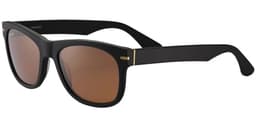
Serengeti Foyt Large (Matte Black, Mineral 555nm Photochromic, Cat 2 to 3)
The only frame here that drops into category 2. Its listing states 'Mineral Non Polarized 555nm Cat 2 to 3' - a photochromic glass lens that lightens as the light falls, and non-polarized, so an LCD dashboard stays readable. Still too dark for night: category 2 transmits 18-43% of light, far under the 75% the guidance sets for twilight. For a bright morning commute that turns into an overcast one, it is the right tool.
Price as of October 10, 2026. #ad How we’re funded
Frame material: Eco-friendly acetate (per Serengeti). Specs read from the listing on September 21, 2026.
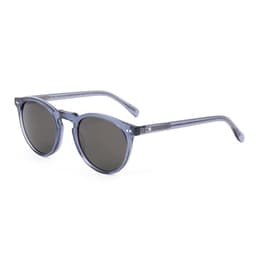
OTIS Omar x Outerknown Eco (Crystal Wave / Neutral Grey)
States filter category 3 with 100% UVA/UVB, per OTIS, in polarized mineral glass on a 47.5 mm round eco-acetate front. A straightforward daytime category 3 with the number actually published - useful for low winter sun straight down the road, and strictly a daylight lens.
Price as of October 10, 2026. #ad How we’re funded
Frame material: Eco-acetate (OTIS states it is derived from cotton seeds and plant matter). Specs read from the listing on September 7, 2026.
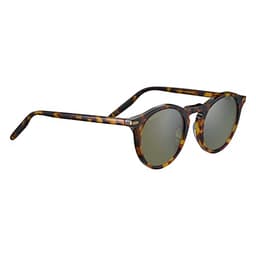
Serengeti Raffaele (Shiny Tortoise, Mineral Polarized 555nm, Cat 3)
Mineral Polarized 555nm glass in category 3 per the listing, with UV protection to 400 nm per Serengeti, in Italian acetate with a keyhole bridge. The 555nm tuning raises apparent contrast, which is the genuine benefit drivers are usually chasing when they reach for a tinted lens - available only in daylight, not after dark.
Price as of October 10, 2026. #ad How we’re funded
Frame material: Italian acetate (per Serengeti). Specs read from the listing on September 21, 2026.
General guidance, not eye-care advice. Acetate Club is written by an eyewear enthusiast, not an optician or optometrist. Sunglasses are sun protection, not a substitute for an eye exam — if you have a vision or eye-health concern, or need prescription lenses, see a qualified professional.
Frequently asked questions
Can you wear sunglasses for night driving?
No, and the reason is a published figure rather than an opinion. The College of Optometrists states that filters for road use shall be categories 0 to 3, and that a filter transmitting under 75% of light is unsuitable for twilight or night driving. Every real sunglass lens is far under that: category 2 transmits 18-43% of visible light and category 3 only 8-18%. So no sunglass lens of any color qualifies after dark - the lightest sunglasses on the market are several times too dark.
Do yellow night driving glasses work?
We will not tell you either way, because we could not find a statement from an issuing authority that settles it, and we do not publish claims we cannot cite. What we can say is what the transmittance rule means for them: a lens light enough to pass the 75% threshold is barely tinted at all, so any yellow lens dark enough to visibly change what you see is too dark for night driving by that measure. If glare at night is a real problem for you, that is a question for an eye-care professional rather than for a tint.
What filter category is legal for driving?
Categories 0 to 3 for road use generally, per the College of Optometrists, with category 4 excluded from driving altogether. The separate and stricter point is about low light: a filter transmitting under 75% of visible light is unsuitable for twilight or night driving, which in practice limits you to category 0 - and most category 0 lenses are clear or near-clear rather than sunglasses at all.
Why do headlights look so bad to me at night?
There are several possible causes and most of them are not about eyewear - uncorrected refractive error, a scratched or dirty windscreen, scratched lenses, cataract and other eye conditions among them. That is why this page does not offer you a lens: a tint that dims oncoming headlights dims the unlit road by the same amount, which makes the real problem worse. New or worsening difficulty with night glare is worth an eye examination, not a purchase.
What should I wear for driving at dawn or dusk?
The useful distinction is between twilight and low sun. If the sun is up and low in the sky, straight down the road, a category 2 or 3 lens is the right tool and a visor helps as much as the lens does. If the light has genuinely gone, nothing tinted belongs on your face. The one frame we track that spans part of this is the Serengeti Foyt Large, whose listing states a photochromic category 2 to 3 lens - it lightens as the light falls, but even at category 2 it is a daylight lens.
Do photochromic lenses clear up enough to drive at night?
They lighten, but not to clear, and there is a complication specific to cars. The AAO notes that car windows block much of the UV light photochromic lenses react to, which can keep them from darkening fully in the first place, and that they adjust more slowly when it is cold. So in a car a photochromic lens behaves unpredictably in both directions. For a lens you need to be genuinely clear at night, photochromic is the wrong technology.
Sources
- The College of Optometrists — Tints and driving (BS EN ISO 12312-1 filter categories) — Category bands: 0 = 80-100% transmission, 1 = 43-80%, 2 = 18-43%, 3 = 8-18%, 4 = 3-8%; filters for road use shall be categories 0-3; under 75% transmittance is unsuitable for twilight or night driving (accessed September 21, 2026)
- ISO 12312-1:2022 — Eye and face protection — Sunglasses for general use — The international standard for general-use sunglasses: UV filtering, filter categories and transmittance (accessed July 21, 2026)
- American Academy of Ophthalmology — Sunglasses With Transition (Photochromic) Lenses: Pros and Cons — AAO on photochromic lenses: one pair works indoors and out, but some brands darken more than others and some take longer to adjust, lenses take longer to adjust when it is cold outside, and car windows block UV light, which can keep transition lenses from darkening fully (accessed October 5, 2026)
- Serengeti — Foyt — Serengeti's product page: handcrafted eco-friendly acetate; category 2 to 3 lenses in polarized and non-polarized mineral versions; photochromic mineral lenses activated in a hydrogen-fueled Lehr furnace (accessed September 21, 2026)
- Serengeti — The Serengeti Lens (lens technology) — Serengeti on its mineral lenses (Corning borosilicate optical glass), the 555 nm tuning, Spectral Control, and UV protection to 400 nm (accessed September 21, 2026)
- American Academy of Ophthalmology — Recommended Types of Sunglasses — AAO on choosing sunglasses that block 99–100% of UV-A and UV-B (UV400) (accessed July 21, 2026)
- U.S. FDA — Tips to Stay Safe in the Sun: From Sunscreen to Sunglasses — FDA: lens darkness does not indicate UV protection; look for a 100% UV / UV400 label (accessed July 21, 2026)
Keep reading
Sunglasses lens categories
The 0-4 scale the road-use rule is written in.
Read the guideBest acetate sunglasses for driving
The daytime picks, with the category checked.
See the picksPhotochromic sunglasses
Why they do not darken behind a windscreen.
Read the guideBrown vs grey lenses
The contrast argument, within the legal range.
Read the guide