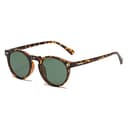
The five shapes that have survived, and roughly when they arrived
Eyewear produces a lot of shapes and keeps very few. The survivors are worth naming because they are the entire field a classic can come from.
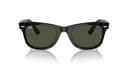
The wayfarer. An angular acetate trapezoid from the 1950s, and the frame that made molded acetate eyewear a mass product rather than a metal-and-glass one. Ray-Ban still publishes two eye sizes for the RB2140, 50 mm and 54 mm, which is itself a sign of a model treated as a staple rather than a season. Worth knowing: the acetate model is the 2140. The lighter New Wayfarer RB2132 is listed by Ray-Ban as nylon, so if the material is the point, the number matters. See wayfarer frames and original vs new wayfarer.
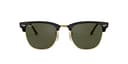
The browline.A thick acetate brow over a metal lower rim — the Clubmaster RB3016 is the surviving example. It is a combination frame rather than an all-acetate one, which matters if you came to acetate because of a metal sensitivity. See browline frames and acetate and metal sunglasses.
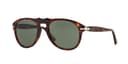
The aviator, in acetate.Most aviators are metal. The Persol 649 is the acetate one, and Persol dates it to 1957 as workwear for tram drivers — with crystal (mineral glass) lenses and an Italian-made acetate frame published at a 54-21 fitting with 140 mm temples. Its sibling, the 714, is the folding version from the 1960s, which Persol says takes ten additional manufacturing steps. Our 649 vs 714 comparison settles which to buy.
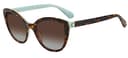
The cat-eye. The one survivor that is a shape rather than a model number: the upswept outer corner has been in production since the 1950s under a hundred different names. The Kate Spade Amberlee/S is the current licensed-designer version we track, with a published 55 mm lens and a polarized lens. See cat-eye frames.
The round. The oldest shape of all and the hardest to attribute to one model, which is why the round pick on this page is explicitly a shape buy rather than a heritage buy. See round frames.
What you are actually buying when you buy a classic
Not better UV protection. A $14 frame that states UV400 is making the same protection claim as a $363 Persol, because the UV filter is the cheap part of a lens — see best UV400 sunglasses. Four concrete things do come with a surviving model, and they are the reason this page exists.
1. Serviceability. A model in continuous production has parts in circulation: screws, hinges, nose pads, replacement lenses. That is the difference between a repair and a bin. Our pages on whether acetate frames can be repaired and replacing sunglasses lenses cover what is realistically fixable.
2. A published fitting.Heritage houses publish measurements because opticians demand them. Three of our five picks publish a lens width (50 mm, 51 mm, 54 mm) and two publish a full three-number fitting. Most of the budget market publishes nothing. If you have ever bought a frame that turned out to be the wrong width, this is what you are paying to avoid — see sunglasses sizing.
3. Material you can confirm. Thick cellulose acetate, cut from sheet, in colorways where the tortoise is layered rather than printed. Our how to tell if a frame is acetate page gives the checks, and why acetate frames cost what they do explains the process.
4. Resale and residual value. We are not going to put a number on this because we have not measured one. What is observably true is that a surviving model has a used market and a trend frame generally does not.
What a classic does not get you
Polarization, in several cases. This is the single most common disappointment. The standard RB2140 variant on this page is not polarized— Ray-Ban sells polarization as a separate, dearer version of the same frame — and the Persol 649 in this colorway is given as not polarized either. If glare off water or asphalt is your reason for buying, start from polarized acetate sunglasses and read the card before you buy a classic. See also polarized vs non-polarized.
A modern fit. A frame designed in 1957 was designed for the faces and habits of 1957. The RB2140 runs deep and sits large on a very small face; the 649 is a 54 mm eye on a 21 mm bridge, which is a wide bridge by current standards. Neither is a flaw, but neither is a universal fit either.
Lightness.Thick acetate is heavier than molded nylon. For all-day wear in heat that is a real consideration — see are acetate sunglasses heavy? and most comfortable sunglasses.
How we ranked these five
Continuous production first. Four picks are models still being manufactured decades after launch. The fifth is explicitly labelled as a shape buy on its card so nobody mistakes a $14 round frame for a heritage object.
Then a stated material.Thick cellulose acetate, or acetate with a stated metal element where that is what the model is. The Clubmaster’s metal lower rim is stated rather than glossed, because that is the kind of detail people discover after buying.
Then a published fitting, then price spread. About $14 at the bottom and $363 at the top. A classic shape and a classic model are two different budgets, and the page is built so you can buy either on purpose. If you want the look without the premium, cheap sunglasses that look expensive is the page for that argument.