Why combination frames exist
Four reasons, in rough order of how much they matter.
1. Metal can be thin where acetate cannot. Cellulose acetate is cut and milled from cured sheet. A rim thinner than roughly two millimeters has very little material resisting the lens pressing outward, so an all-acetate frame with a delicate lower rim is a frame that cracks. A metal lower rim can be a wire. That is the entire design logic of a browline frame: heavy on top, almost nothing underneath.
2. Weight.Acetate is denser than it looks and a full acetate front in a large size is noticeably heavier than a combination one. Swapping the lower rim or the temple core to metal takes weight off the nose, which is where all of it is carried. Nobody in this category publishes a figure in grams, so we do not print one — but the direction of the effect is not in dispute. Our page on whether acetate sunglasses are heavy argues it from the measurements sellers do publish.
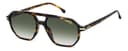
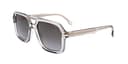
3. A metal core makes a temple hold its shape. Several houses run a wire inside an acetate temple. Carrera describes a metal insert running back to the temples on the 341/S, and inserts on each side of the 317/S front. A cored temple resists splaying over years of being pushed on and pulled off, which is the most common way an acetate frame loosens.
4. It is cheaper to make a thin front in metal.This is the honest commercial reason, and it is why combination construction is most common in the band between $50 and $200. It is not a reason to avoid it — it is a reason to read the material line rather than the material word.
Our explainer on acetate and metal frames goes through the constructions in more detail, and acetate vs metal is the straight comparison if you are choosing between the two outright.
The question that decides this for some readers
A meaningful share of people shopping for acetate are shopping for it because metal irritates their skin. If that is you, a combination frame is the one construction to check rather than assume.
Nickel is among the most common causes of allergic contact dermatitis, and the giveaway is that the rash appears where the allergen touched the skin— so a metal lower rim sitting on the cheek, or a metal insert at the temple resting behind the ear, is in exactly the wrong place. A dermatologist can identify the trigger with patch testing. It is also not only nickel: the published review literature records palladium and titanium frames causing allergic contact dermatitis too, and plastic frames provoking reactions through a plasticizer, a UV stabilizer or a surface varnish rather than the base polymer. In other words, “switch to plastic” is not automatically a cure either.
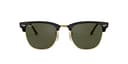
What is reliable is knowing what is in contact with you. On the three frames here: the Clubmaster's brow is acetate and the lower rim is metal; the Carrera 317/S is an acetate front with metal inserts on each side; the 341/S is an acetate front and acetate temples with a metal insert running back to the temples. None of the three brand pages names the alloy. If a stated-alloy frame is what you need, titanium is the usual answer — it is corrosion-resistant, handles sweat and humidity without pitting, and is described as hypoallergenic in optometry references, at a higher cost than basic metals. Our hypoallergenic sunglasses roundup is the page built around that question, and acetate vs titanium compares the two materials directly.
What combination construction costs you long-term
Two things, and they are both about repair rather than daily use.
You lose some of the adjustability that makes acetate worth buying. An all-acetate frame can be warmed and bent to the shape of your head, and re-polished when the surface dulls. The acetate parts of a combination frame still can be. The metal parts bend cold, which an optician can also do — but the jointbetween the two is the part that cannot be reworked. Our guide to adjusting acetate frames covers what is safely adjustable, and whether acetate frames can be repaired covers the limits.
The joint is the failure point. Every frame fails somewhere, and on a combination frame it is usually where the metal enters the acetate: the rivet works loose, or the acetate around an insert fatigues. It is not a common failure, and Ray-Ban has been selling the Clubmaster for decades, but it is the thing to inspect when you are looking at a used pair. Our page on acetate frame hinges explains the related construction, and acetate frame care covers keeping the acetate half alive.
Only three picks, and why
Three frames, not five, because three is how many we track whose brand pages state the construction precisely enough to rank. That is deliberate. Half the frames sold as “acetate and metal” are an acetate-look molded front with metal temples, and most listings do not say which. We would rather publish a short list that is true than a long one that is padded — our how we choose page sets out that rule, and how to tell if a frame is acetate covers the checks you can run on a pair in your hands when a listing will not tell you.
Two of the three are Carrera, which is worth stating plainly rather than hiding: it is the brand in this price band that publishes both a material and a full three-number fitting, and that combination is rare enough to earn two slots. Our Carrera review covers the line as a whole, including the models we did not pick. If you want an all-acetate frame instead, the flagship acetate roundup is the page to start from.