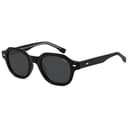
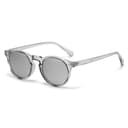
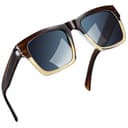
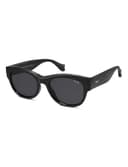
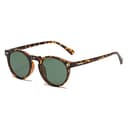
What $25 actually buys
Three things, reliably, and three things it does not.
It buys UV protection.Every frame here states UV400, and that claim is cheap to meet because UV filtering comes from the lens material and an additive rather than from darkness or price. The FDA's warning runs the other way — you cannot judge UV protection by how dark a lens looks — which is exactly why a $14 lens stating UV400 can be as protective as a $300 one. Our guide to checking UV protection covers how to verify it, and whether cheap sunglasses are bad for your eyes addresses the fear directly.
It buys polarization.Every one of these five states polarized lenses. Polarization is a film laminated into the lens stack and it is not expensive at scale. Whether you want it is a separate question — polarized vs non-polarized covers the trade, and how to tell if sunglasses are polarized gives you the check to run when the pair arrives.
It buys cut-from-sheet acetate — sometimes. Three of the five state cellulose acetate. That is a real material claim, and it matters because acetate can be warmed and adjusted by an optician while molded plastic largely cannot.
What it does not buy: a published fitting (one frame here publishes measurements, and it is the recycled-plastic one), a stated filter category (none of them), and a serviceable hinge— at this price a snapped hinge is the end of the frame, not a repair. Our page on acetate frame hinges explains what separates a repairable hinge from a disposable one.
The two frames here that are not acetate, and why they are still on the list
The Joopin Oversized Squareputs “Acetate” in its title. Every current listing we read says the same thing in the bullets: hand-crafted acetate temples on an unbreakable TR90 front. The arms are acetate; the front is molded nylon. It is on this list because it is the cheapest route to real oversized coverage and because the honest version of that information is more useful to you than silence. If you want the shape in actual acetate, our oversized acetate roundup is the page, and it costs more.
The SOJOS Ocean Collection Bloom Squareis recycled plastic, and SOJOS says so: its spec field reads recycled materials, described as non-toxic and BPA-free. It earns a place because it is the only frame in the band that publishes a full measurement block — 140 mm frame width, 140 mm temples, a 20 mm bridge, a 54 mm lens width and a 41.5 mm lens height — which is more than either bio-acetate budget frame we track offers. If what you care about is diverting existing plastic rather than frame material, that is a coherent position, and bio-acetate vs recycled plastic compares the two claims properly. What recycled plastic cannot do is be heat-adjusted or re-polished.
How to buy in this band without getting burned
1. Read the bullets, not the title. Marketplace titles are keyword fields. The bullets and the spec table are where a seller states what the frame is, and the gap between the two is the single most common misrepresentation at this price. The Joopin frame on this page is the textbook case.
2. Treat a missing material line as plastic.Two frames we track under $25 state no material at all. That is not a reason to assume the worst about the seller, but it is a reason to assume molded plastic for your own planning, because a seller with real acetate almost always says so — it is the expensive part.
3. Check the edge when it arrives.On a frame cut from acetate sheet, the tortoise or havana pattern continues through the cut edge of the rim and the temple tip, and there is no mold parting line inside the rim. On a clear frame the check is even easier, because a transparent front hides nothing — every edge and polish mark is on show, which is why the Gleyemor clear round is worth the extra dollar over the tortoise if you want to inspect what you bought. Our guide to telling whether a frame is acetate has the full set of checks.
4. Expect the fit to be a guess. No frame here publishes an eye size, so measure a pair you already own and compare the photographs against it. Our sizing guide explains how to read the three-number fitting when a seller does give you one, and how to buy sunglasses online covers the return-policy question that follows from not knowing.
Should you spend more?
Honestly: for most people, a little. The jump from $25 to $50 buys published measurements, better hinges and a stated UV figure from a brand with a warranty behind it, and our affordable acetate roundup under $50 is where that argument is made with the picks to match. The jump from $25 to $100 buys a designer name that publishes a fitting — under $100 is that page.
But there are two situations where $25 is the right answer and not a compromise. The first is trying a shape you have never worn: if you have never owned a clear frame or an oversized square, finding out for $15 is rational. The second is frames you will lose — a beach bag pair, a car pair, a festival pair. Our cheap sunglasses that look expensive page is built around the first case, and beach sunglasses around the second.