What to prioritize, in order
1. Lens area. This is the one that actually matters for your eyes. UV reaches them from above and from the side as well as straight on, and a small lens leaves the thin skin of the eyelid and the outer corner exposed — the Skin Cancer Foundation is specific about eyelid skin being a common site. A larger lens and a frame that sits close to the face does more for you than any lens coating. That is the argument for the oversized picks here, and it is the same argument our oversized acetate sunglasses page makes at length.
2. Stated UV protection, not lens darkness. The FDA says it plainly: how dark a lens looks tells you nothing about whether it blocks UV. Look for UV400 or “100% UV protection” on the listing — every pick on this page states it. Our guide to checking UV protection covers what to do when a listing is vague, and UV400 explained covers what the number means.
3. The bridge, then the weight. A thick acetate front is heavier than a wire frame, and all of that weight lands either across the top of your nose or on two pads either side of it. If frames tend to slide down, or leave a mark, the bridge is the thing to fix — not the temples. Our guide to sunglasses that slip down your nose runs through the fixes in order, and how to read sunglasses sizes explains the 53-20-140 style numbers that tell you whether a frame will fit before you buy.
4. Polarization, if you drive. Polarized lenses cut reflected glare off wet road, car bodies and water, which is a different job from blocking UV. Four of the five picks here are polarized. The trade-off is that polarized lenses can make some dashboard and phone screens look patchy; our polarized vs non-polarized guide covers when it is worth it.
If you wear readers or progressives
Two practical points, and one honest limitation. The practical points: a deeper lens gives a progressive or bifocal prescription somewhere to put the reading zone, so a shallow, narrow frame is the wrong shape even when it is the prettiest one on the page; and a frame with published measurements is far easier for an optician to glaze than one whose seller publishes nothing. The Serengeti Joan is the only pick here with a full published fitting (53-20-140).
The limitation: we do not sell prescription lenses and cannot tell you which of these frames your lab will glaze. Our prescription acetate sunglasses guide explains the realistic routes — take an off-the-shelf acetate frame to an optician, or order a prescription version direct from a brand that offers one — and is deliberately free of product picks for that reason.
The picks, and who each suits
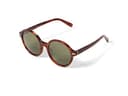
The Serengeti Joan is our best overall. Serengeti describes it as a bold oversized silhouette on a bio-acetate, eco-friendly handmade acetate frame, with its Ultra-Light Mineral lens listed as photochromic, polarized, anti-reflective and carrying Serengeti’s Spectral Control blue-light filtering. The fitting is 53-20-140 in a medium fit. What that adds up to in practice is a frame that covers properly, adapts between a bright street and an overcast one, and costs well under the brand’s own list price at the moment. The cons are honest: a 20 mm bridge is on the wider side, and a mineral glass lens is heavier than plastic. Our Serengeti review has the brand in full.
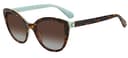
Best designer is the Kate Spade Amberlee, a cellulose acetate cat-eye with a 55 mm lens and polarized lenses. It is the pick if you want a frame that is recognisably designed rather than neutral: the upswept outer corner lifts the eye and is genuinely flattering on a heart, square or round face. It is a mid-priced frame rather than a cheap one, and the cat-eye is a statement — if you want something that disappears, take the CARFIA instead. Our Kate Spade review covers the line.
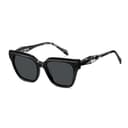
Best coverage under $50 is the SOJOS Audrey Oversize Square. SOJOS states cellulose acetate for both frame and temples, polarized and UV400, in a deliberately large square that covers more of the eye area than anything else at this price. It suits oval, heart, diamond and long faces. SOJOS does not publish measurements, which is the real compromise, and an oversized frame on a small face looks like borrowed sunglasses — if your face is on the smaller side, skip to the last pick.
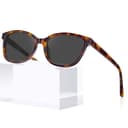
Best everyday value is the CARFIA Designer Acetate. A hand-crafted acetate soft square, polarized, that runs small-to-medium and flatters a wide range of faces because the corners are rounded rather than hard. It is the pair to buy if you want one inoffensive, comfortable frame for driving, walking and the grocery run, at a price where you will not panic when it goes missing. “Suits most faces” means flattering rather than striking — that is the trade. Our CARFIA review covers what the brand does well.
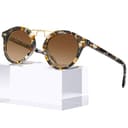
Best for a smaller face is the CARFIA Small-Face Double-Bridge. It is the one frame here built for a narrower face rather than scaled down from a larger one, with a double bridge that spreads weight across two contact points instead of one — which is exactly what helps when frames leave a mark or slide. It is also the cheapest pick. The lens is smaller, so you give up some of the coverage argued for above; our guide to sunglasses for small faces explains how to trade those off.
Color, honestly
The convention in eyewear is that warm skin tones sit well with tortoise, havana, honey and amber acetate, and cooler tones with black, grey-crystal and clear frames. It is a convention, not a finding, and plenty of people look better breaking it — our guide to choosing a frame color for your skin tone gives you the test and the caveats. What we will say with more confidence is that depth of color is what separates a frame that looks expensive from one that does not, and that is a property of the material: layered acetate has pattern running through it, while printed plastic has pattern sitting on it. Our page on why acetate sunglasses cost what they do shows where that difference comes from.