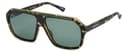
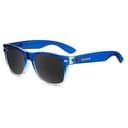
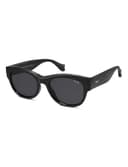
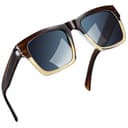
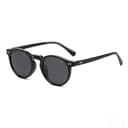
What goodr actually sells, and it is not a material
Work out what you are replacing before you replace it. goodr’s product is a grip coating on a light molded frame at $30, sold in hundreds of colorways with names written like indie album titles. The OG pages list the features in this order: no slip, no bounce, polarized, UV400. That ordering is honest about the proposition — the lens spec is table stakes and the grip is the thing you are paying for.
Which means the substitution question is not “what else is $30”. It is do you need the grip?If you are running, cycling, playing a sport or sweating in them, you do, and no frame on this page beats a goodr at it — see the section below, which is not a formality. If you bought them because they were cheap, polarized and you did not want to care if they got sat on, then the grip is irrelevant to you and you have been paying for a feature you do not use. That is the reader this page is for.
goodr names three different frame materials on its own site
This is the finding that decides the page, and it took three pages to assemble, all of them goodr’s own.
The support article answering “What are your glasses made of?” states that the frames are plastic with a soft touch coating. The OGs collection page describes the frames as acetate. And the brand’s own blog post about flexible frames states they are designed with high-performance nylon materials. The eco line is given separately as 100% recycled plastic frames. The lens story splits the same way: the support article says TAC, while the Mach G collection page says laminated polycarbonate.
None of those is a lie on its own. A brand with several production lines can genuinely use nylon for one and a soft-touch plastic for another, and the word “acetate” gets used loosely across the whole eyewear industry for anything cut rather than molded. But the practical effect for a buyer is that you cannot tell from goodr’s pages what the frame in your hand is made of, and the three answers behave differently: a soft-touch coating wears, nylon flexes and resists heat, and real cellulose acetate can be warmed, adjusted and re-polished. Our how to tell if frames are real acetate checklist is the practical test, and acetate vs nylonis the material comparison that matters most here, since nylon is what goodr’s flexible line claims.
We are not calling the OG an acetate frame on the strength of one collection page, and our own goodr review treats it as what it plainly is: a molded sport frame, judged as a molded sport frame. If the material line is the reason you are leaving, that is a sound reason.
There is no measurement anywhere. The size is a letter
On every goodr page we read — product pages, collection pages, the sizing page and the support center — there is no lens width, bridge width or temple length in millimeters. Fit is expressed as head-size buckets: the sizing page gives LFG for small heads and BFG for bigger ones, and the OG now comes in Small and Large as well as the standard. The petite slim-fit style sits at $25; the standard OG at $30.
A letter is not nothing — for a $30 purchase with easy returns it is arguably the right amount of information, and it saves a lot of shoppers from a spec sheet they would not read. But it means you cannot compare a goodr to anything else numerically, you cannot check it against a frame you already own, and if you are between sizes there is no number to split. Our sunglasses sizing guide explains how to read the three-number fitting printed inside most temples, and how to measure your face gets you the figure to compare against.
It also sets up the honest symmetry on this page. Most budget frames publish nothing either. Three of the five picks below publish no measurement at all, and we say so on every card. The one that does — the SOJOS Ocean Bloom — publishes a complete block: 140 mm frame width, 140 mm temples, a 20 mm bridge, a 54 mm lens width and a 41.5 mm lens height. That is why it is on the page despite not being acetate, and why its award is the specific thing it earns.
Keep the goodrs for running. This is not a formality
Acetate is the wrong material for sport and we are not going to pretend otherwise. Three reasons, all of them about the physics rather than the brand.
It softens with heat.Cellulose acetate is thermoplastic — that property is exactly why an optician can heat a frame and bend it to your head, and why it can be re-polished years later. The same property means a frame left on a dashboard or worn on a hot climb can relax out of adjustment. A molded nylon or TR90 sport frame does not do this.
It is heavier.Acetate is cut from solid sheet, and a thick front weighs meaningfully more than an injected one. For a walk that is a feature — it is the planted feel people pay for. For a 10k it is weight bouncing on your nose every stride. Our page on whether acetate sunglasses are heavy has the honest version of this.
Nothing here has a grip coating.goodr’s no-slip finish is an applied coating on the frame and temples. None of the five picks below states one, and a polished acetate temple on a sweaty temple slides. If your use case is movement, the answer in this list is the Knockaround Fort Knocks, which is polycarbonate and says so — or keeping the goodrs. Buying acetate for running is buying the wrong tool confidently.
How we picked these five
First, the money has to match. A goodr OG is $30. Every pick here sits between about $14 and about $38 at the time of writing, with live prices on the buttons rather than numbers typed into prose. A $200 frame is not an alternative to a $30 one, however much better it is; if you want that argument, start at acetate sunglasses under $100.
Second, the seller has to state the material. That is the entry requirement and it removes most of the budget market. Two picks here are deliberately notacetate — the Knockaround is polycarbonate and the SOJOS Ocean is recycled plastic — and both say so on their own listings and on their cards here. A stated plastic beats an unstated anything.
Third, polarization has to be stated, not implied. goodr states polarized on every OG page, so an alternative that cannot match that is a downgrade on the one feature you can feel. All five picks state polarized lenses. Only four state a UV figure: the Gleyemor black round does not publish one, and we do not carry UV400 across from its sibling listings, so its card reads not published. Our guide to checking UV protection covers what to do about that before you wear them, and polarized vs non-polarized covers what polarization does and does not do.
Fourth, we read the bullets, not the title.The Joopin oversized square puts “Acetate” in its product title, and its own bullets say hand-crafted acetate temples on an unbreakable TR90 front. The arms are acetate; the front is molded nylon. It is on this page because it is the cheapest honest route to real coverage, and its card leads with the correction rather than hiding it.
What you give up by leaving goodr
Four things, and they are worth naming plainly so nobody feels misled after the parcel arrives.
The grip. Covered above. It is the product.
The colorway catalog.goodr runs hundreds of them, including limited editions. The budget acetate market runs black, tortoise, clear and a few translucents. If picking the pair was the fun part, that fun is smaller here — although tortoise acetate has a depth no printed plastic reproduces, because the pattern runs through the sheet instead of sitting on the surface.
The returns experience. Buying a cheap frame from a marketplace seller is not the same as buying from a brand that wants you back. Check the return window before you order, especially on the sub-$20 picks.
Certainty about size. You trade a letter for silence on three of these five. That is a real loss, not a wash. If fit is your main worry, buy the SOJOS Ocean Bloom, which publishes every number, or read how sunglasses should fit and measure a pair you already own.
Who should skip this page entirely
Runners, cyclists and anyone who sweats in their sunglasses. Keep the goodrs, or read our goodr vs Knockaround comparison, which is the real decision inside the sport-plastic category.
Anyone who needs a frame to survive being dropped repeatedly. Acetate chips and cracks where nylon flexes. Acetate vs TR90 sets the two side by side without picking a winner, because the winner depends on what you are doing.
Anyone buying for a child.Nothing here is a kids’ frame, and the fit information is too thin to guess with.
Anyone who wants the material upgrade to be obvious. At $30 it is not. Budget acetate is genuine acetate with budget finishing: thinner edge polish, simpler hinges, no layered sheet to speak of. The step where the material starts visibly paying for itself is nearer the $50 band, and the step where it becomes the point is higher again. We would rather say that than oversell a $14 frame.