Sunglasses for Deep-Set and Hooded Eyes
Eye set is a different axis from face shape, and it is the one nobody shops on. Three published numbers decide whether a frame works with a recessed eye or a heavy lid — and almost no seller prints them.
How this is funded: we earn a commission if you buy through our links, at no extra cost to you. It never changes which product we recommend, and we’ll tell you when we’d skip one. Full disclosure.
Face shape gets all the attention, and it only answers half the question. Two people with the same oval face can need completely different frames because of where their eyes sit in the socket: one reads bright and open behind a thick black frame, the other disappears behind it. That second axis — eye set — is what this page is about, and it is decided by three measurements, two of which almost no seller publishes.
Deep-set eyes sit further back in the socket, with a prominent brow casting shade over them. Hooded eyes have a fold of upper-lid skin covering part of the crease, which reduces the visible lid space above the lash line. They frequently occur together, they are both completely ordinary, and they want partly opposite things from a frame. The verdict, before the detail: look for a flat base curve, a deeper lens, and a light or translucent front for a deep-set eye, and lift at the outer corner with a top rim that stays high for a hooded lid.
1. Base curve: the number that decides how the frame sits
Base curve describes how much a lens and frame front curve away from your face across their width. A 4 base is close to flat; a 6 base wraps noticeably. On a deep-set eye the flat geometry is the easier one to live with: the frame sits close and level to the brow line and the socket, instead of bowing out and opening a visible gap at the temple that makes the eye look further recessed than it is.
Base curve is also the measurement that explains the opposite complaint. If your lashes brush the lens, your eyes are prominent rather than deep-set, and a 6 base is the fix rather than the problem — the curve carries the lens away from the lash line.
Almost no seller publishes this number. OTIS is the exception we keep citing because it is the only brand in our registry that does: it lists a 4 base on the Omar Eco and a 6 base on the Guilt Trip X. If you find base curve printed on a listing, it tells you more about how a frame will sit on your face than the shape name does.
2. Lens height: how much frame sits below the eye
Lens height is the vertical measurement of the lens opening, and it decides whether your eye sits in the middle of the frame or near the top of it. For a deep-set eye, more height is usually better: it keeps the top rim above the brow shadow rather than adding a second dark band across it, and it puts the eye in the open middle of the lens.
Ray-Ban publishes this, and the spread across one family makes the point. Its listings give the Original Wayfarer RB2140 a 41 mm lens height at the 50-22 fitting and 47.2 mm at 54-18. The lighter New Wayfarer RB2132 — which Ray-Ban lists as nylon rather than acetate — is given as 37.6 mm at 52-18 and 40.8 mm at 55-18. That is nearly ten millimetres of difference between the shallowest and deepest frames in what most people would describe as the same style, and it is the single biggest reason two wayfarers can look so different on the same face. Our Original vs New Wayfarer comparison goes through both, and 50 mm vs 54 mm covers the sizing decision.
3. The bridge: what keeps the frame off your nose
A deep-set eye is often paired with a strong brow and a higher nose bridge, and the practical effect is that a frame which sits too low puts the top rim straight into the brow shadow. The bridge is what sets that height.
Two designs are worth looking for. A keyhole bridge — the notch that rests on the sides of the nose instead of across the top — sits the frame slightly higher and spreads the load; Persol’s 649 product page lists one, as does Serengeti’s Raffaele, and our keyhole bridge guide explains the geometry. A double bridge adds a second bar high across the nose, which does something useful on a hooded eye: it draws attention upward, away from the lid, and breaks up what would otherwise be a single heavy top rim.
A wide stated bridge width helps too, and it is the figure most likely to be published. The OTIS Omar Eco’s 22.5 mm bridge is unusually wide for a 47.5 mm eye, which is exactly the combination that keeps a small frame from sinking. If the opposite is your problem — a frame that slides down — that is a different page, and low nose bridge fit covers the other end of the bridge question.
Colour and tint do more here than shape does
This is the part that surprises people, and it is why one of the frames below is named for its colourway rather than its measurements. A deep-set eye is already in shade. Put a thick, flat black front above it and you have stacked a second shadow on the first — the eye reads as a dark gap. Put the same shape in a clear, honey or warm translucent acetate and light passes through the frame, the brow line softens, and the eye reads open.
The same logic applies to the lens. A gradient tint — darker at the top, lighter toward the bottom — lets more of your eye show through than a flat dark lens does, which is a genuine cosmetic advantage on a recessed eye. What it is not is a protection decision: the FDA’s position is that you cannot judge UV protection by how dark a lens looks, and the AAO recommends sunglasses blocking 99–100% of UV-A and UV-B, so read the stated figure and treat tint as a separate, aesthetic choice. Our guides to mirrored vs gradient lenses, lens tint colours and clear acetate frames cover the three choices involved.
One material note, since it decides whether any of this is fixable after you buy. An acetate frame can be warmed and adjusted by an optician, so the pantoscopic tilt — how far the bottom of the frame sits in toward your cheeks — can be changed to lift the lens relative to your eye. That adjustment is often the whole fix on a deep-set eye, and it is not available on a moulded frame. See how to adjust acetate frames and acetate vs plastic.
What to avoid, briefly
A thick, straight, low top rim is the one combination that fights both conditions at once: it lands on a hooded fold and it adds shadow to a recessed eye. If you love a bold frame, look for one where the brow line rises at the outer corner rather than running flat. Very dark flat lenses in a black frame are the second thing, for the reasons above. And frames with no published measurements at all are the third, not because they are bad frames, but because eye set is the one fit question you cannot solve by eye from a listing photograph — which is why the few frames below are the ones that print their numbers.
Once you know which geometry you are after, the shape is the easy part. Our style guides cover each silhouette and the faces it suits, and the best-of roundups rank frames within each one on material, fit and value.
Frames that publish what this page turns on
Each of these is here for one reason the advice above names - a published base curve, a light colourway, a small-face fitting, or an upswept front. No ranking and no awards: a guide earns the right to name a few frames, not to rank a field. Prices are live and dated.
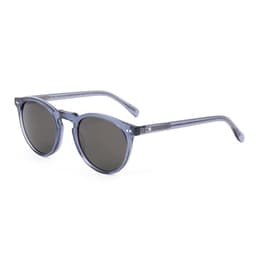
OTIS Omar x Outerknown Eco (Crystal Wave / Neutral Grey)
The only frame in our registry that publishes its lens curve: OTIS lists the Omar Eco at 47.5-22.5-140 with a 4 base curve. A flat 4 base is the easiest geometry to live with on a recessed eye, and the wide 22.5 mm bridge keeps the frame off the nose rather than sinking it. Note OTIS lists 50-23-140 for a different Omar colourway, so measure a pair you own first.
Price as of October 16, 2026. #ad How we’re funded
Frame material: Eco-acetate (OTIS states it is derived from cotton seeds and plant matter). Specs read from the listing on September 7, 2026.
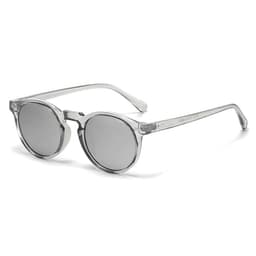
Gleyemor Vintage Round (Clear Acetate)
The shadow problem, answered by colourway rather than by shape. A translucent front puts light through the frame instead of casting a dark band across an already-shaded eye - which is why a clear acetate frame reads so differently on a deep-set eye than the same shape in black. Listing states hand-crafted acetate, polarized, UV400.
Price as of October 16, 2026. #ad How we’re funded
Frame material: Cellulose acetate (hand-crafted, per listing). Specs read from the listing on August 19, 2026.
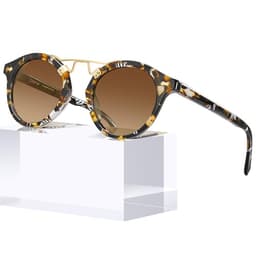
CARFIA Small-Face Double-Bridge (Acetate)
For a smaller face, and the one frame here whose detail does the lifting: a double bridge puts a second bar high across the nose, which draws the eye upward and breaks up the heavy top rim that hooded lids struggle with. Stated small-face sizing, acetate, polarized and UV400 - but no published measurements.
Frame material: Cellulose acetate. Specs read from the listing on July 21, 2026.
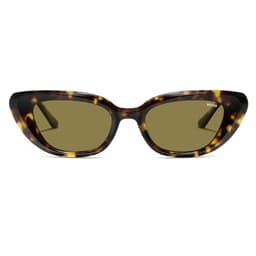
SOJOS Aria Cat-Eye (Polarized Acetate)
A soft upswept front for hooded eyes specifically. The lift happens at the outer corner, where the frame rises above the lid line instead of sitting on it, and the Aria is the gentler of the two SOJOS cat-eyes rather than a dramatic one. Stated acetate, polarized, UV400; no published measurements.
Price as of October 16, 2026. #ad How we’re funded
Frame material: Cellulose acetate. Specs read from the listing on August 24, 2026.
Frequently asked questions
What sunglasses suit deep-set eyes?
A frame with a flat base curve, a reasonably deep lens and a light or translucent colourway. Deep-set eyes already sit in shadow under the brow, so a dark frame with a heavy top rim makes them disappear; a clear or warm translucent acetate front puts light through the frame instead. The one frame in our registry that publishes the relevant number is the OTIS Omar Eco, listed at 47.5-22.5-140 with a 4 base curve - a flat geometry that sits close to the face without wrapping.
What is the difference between deep-set eyes and hooded eyes?
Deep-set eyes sit further back in the socket, so the brow casts a shadow over them and the eye reads as recessed. Hooded eyes have a fold of upper lid skin that covers part of the crease, so the lid space above the lash line is reduced. They often occur together and they want opposite things from a frame: a deep-set eye wants light and a flat geometry, while a hooded lid wants lift at the outer corner and a top rim that does not sit down on the fold.
Do my eyelashes hit the lenses?
Rarely if your eyes are deep-set - that is the problem of prominent eyes, which sit forward in the socket. If your lashes brush the lens, the fix is a frame with more curve rather than less: a 6 base wraps away from the face across the lens, where a 4 base sits flat. OTIS is the only brand we track that publishes base curve at all, listing 4 base on the Omar Eco and 6 base on the Guilt Trip X, which is why those two keep coming up on this site.
Should hooded eyes avoid cat-eye sunglasses?
No - a soft cat-eye is usually the better choice, because the lift sits at the outer corner where it rises above the lid line rather than pressing on the fold. What hooded eyes struggle with is a thick, straight, low top rim that lands on the hood and shortens the lid space further. The distinction is the angle of the brow line, not the category of the frame. Our cat-eye style guide covers how much sweep is too much.
Does lens height matter more than frame width?
For eye set, yes, and it is the measurement almost nobody publishes. Ray-Ban is a useful exception: its listings give the Original Wayfarer a 41 mm lens height at 50-22 and 47.2 mm at 54-18, against 37.6 mm and 40.8 mm on the New Wayfarer in its two fittings. That six-millimetre spread is the difference between a frame that sits level with a recessed eye and one that crops it. Frame width still decides whether the frame fits your head at all - our sizing guide covers reading both.
Will a lighter lens tint help deep-set eyes?
It helps how your eyes read to other people, which is usually what the question is about: a gradient or a mid-brown tint lets some of your eye show through, where a flat very dark lens plus a shadowed socket shows nothing. It does not change sun protection - the FDA's point is that lens darkness is not a measure of UV protection, so read the stated 100% UV or UV400 figure separately and treat tint as a cosmetic and comfort decision.
Sources
- Ray-Ban — Original Wayfarer Classic RB2140, Polished Tortoise / G-15 Green (50-22) — Ray-Ban's listing for the 50 mm Original Wayfarer: 50-22 fitting, 41 mm lens height, 150 mm temples, acetate frame, G-15 green lens (accessed September 18, 2026)
- Ray-Ban — Original Wayfarer Classic RB2140, Polished Tortoise / G-15 Green (54-18) — Ray-Ban's listing for the 54 mm Original Wayfarer: 54-18 fitting, 47.2 mm lens height, 150 mm temples, acetate frame, G-15 green lens (accessed September 18, 2026)
- Ray-Ban — New Wayfarer Classic RB2132, Polished Black / G-15 Green (52-18) — Ray-Ban's listing for the New Wayfarer: frame material given as nylon, square shape, 52-18 and 55-18 fittings with 145 mm temples, lens height 37.6 mm at 52-18 and 40.8 mm at 55-18 (a 58-18 Color Mix variant is also listed), plus an RB2132F low-bridge version in 55-18 (accessed October 5, 2026)
- Persol — 649 Original, Havana frame with green lenses (PO0649 24/31) — Persol's product page: 52-20, 54-20 and 56-20 sizes; acetate frame, crystal lenses, made in Italy; keyhole bridge, arrow and Meflecto; designed in 1957 for Turin's tram drivers (accessed September 15, 2026)
- Specialty Vision — Eyeglass Frame Materials (optometry-practice reference) — On titanium frames: very strong, lightweight and corrosion-resistant, suited to a thin, light profile and small or delicate styles; hypoallergenic, which matters for patients with a nickel allergy; corrosion resistance handles sweat, humidity and daily handling without pitting; a higher cost than basic metals. On blended-nylon frames: commonly used for sports and safety eyewear including wraparound styles, handles impact and motion better than standard plastics, and resists sweat and moisture well. On plastic frames: the most popular choice for affordability and styling, but they break more easily than metal and may fade in color over time, while Italian zyl acetate is known for its quality, hand-polished finishes and multi-layer color effects, and lasts many years with proper care (accessed October 11, 2026)
- American Academy of Ophthalmology — Recommended Types of Sunglasses — AAO on choosing sunglasses that block 99–100% of UV-A and UV-B (UV400) (accessed July 21, 2026)
- U.S. FDA — Tips to Stay Safe in the Sun: From Sunscreen to Sunglasses — FDA: lens darkness does not indicate UV protection; look for a 100% UV / UV400 label (accessed July 21, 2026)
Keep reading
How should sunglasses fit?
The three contact points, and what a correct fit looks like.
Read the guideSunglasses sizing
How to read 54-18-145, and which number to match first.
Read the guideSunglasses by face shape
The other axis - and the one more people already know.
Find your shapeCat-eye acetate sunglasses
How much sweep lifts a hooded lid, and how much is too much.
Read the guide