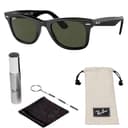
Ray-Ban Original Wayfarer Bio-Based RB2140
The only bio-acetate frame here that puts a measured number behind the claim. Ray-Ban states 67% bio-based carbon content calculated to ASTM D6866 — an actual standard, an actual figure — on the reference acetate shape. You pay Ray-Ban money for it, and the number is about feedstock, not biodegradability.
Strengths
- 67% bio-based carbon content stated by Ray-Ban and calculated to ASTM D6866 — a real standard, not a slogan
- The reference Wayfarer shape and full Ray-Ban serviceability, unchanged by the material swap
- 100% UV protection stated, same as the standard RB2140
Who should skip it
- Bio-based carbon content is a feedstock measure — it is NOT a biodegradability claim, and Ray-Ban does not make one
- By far the most expensive way to buy bio-acetate here
- This listing does not state whether the pair is polarized; check the variant before you buy
| Frame material | Bio-based cellulose acetate (Ray-Ban states 67% bio-based carbon content, ASTM D6866) |
|---|---|
| Frame shape | Wayfarer |
| Lens protection | 100% UV protection (per Ray-Ban) |
| Polarized | Not published |
| Lens width | Not published |
| Suits face shapes | Oval, Round, Heart |
Spec note. Ray-Ban describes its bio-acetate as cellulose acetate from cotton or wood pulp combined with a bio-based plasticizer made from renewable sources such as cereals, beet or sugar cane — the plasticizer is the part that changes. Ray-Ban's own bio-based RB2140 pages list a 50-22 fitting; this listing does not state the size it ships.
Specs and material read from the product listing, on September 3, 2026. “Not published” means the seller does not state that figure.